


Fourier–Bessel series
 | This article includes a list of general references, but it lacks sufficient corresponding inline citations. (February 2014) |
In mathematics, Fourier–Bessel series is a particular kind of generalized Fourier series (an infinite series expansion on a finite interval) based on Bessel functions.
Fourier–Bessel series are used in the solution to partial differential equations, particularly in cylindrical coordinate systems.
Definition
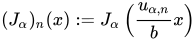
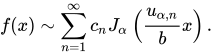
[edit]The Fourier–Bessel series of a function f(x) with a domain of [0, b] satisfying f(b) = 0


is the representation of that function as a linear combination of many orthogonal versions of the same Bessel function of the first kind Jα, where the argument to each version n is differently scaled, according to [1][2] where uα,n is a root, numbered n associated with the Bessel function Jα and cn are the assigned coefficients:[3]
![{\displaystyle f:[0,b]\to \mathbb {R} }](https://wikimedia.org/api/rest_v1/media/math/render/svg/c2f74d3dedb1846830ea4bfbe8f3a0700a56135f)
Interpretation
[edit]The Fourier–Bessel series may be thought of as a Fourier expansion in the ρ coordinate of cylindrical coordinates. Just as the Fourier series is defined for a finite interval and has a counterpart, the continuous Fourier transform over an infinite interval, so the Fourier–Bessel series has a counterpart over an infinite interval, namely the Hankel transform.
Calculating the coefficients
[edit]As said, differently scaled Bessel Functions are orthogonal with respect to the inner product

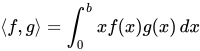
according to
![{\displaystyle \int _{0}^{b}xJ_{\alpha }\left({\frac {xu_{\alpha ,n}}{b}}\right)\,J_{\alpha }\left({\frac {xu_{\alpha ,m}}{b}}\right)\,dx={\frac {b^{2}}{2}}\delta _{mn}[J_{\alpha +1}(u_{\alpha ,n})]^{2},}](https://wikimedia.org/api/rest_v1/media/math/render/svg/370e5ce7548098c9890713c039be4465258496f6)
(where: is the Kronecker delta). The coefficients can be obtained from projecting the function f(x) onto the respective Bessel functions:


where the plus or minus sign is equally valid.
For the inverse transform, one makes use of the following representation of the Dirac delta function[4]

One-to-one relation between order index (n) and continuous frequency ()
[edit]

Fourier–Bessel series coefficients are unique for a given signal, and there is one-to-one mapping between continuous frequency () and order index which can be expressed as follows:

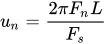
Since, . So above equation can be rewritten as follows:


where is the length of the signal and is the sampling frequency of the signal.


2-D Fourier–Bessel series expansion
[edit]For an image of size M×N, the synthesis equations for order-0 2D-Fourier–Bessel series expansion is as follows:


Where is 2D-Fourier–Bessel series expansion coefficients whose mathematical expressions are as follows:


where,

Fourier–Bessel series expansion–based entropies
[edit]For a signal of length , Fourier-Bessel based spectral entropy such as Shannon spectral entropy (), log energy entropy (), and Wiener entropy () are defined as follows:


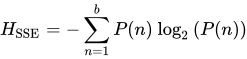
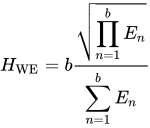
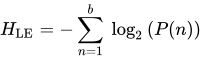
where is the normalized energy distribution which is mathematically defined as follows:

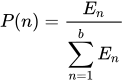
is energy spectrum which is mathematically defined as follows:

![{\displaystyle E_{n}={\frac {c_{n}^{2}b^{2}[J_{1}(u_{1,n})]^{2}}{2}}}](https://wikimedia.org/api/rest_v1/media/math/render/svg/c5a4709346f51d876d62eb1ac1c62c1a3e2f3817)
Fourier–Bessel series expansion–based empirical wavelet transform
[edit]The Empirical wavelet transform (EWT) is a multi-scale signal processing approach for the decomposition of multi-component signal into intrinsic mode functions (IMFs).[5] The EWT is based on the design of empirical wavelet based filter bank based on the segregation of Fourier spectrum of the multi-component signals. The segregation of Fourier spectrum of multi-component signal is performed using the detection of peaks and then the evaluation of boundary points.[5] For non-stationary signals, the Fourier Bessel Series Expansion (FBSE) is the natural choice as it uses Bessel function as basis for analysis and synthesis of the signal. The FBSE spectrum has produced the number of frequency bins same as the length of the signal in the frequency range [0, ]. Therefore, in FBSE-EWT, the boundary points are detected using the FBSE based spectrum of the non-stationary signal. Once, the boundary points are obtained, the empirical wavelet based filter-bank is designed in the Fourier domain of the multi-component signal to evaluate IMFs. The FBSE based method used in FBSE-EWT has produced higher number of boundary points as compared to FFT part in EWT based method. The features extracted from the IMFs of EEG and ECG signals obtained using FBSE-EWT based approach have shown better performance for the automated detection of Neurological and cardiac ailments.

Fourier–Bessel series expansion domain discrete stockwell transform
[edit]For a discrete time signal, x(n), the FBSE domain discrete Stockwell transform (FBSE-DST) is evaluated as follows:where Y(l) are the FBSE coefficients and these coefficients are calculated using the following expression as

![{\displaystyle Y(l)={\frac {2}{N^{2}[J_{1}(\lambda _{l})]^{2}}}\sum _{n=0}^{N-1}nx(n)J_{0}{\Big (}{\frac {\lambda _{l}}{N}}n{\Big )}}](https://wikimedia.org/api/rest_v1/media/math/render/svg/c795a5a4e96451471628996061566bc567b2d852)
The is termed as the root of the Bessel function, and it is evaluated in an iterative manner based on the solution of using the Newton-Raphson method. Similarly, the g(m,l) is the FBSE domain Gaussian window and it is given as follows :



Fourier–Bessel expansion–based discrete energy separation algorithm
[edit]For multicomponent amplitude and frequency modulated (AM-FM) signals, the discrete energy separation algorithm (DESA) together with the Gabor's filtering is a traditional approach to estimate the amplitude envelope (AE) and the instantaneous frequency (IF) functions.[6] It has been observed that the filtering operation distorts the amplitude and phase modulations in the separated monocomponent signals.
Advantages
[edit]The Fourier–Bessel series expansion does not require use of window function in order to obtain spectrum of the signal. It represents real signal in terms of real Bessel basis functions. It provides representation of real signals it terms of positive frequencies. The basis functions used are aperiodic in nature and converge. The basis functions include amplitude modulation in the representation. The Fourier–Bessel series expansion spectrum provides frequency points equal to the signal length.
Applications
[edit]The Fourier–Bessel series expansion employs aperiodic and decaying Bessel functions as the basis. The Fourier–Bessel series expansion has been successfully applied in diversified areas such as Gear fault diagnosis,[7] discrimination of odorants in a turbulent ambient,[8] postural stability analysis, detection of voice onset time, glottal closure instants (epoch) detection, separation of speech formants, speech enhancement,[9] and speaker identification.[10] The Fourier–Bessel series expansion has also been used to reduce cross terms in the Wigner–Ville distribution.
Dini series
[edit]A second Fourier–Bessel series, also known as Dini series, is associated with the Robin boundary condition where is an arbitrary constant. The Dini series can be defined by


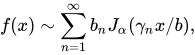
where is the n-th zero of .


The coefficients are given by


See also
[edit]- Orthogonality
- Generalized Fourier series
- Hankel transform
- Kapteyn series
- Neumann polynomial
- Schlömilch's series
References
[edit]- ^ Magnus, Wilhelm; Oberhettinger, Fritz; Soni, Raj Pal (1966). Formulas and Theorems for the Special Functions of Mathematical Physics. doi:10.1007/978-3-662-11761-3. ISBN 978-3-662-11763-7.
- ^ R., Smythe, William (1968). Static and dynamic electricity. - 3rd ed. McGraw-Hill. OCLC 878854927.
{{cite book}}: CS1 maint: multiple names: authors list (link) - ^ Schroeder, Jim (April 1993). "Signal Processing via Fourier-Bessel Series Expansion". Digital Signal Processing. 3 (2): 112–124. doi:10.1006/dspr.1993.1016. ISSN 1051-2004.
- ^ Cahill, Kevin (2019). Physical Mathematics. Cambridge University Press. p. 385. ISBN 9781108470032. Retrieved 9 March 2023.
- ^ a b Gilles, Jerome (August 2013). "Empirical Wavelet Transform". IEEE Transactions on Signal Processing. 61 (16): 3999–4010. arXiv:2410.23534. Bibcode:2013ITSP...61.3999G. doi:10.1109/TSP.2013.2265222. ISSN 1053-587X. S2CID 6341052.
- ^ Maragos, Petros; Kaiser, James F. (October 1993). "Energy Separation in Signal Modulations with Application to Speech Analysis". IEEE Transactions on Signal Processing. 41 (10): 3024–3051. Bibcode:1993ITSP...41.3024M. doi:10.1109/78.277799.
- ^ D’Elia, Gianluca; Delvecchio, Simone; Dalpiaz, Giorgio (2012), "On the Use of Fourier-Bessel Series Expansion for Gear Diagnostics", Condition Monitoring of Machinery in Non-Stationary Operations, Berlin, Heidelberg: Springer Berlin Heidelberg, pp. 267–275, doi:10.1007/978-3-642-28768-8_28, ISBN 978-3-642-28767-1, retrieved 2022-10-22
- ^ Vergaraa, A.; Martinelli, E.; Huerta, R.; D’Amico, A.; Di Natale, C. (2011). "Orthogonal Decomposition of Chemo-Sensory Signals: Discriminating Odorants in a Turbulent Ambient". Procedia Engineering. 25: 491–494. doi:10.1016/j.proeng.2011.12.122. ISSN 1877-7058.
- ^ Gurgen, F.S.; Chen, C.S. (1990). "Speech enhancement by fourier–bessel coefficients of speech and noise". IEE Proceedings I - Communications, Speech and Vision. 137 (5): 290. doi:10.1049/ip-i-2.1990.0040. ISSN 0956-3776.
- ^ Gopalan, K.; Anderson, T.R.; Cupples, E.J. (May 1999). "A comparison of speaker identification results using features based on cepstrum and Fourier-Bessel expansion". IEEE Transactions on Speech and Audio Processing. 7 (3): 289–294. doi:10.1109/89.759036. ISSN 1063-6676.
External links
[edit]- "Fourier-Bessel series", Encyclopedia of Mathematics, EMS Press, 2001 [1994]
- Weisstein, Eric. W. "Fourier-Bessel Series". From MathWorld--A Wolfram Web Resource.
- Fourier–Bessel series applied to Acoustic Field analysis on Trinnov Audio's research page