In graph theory, a graph product is a binary operation on graphs. Specifically, it is an operation that takes two graphs G1 and G2 and produces a graph H with the following properties:
The vertex set of H is the Cartesian productV(G1) × V(G2), where V(G1) and V(G2) are the vertex sets of G1 and G2, respectively.
Two vertices (a1,a2) and (b1,b2) of H are connected by an edge, iff a condition about a1, b1 in G1 and a2, b2 in G2 is fulfilled.
The graph products differ in what exactly this condition is. It is always about whether or not the vertices an, bn in Gn are equal or connected by an edge.
The terminology and notation for specific graph products in the literature varies quite a lot; even if the following may be considered somewhat standard, readers are advised to check what definition a particular author uses for a graph product, especially in older texts.
Even for more standard definitions, it is not always consistent in the literature how to handle self-loops. The formulas below for the number of edges in a product also may fail when including self-loops. For example, the tensor product of a single vertex self-loop with itself is another single vertex self-loop with , and not as the formula would suggest.
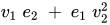
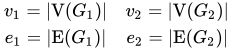
The following table shows the most common graph products, with denoting "is connected by an edge to", and denoting non-adjacency. While does allow equality, means they must be distinct and non-adjacent. The operator symbols listed here are by no means standard, especially in older papers.
Let be the complete graph on two vertices (i.e. a single edge). The product graphs , , and look exactly like the graph representing the operator. For example, is a four cycle (a square) and is the complete graph on four vertices.
The notation for lexicographic product serves as a reminder that this product is not commutative. The resulting graph looks like substituting a copy of for every vertex of .
^ abRoberson, David E.; Mancinska, Laura (2012). "Graph Homomorphisms for Quantum Players". Journal of Combinatorial Theory, Series B. 118: 228–267. arXiv:1212.1724. doi:10.1016/j.jctb.2015.12.009.
^Bačík, R.; Mahajan, S. (1995). "Semidefinite programming and its applications to NP problems". Computing and Combinatorics. Lecture Notes in Computer Science. Vol. 959. p. 566. doi:10.1007/BFb0030878. ISBN978-3-540-60216-3.
^The hom-product of [2] is the graph complement of the homomorphic product of.[1]





















![{\displaystyle G_{1}[G_{2}]}](https://wikimedia.org/api/rest_v1/media/math/render/svg/2fb5fc505f29f9d3f03f199cea37a9141fab57ea)