


Harris Ranch
 | |
| Industry | Beef producer |
|---|---|
| Founded | 1937 |
| Founder | Jack Harris |
| Headquarters | Selma, California, United States |
Area served | United States |
| Products | Beef |
| Owner | John C. Harris |
Number of employees | 400 |
| Parent | Harris Farms |
| Website | www |


Harris Ranch, or the Harris Cattle Ranch, feedlot is California's largest beef producer, producing 150 million pounds (68 kt) of beef per year in 2010.[1] It is located alongside Interstate 5 at its intersection with State Route 198 east of Coalinga, in the San Joaquin Valley of central California. The ranch is owned by Harris Farms.[2]
Description
[edit]History
[edit]Founded by Jack Harris in 1937, the Harris Ranch Beef Company (now operated by Jack Harris' son John) was originally a cotton and grain operation.[1] In the 1970s the ranch opened a burger stand near Interstate 5.[3]
The farm also operates an inn and restaurant, raises fruit and vegetable crops, and breeds thoroughbred horses.[1][4] Overall, the operation has more than 400 employees.[5] Approximately 14,000 acres (5,700 ha) are devoted to garlic, broccoli, pomegranates, and tomatoes, among 35 types of fruits and vegetables.[6]
During the war on terror, volunteers from the San Joaquin Valley, especially Bakersfield, supplied with beef from Harris Ranch, have volunteered to serve steaks to service-members who are OCONUS.[7]
In January 2012, an arsonist destroyed fourteen cattle trucks on the ranch. The Animal Liberation Front claimed responsibility.[8][9]
Marketing and distribution
[edit]At over 800 acres (320 ha) and with a population of over 100,000 cattle,[6] and hundreds harvested daily, the ranch is the largest on the West Coast. It is also among the largest (when including density) in the United States. A vertically integrated operation, it owns a fleet of trucks that take cattle from several ranches with which it deals, and does its own finishing, slaughtering, and packaging.[1]
The ranch supplies the hamburger meat for the In-N-Out Burger chain, and also distributes beef and prepared meals through grocery stores and restaurants nationwide.[1][5]
Harris Ranch was one of the first to build a brand around itself as a specialty niche product, and is credited as a forerunner of companies like Niman Ranch and Dakota Beef.[1]
Restaurant and inn
[edit]The restaurant was targeted to local farmers when it opened in 1977, but later became popular as a halfway stop on the busy highway connecting San Francisco and Los Angeles.[10][11][12] A 153-room luxury inn was added in 1987.[6] It was built in hacienda-style.[11] The restaurant evolved into a "farm to fork" concept in the late 2000s, featuring not only beef but wine and other products made locally by the ranch.[1] As of 2008 the restaurant was the 57th busiest in the United States and sixth busiest in California based on gross receipts.[5] The site was chosen for a hydrogen vehicle fuel station as well as one of the first battery swapping Tesla stations.[13][14] Later, 18 superchargers were added. Then, in 2021 an expansion of 80 more V3 superchargers was planned for 2022, making it the world's largest supercharger location.[15]
Public reception
[edit]The ranch is known to travelers for the "ripe, tangy odor of cow manure", described alternately as a "horrible stench"[16] and "a good, honest, American smell".[17] This smell inspired food writer Michael Pollan to conduct the research on factory farming that led to his sustainability book, The Omnivore's Dilemma.[16] The owner of Harris Ranch, in turn, threatened to withhold a $500,000 donation to California Polytechnic State University, San Luis Obispo if it sponsored a speech there by Pollan.[18] In reference to the large number of cattle processed at its facilities, some critics[19] have nicknamed the ranch "Cowschwitz",[16] comparing the slaughtering of cattle to the slaughtering of Jews during the Holocaust at the Auschwitz concentration camp.[6][20][21] Animal behavior expert Temple Grandin described the nickname as a matter of public misperception, saying that the company "does a great job" of keeping its animals.[22]
See also
[edit]Gallery
[edit]-
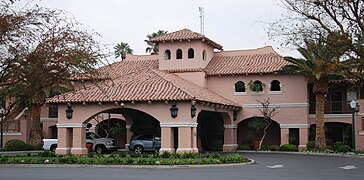 Harris Ranch Inn
 -
 For most travelers, the feedlot is the most recognizable view (and smell) of Harris Ranch from Interstate 5.


References
[edit]- ^ a b c d e f g Munoz, Olivia (October 4, 2010). "Harris Ranch markets farm-to-fork". San Jose Mercury-News. Associated Press.
- ^ Kazanjian, Gary (April 15, 2019). "Harris Ranch, buyer quiet on details but stress family-owned roots in wake of sale". Fresno Bee. Retrieved April 16, 2019.
- ^ Reynolds, Christopher (February 16, 2017). "Gnaw beef (or charge your Tesla) at Harris Ranch in Coalinga". Los Angeles Times. Retrieved July 17, 2018.
- ^ "About Us: Our History". Harris Ranch. Archived from the original on February 7, 2008. Retrieved February 1, 2008.
- ^ a b c Ordway, Cary. "Stop at Harris Ranch like visiting destination resort". California Weekend Getaways.
- ^ a b c d Clark, Krissy (December 22, 2007). "Coming Home to a Smell". Weekend America.
- ^ Hardisty, Dianne (July 3, 2010). "A call to serve ... meat". Bakersfield, California: TBC Media. Retrieved July 17, 2018.
- ^ Lee, Henry K. (January 10, 2012). "Animal-rights arson at Harris Ranch?". San Francisco Chronicle.
- ^ Marble, Steve (January 10, 2012). "Animal rights activists take credit for blaze at cattle ranch". Los Angeles Times. Retrieved January 11, 2012.
- ^ Schwartz, Ariel (February 24, 2010). "Earl Cox's Tesla Charging Station Makes Electric Roadtrip From L.A. to S.F. a Reality". Fast Company.
- ^ a b Hian, Howard (May 1, 2018). "A surprising discovery: Harris Ranch". Military Press. San Diego. Retrieved July 17, 2018.
- ^ Maybury, John (February 7, 2012). "Wandering and Wondering". Pacifica Tribune.
- ^ Fehrenbacher, Katie (August 7, 2013). "Record sales, upbeat Q2 earnings for electric car maker Tesla". Gigaom. Archived from the original on February 19, 2014. Retrieved August 8, 2013.
- ^ Tesla Motors Team (December 19, 2014). "Battery Swap Pilot Program". Tesla Motors. Retrieved December 20, 2014.
- ^ Simon Alvarez (April 6, 2021). "Tesla's new giant Supercharger with 100 stalls confirmed for Harris Ranch". Teslarati. Retrieved May 18, 2022.
- ^ a b c Black, Jane (December 7, 2009). "Think you're dining 'green'? Menus won't always tell you". The Washington Post.
- ^ Spano, Susan (October 8, 2006). "Eat well, sleep deeply off I-5, at Harris Ranch". Los Angeles Times.
- ^ Enzinna, Wes (November 2010). "Big Meat vs. Michael Pollan". Mother Jones.
- ^ Estabrook, Barry (December 28, 2011). "Feedlots vs. Pastures: Two Very Different Ways to Fatten Beef Cattle". The Atlantic.
- ^ Sachs, Micah (July 4, 2005). "Punk and Stupid". San Diego Jewish Journal.
- ^ "Sacred cows at Cal Poly San Luis Obispo". Los Angeles Times. October 16, 2009.
- ^ Mitchell, Larry (February 19, 2012). "Temple Grandin: Ag must make progress known". Chico Enterprise Record.