


IDEO
 | |
| Company type | Private |
|---|---|
| Industry | Design firm[1] |
| Founded | 1991, with the merging of David Kelley Design (est 1978), Moggridge Associates (est 1969), ID Two (est 1979), and Matrix Product Design (est 1983). |
| Founders | David Kelley[2] Bill Moggridge[3] Mike Nuttall |
| Headquarters | San Francisco, California[4] |
Key people |
|
Number of employees | 500+ (2023)[5] |
| Website | www |
IDEO (/ˈaɪdioʊ/) is a design and consulting firm with offices in the U.S., England, and China. It was founded in Palo Alto, California, in 1991.[6][7][8] The company's 500 staff uses a design thinking approach to design products, services, environments, brands, and digital experiences.[9][6][10]
In 1996, Steelcase took a majority ownership stake in the firm, which continued to operate independently.[11] By the early 2000s, the company had expanded into management consulting and organizational design.[11] In 2016, Japanese holding company Kyu Collective purchased a minority stake in the firm,[12][13] with Steelcase continuing to hold a small stake.
History[edit]
IDEO was formed in 1991 by a merger of David Kelley Design (founded by Stanford University professor David Kelley in 1978), London-based Moggridge Associates and San Francisco's ID Two (both founded by British-born Bill Moggridge, in 1969 and 1979, respectively), and Matrix Product Design (founded by Mike Nuttall in 1983).[14][15] David Kelley Design was previously Hovey-Kelley Design, which was a partnership between David Kelley and Dean Hovey. [16] Hovey-Kelley Design worked on the design for the computer mice for the Apple Lisa and the original Apple Macintosh.[17]
In 1996, Office-furniture maker Steelcase took a majority ownership stake in IDEO, which continued to operate independently. Steelcase[11] began divesting its shares through a five-year management buy-back program in 2007.[18][11] By the early 2000s, IDEO had expanded into management consulting and organizational design.[11] In 2016, Japanese holding company Kyu Collective purchased a minority stake in the firm.[13][12]
While the company started with a focus on designing consumer products (e.g., toothbrush, personal assistant, computers), by 2001, IDEO began to widen its focus on consumer experiences and services.
In 2011, IDEO incubated IDEO.org — a registered 501(c)(3) nonprofit focused on doing work the centers people in poor and vulnerable communities.[19]
_3-5_screenshot.png)
In April 2019, the company announced that Sandy Speicher would replace Tim Brown as CEO of the company.[20]
.jpg)
In November 2022, the company announced that Derek Robson would become CEO effective January 5, 2023.[21]
The Deep Dive[edit]
On February 9, 1999, the ABC show Nightline featured IDEO in a segment called The Deep Dive: One Company's Secret Weapon for Innovation.[22][23] The segment featured Jack Smith of ABC touring the IDEO office and challenging the company to redesign the shopping cart in five days to demonstrate IDEO's process for innovation.[24] The result was a shopping cart with a nestable steel frame which holds removable plastic baskets to help deter theft and increase shopper flexibility. A dual child seat with a swing-up tray was also included in the design, as well as a cup holder, a barcode reader to skip the checkout line and steerable back wheels for manoeuvrability.[24] The demonstration of IDEO's innovation process has led to the segment becoming part of numerous curricula, including Project Lead the Way[25] and multiple universities.[26][27][28]
Acquisitions and partnerships[edit]
On October 17, 2017, IDEO acquired Datascope — a data science firm based in Chicago.[29] Datascope has worked with IDEO as a consultant on many projects over the past four years.[30] Tim Brown, Chair of IDEO, states that the acquisition is largely motivated by advances in data sciences and machine learning. These advances allow for a bigger focus in human-centered applications including facilitation of the design process.[31] Datascope's 15-person team will be moved to IDEO's Chicago office.
With IDEO's acquisition by Kyu, the firm increasingly partners with other member firms of the collective.[32][33]
Organizational culture[edit]
IDEO's organizational culture consists of project teams, flat hierarchy, individual autonomy, creativity, and collaboration.[34] The firm currently employs over 500 people across many disciplines, including: Behavioral Science, Branding, Business Design, Communication Design, Design Research, Digital Design, Education, Electrical Engineering, Environments Design, Food Science, Healthcare Services, Industrial Design, Interaction Design, Mechanical Engineering, Organizational Design, and Software Engineering.[35]
Products and services[edit]
IDEO has worked on projects in the consumer food and beverage, retail, computer, medical, educational, furniture, office, and automotive industries. Some examples include Apple's first mouse, the Palm V PDA, and Steelcase's Leap chair. Clients include Air New Zealand, Coca-Cola, ConAgra Foods, Eli Lilly, Ford, Medtronic, Mexichem, Sealy, ShinHo, and Steelcase among many others.[35]
-
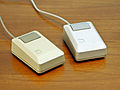 Early Apple computer mice
 -
 Palm V


OpenIDEO[edit]
In August 2010, IDEO introduced OpenIDEO - a collaborative platform for the design process.[36] OpenIDEO was designed to be an internal tool for IDEO to collaborate with clients, but it is now a public tool.[37] The purpose of the tool is to virtually drive the creative process to solve social problems, allowing for people of different expertise and backgrounds to collaborate. Examples of projects that have been facilitated by OpenIDEO include various projects of the WWF and TEDPrize winner Jamie Oliver's Food Revolution movement.[38] In a collaboration with Sutter Health, London's Helix Centre and Shoshana R. Ungerleider,[39] they completed an OpenIDEO Challenge to "reimagine the end of life experience" which later led to the founding of international initiatives, End Well and Re:imagine.[40]
Design education[edit]
IDEO U is an online educational program released in early 2015.[41][42] Course participants are instructed on the concepts surrounding human-centered design thinking.
In addition to the online program, IDEO and its affiliates have released multiple books on design thinking, including New York Times best-selling Creative Confidence: Unleashing the Creative Potential Within Us All.[43] Former CEO Tim Brown is the author of Change by Design: How Design Thinking Transforms Organizations and Inspires Innovation (2009) in which he argues that design can transform problems into opportunities – emphasizing design thinking as a human-centered activity, he specifically prizes the feeling of empathy, where designers are capable of understanding the perspectives and problems the end users face.[44]
Notes[edit]
- Dobbin, Frank. “High Commitment Practices”. Harvard University. October 10, 2012. Lecture.
- Thomke, Stefan and Ashok Nimgade. Ideo Product Development. 9-600-143. Boston. Harvard Business Publishing
- Kelley, Tom, and Jonathan Littman. The Art of Innovation: Lessons in Creativity from IDEO, America's Leading Design Firm. New York: Currency/Doubleday, 2001. page 70.
- “Recruiting Q&A: IDEO” Business week. January 10, 2001
- "Designed Chaos - An Interview with David Kelley, Founder and CEO of IDEO." Designed Chaos. N.p., n.d.
- "Navigate." Careers FAQ. N.p., n.d.
- Stevents, Tim. “Creative Genius”. Industry Week. July 4, 1994. Skokie, IL
References[edit]
- ^ Harris, Jessica (June 26, 2014). "David Kelley, Co-Founder of IDEO". NPR. Archived from the original on January 8, 2015. Retrieved September 25, 2014.
- ^ Eng, Dinah (April 11, 2013). "How IDEO brings design to corporate America". Fortune.
- ^ "Bill Moggridge". www.ideo.com. Retrieved September 15, 2021.
- ^ "IDEO". Forbes.
- ^ "About IDEO". IDEO Inc. Retrieved September 9, 2020.
- ^ a b "IDEO LLC". Bloomberg Businessweek. Archived from the original on December 20, 2011. Retrieved November 12, 2011.
- ^ "IDEO Contact page". Ideo.com. Archived from the original on November 10, 2011. Retrieved November 12, 2011.
- ^ "Contact". www.ideo.com. Retrieved June 9, 2020.
- ^ Brown, Tim. "The Making of a Design Thinker." Metropolis Oct. 2009: 60–62. p. 60: "David Kelley ... said that every time someone came to ask him about design, he found himself inserting the word thinking to explain what it is that designers do. The term design thinking stuck."
- ^ Kelley, David; Kelley, Tom (2013). Creative Confidence. United States of America: Crown Business. p. 21. ISBN 9780385349369.
- ^ a b c d e Nussbaum, Bruce (May 17, 2004). "The Power of Design". Business Week. Archived from the original on January 8, 2007. Retrieved December 19, 2006.
- ^ a b Budds, Diana (February 9, 2016). "Ideo, Silicon Valley's Most Influential Design Firm, Sells A Minority Stake". Fast Company. Retrieved April 6, 2020.
- ^ a b "Ideo Sold Part of Itself and Joined a Collective. But Why?". Wired.
- ^ "International Directory of Company Histories". Findarticles.com. Archived from the original on August 17, 2010. Retrieved November 12, 2011.
- ^ "Bill Moggridge dies at 69; developer of laptop design". Los Angeles Times. September 11, 2012. Retrieved April 6, 2020.
- ^ "David Kelley interview – Founding Hovey-Kelley". Making the Macintosh: Technology and Culture in Silicon Valley. July 24, 2000. Archived from the original on September 20, 2012. Retrieved September 1, 2012.
- ^ "Hovey-Kelley and the Mouse". web.stanford.edu. Retrieved November 21, 2023.
- ^ Bauer, Julia (September 20, 2007). "Steelcase's IDEO will be sold over next five years". Grand Rapids Press. Archived from the original on May 28, 2009. Retrieved September 20, 2007.
- ^ Miller, Meg (November 7, 2016). "How Ideo.org Helps Fight Global Poverty With Design". Fast Company. Retrieved April 6, 2020.
- ^ Wilson, Mark (April 4, 2019). "Ideo CEO Tim Brown, who helped popularize design thinking, steps down". Fast Company. Retrieved April 6, 2020.
- ^ "IDEO APPOINTS DEREK ROBSON AS CHIEF EXECUTIVE OFFICER". PRNewswire. November 29, 2022. Retrieved April 25, 2023.
- ^ "IDEO Nightline Transcript" (PDF). ciow.org/. THE TRANSCRIPTION COMPANY. Archived (PDF) from the original on December 23, 2015. Retrieved January 8, 2017.
- ^ "No mystery why IDEO became the home of good ideas". The Independent. May 9, 2001. Archived from the original on January 9, 2017. Retrieved January 8, 2017.
- ^ a b "Reimagining the Shopping Cart". ideo.com. IDEO. April 1999. Archived from the original on January 9, 2017. Retrieved January 8, 2017.
- ^ "1.5.A DeepDive". studylib.net. Project Lead the Way. Archived from the original on January 8, 2017. Retrieved January 8, 2017.
- ^ "CIOW - Videos". ciow.org. University of Pennsylvania. Archived from the original on January 8, 2017. Retrieved January 8, 2017.
- ^ Smith, Karl. "The Art of Innovation - University of Minnesota". University of Minnesota.
- ^ "The Deep Dive - Weber State University". Weber State University. Archived from the original on January 9, 2017.
- ^ IDEO. "Datascope joins the IDEO Family". IDEO News.
- ^ Budds, Diana. "Exclusive: Ideo's Plan To Stage An AI Revolution". CO.DESIGN.
- ^ Brown, Tim (October 17, 2017). "Design for Augmented Intelligence". Medium.
- ^ Stinson, Liz. "Ideo Sold Part of Itself and Joined a Collective. But Why?". Wired. ISSN 1059-1028. Retrieved January 27, 2022.
- ^ Budds, Diana (February 9, 2016). "Ideo, Silicon Valley's Most Influential Design Firm, Sells A Minority Stake". Fast Company. Retrieved January 27, 2022.
- ^ Dobbin, Frank (October 10, 2012). High Commitment Practices. Harvard University. pp. Lecture.
- ^ a b "IDEO Fact Sheet". Retrieved January 8, 2017.
- ^ Grams, Chris. "OpenIDEO: a new experiment in open innovation". opensource.
- ^ Diamandis, Peter. "INNOVATION ON STEROIDS: THE OPENIDEO APPROACH TO A BETTER SOCIETY". XPRIZE.
- ^ Popova, Maria. "OpenIDEO: Collaborative Design Thinking". Big Think.
- ^ "How to Design for Death: OpenIDEO Challenges Designers to Reimagine the End of Life Experience". core77.com. Retrieved August 26, 2020.
- ^ "The Journey". endwellproject.org. December 5, 2017. Retrieved August 25, 2020.
- ^ "Introducing IDEO U: IDEO's online learning school!". www.ideo.com. Retrieved April 6, 2020.
- ^ Peters, Adele. "5 Things You'll Learn In Ideo's New Online Innovation Class". Fast Company. Fast Company.
- ^ Stober, Dan (January 23, 2023). "Stanford d.school founder fosters creative confidence with design thinking". Stanford News.
- ^ Kimbell, Lucy (2011). "Rethinking Design Thinking: Part I". Design and Culture. 3 (3): 285–306. doi:10.2752/175470811X13071166525216. S2CID 145069798.
| International | |
|---|---|
| National | |
| Artists | |
