


Innsbruck, ich muss dich lassen
| "Innsbruck, ich muss dich lassen" | |
|---|---|
| Renaissance song | |
| English | "Innsbruck, I must leave thee" |
| Language | German |
| Composed | 1485 |
"Innsbruck, ich muss dich lassen" ("Innsbruck, I must leave thee") is a German Renaissance song. It was first published as a choral movement by the Franco-Flemish composer Heinrich Isaac (ca. 1450–1517); the melody was probably written by him. The lyricist is unknown; an authorship of Emperor Maximilian I, as was previously assumed, seems highly unlikely. Chester Lee Alwes writes that the song "became the gold standard of the Lied genre".[1]
Melody[edit]
There has been doubt whether the melody was in fact written by Heinrich Isaac or copied from earlier tunes. The melody was later used in a Lutheran chorale, "O Welt, ich muß dich lassen", and still appears in modern English-language hymnals under the name "Innsbruck", to a wide variety of text, of which the most common one is "The duteous day now closeth",[2] a paraphrase of Paul Gerhardt's "Nun ruhen alle Wälder.[3]
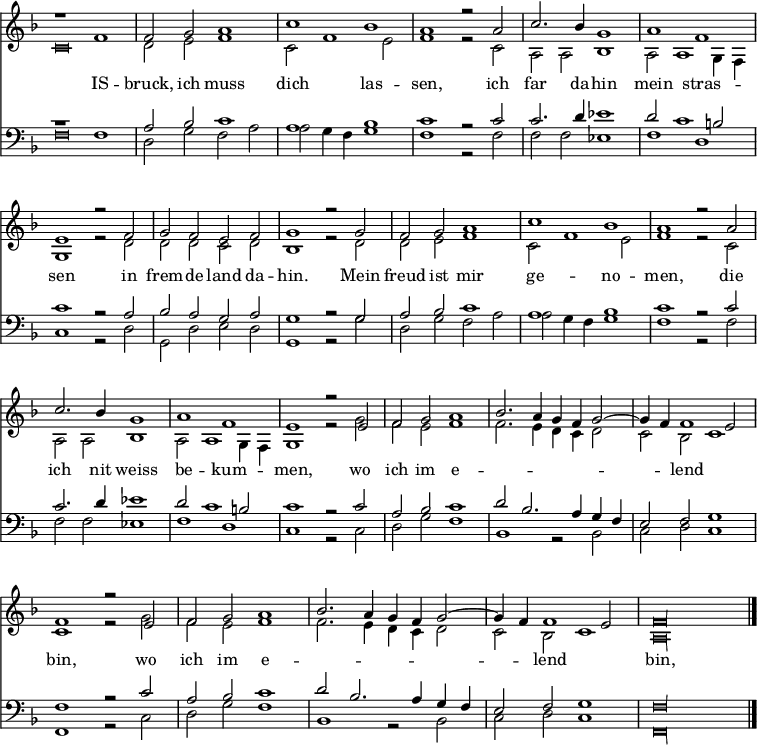
The song exists in two different four-part settings by Heinrich Isaac: a Diskantlied with the melody in the soprano part (transcribed below),[4] and a Tenorlied with the cantus firmus in the tenor part.
The hymn "In allen meinen Taten" by Paul Fleming (1609–1640) was written for the same melody. Johann Sebastian Bach used it in several cantatas, especially in the chorale cantata In allen meinen Taten, BWV 97 (1734).
Lyrics[edit]
The song is famously associated with the city of Innsbruck in Tyrol (in modern-day Austria). The lyrics express sorrow at having to leave a post at court, as the singer is forced to abandon his love and to depart to a foreign country. He promises her faithfulness and commends her to God's protection. Though Heinrich Isaac indeed spent some time in Innsbruck, the text was probably not written by him.
The stanzaic form consists of six iambic trimeters with a A–A–B–C–C–B rhyme scheme.
Innsbruck, ich muss dich lassen, |
Innsbruck, I must leave you; |
See also[edit]
References[edit]
Notes
- ^ Alwes, Chester Lee (2015). A History of Western Choral Music. Oxford University Press. p. 66. ISBN 978-0-19-936193-9. Retrieved 10 December 2022.
- ^ "Tune: 'Innsbruck'". Hymnary.org. Retrieved 10 May 2020.
- ^ "The duteous day now closeth". The Canterbury Dictionary of Hymnology. Canterbury Press.
- ^ Denkmäler der Tonkunst in Österreich, Vol. 28, Vienna: Österreichischer Bundesverlag, 1907, p. 15
- ^ Caesar Flaischlen, ed. (2015) [1925]. Das Buch unserer deutschen Dichtung: Die Frühzeit (1500–1800). BoD – Books on Demand. p. 159. ISBN 978-3-8460-8715-2.
- ^ "Elend", Das Wörterbuch der Idiome [Lexicon of Idioms], deacademic.com
Sources
- "Chorale Melodies used in Bach's Vocal Works: 'O Welt, ich muß dich lassen / Nun ruhen alle Wälder'". Bach Cantatas Website bach-cantatas.com. Retrieved 7 November 2006.
- "Heinrich Isaac (Composer)". Poets & Composers: Short Biographies. bach-cantatas.com. Retrieved 7 November 2006.
External links[edit]
 Media related to Innsbruck, ich muss dich lassen at Wikimedia Commons
- Innsbruck, ich muss dich lassen: Free scores at the Choral Public Domain Library (ChoralWiki)
- Innsbruck, ich muss dich lassen: Scores at the International Music Score Library Project
- Innsbruck, ich muss dich lassen on YouTube, Die Singphoniker
- Des außbunds schöner Teutscher Liedlein zu singen, Nürnberg: 1561. (discantus, altus, tenor, bassus)

| International | |
|---|---|
| National | |
| Other | |
