Iterative method used to solve a linear system of equations
In numerical linear algebra , the Jacobi method (a.k.a. the Jacobi iteration method ) is an iterative algorithm for determining the solutions of a strictly diagonally dominant system of linear equations . Each diagonal element is solved for, and an approximate value is plugged in. The process is then iterated until it converges. This algorithm is a stripped-down version of the Jacobi transformation method of matrix diagonalization . The method is named after Carl Gustav Jacob Jacobi .
Description [ edit ] Let
A
x
=
b
{\displaystyle A\mathbf {x} =\mathbf {b} }
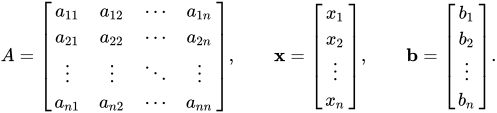
n linear equations, where:
A
=
[
a
11
a
12
⋯
a
1
n
a
21
a
22
⋯
a
2
n
⋮
⋮
⋱
⋮
a
n
1
a
n
2
⋯
a
n
n
]
,
x
=
[
x
1
x
2
⋮
x
n
]
,
b
=
[
b
1
b
2
⋮
b
n
]
.
{\displaystyle A={\begin{bmatrix}a_{11}&a_{12}&\cdots &a_{1n}\\a_{21}&a_{22}&\cdots &a_{2n}\\\vdots &\vdots &\ddots &\vdots \\a_{n1}&a_{n2}&\cdots &a_{nn}\end{bmatrix}},\qquad \mathbf {x} ={\begin{bmatrix}x_{1}\\x_{2}\\\vdots \\x_{n}\end{bmatrix}},\qquad \mathbf {b} ={\begin{bmatrix}b_{1}\\b_{2}\\\vdots \\b_{n}\end{bmatrix}}.}
When
A
{\displaystyle A}
b
{\displaystyle \mathbf {b} }
x
{\displaystyle \mathbf {x} }
x
{\displaystyle \mathbf {x} }
x
(
0
)
{\displaystyle \mathbf {x} ^{(0)}}
x
{\displaystyle \mathbf {x} }
x
i
(
0
)
=
0
{\displaystyle \mathbf {x} _{i}^{(0)}=0}
i
=
1
,
2
,
.
.
.
,
n
{\displaystyle i=1,2,...,n}
x
(
k
)
{\displaystyle \mathbf {x} ^{(k)}}
k- th approximation or iteration of
x
{\displaystyle \mathbf {x} }
x
(
k
+
1
)
{\displaystyle \mathbf {x} ^{(k+1)}}
k +1) iteration of
x
{\displaystyle \mathbf {x} }
Matrix-based formula [ edit ] Then A can be decomposed into a diagonal component D , a lower triangular part L and an upper triangular part U :
A
=
D
+
L
+
U
where
D
=
[
a
11
0
⋯
0
0
a
22
⋯
0
⋮
⋮
⋱
⋮
0
0
⋯
a
n
n
]
and
L
+
U
=
[
0
a
12
⋯
a
1
n
a
21
0
⋯
a
2
n
⋮
⋮
⋱
⋮
a
n
1
a
n
2
⋯
0
]
.
{\displaystyle A=D+L+U\qquad {\text{where}}\qquad D={\begin{bmatrix}a_{11}&0&\cdots &0\\0&a_{22}&\cdots &0\\\vdots &\vdots &\ddots &\vdots \\0&0&\cdots &a_{nn}\end{bmatrix}}{\text{ and }}L+U={\begin{bmatrix}0&a_{12}&\cdots &a_{1n}\\a_{21}&0&\cdots &a_{2n}\\\vdots &\vdots &\ddots &\vdots \\a_{n1}&a_{n2}&\cdots &0\end{bmatrix}}.}
The solution is then obtained iteratively via
x
(
k
+
1
)
=
D
−
1
(
b
−
(
L
+
U
)
x
(
k
)
)
.
{\displaystyle \mathbf {x} ^{(k+1)}=D^{-1}(\mathbf {b} -(L+U)\mathbf {x} ^{(k)}).}
Element-based formula [ edit ] The element-based formula for each row
i
{\displaystyle i}
x
i
(
k
+
1
)
=
1
a
i
i
(
b
i
−
∑
j
≠
i
a
i
j
x
j
(
k
)
)
,
i
=
1
,
2
,
…
,
n
.
{\displaystyle x_{i}^{(k+1)}={\frac {1}{a_{ii}}}\left(b_{i}-\sum _{j\neq i}a_{ij}x_{j}^{(k)}\right),\quad i=1,2,\ldots ,n.}
The computation of
x
i
(
k
+
1
)
{\displaystyle x_{i}^{(k+1)}}
requires each element in
x
(
k
)
{\displaystyle \mathbf {x} ^{(k)}}
except itself. Unlike the
Gauss–Seidel method , we can't overwrite
x
i
(
k
)
{\displaystyle x_{i}^{(k)}}
with
x
i
(
k
+
1
)
{\displaystyle x_{i}^{(k+1)}}
, as that value will be needed by the rest of the computation. The minimum amount of storage is two vectors of size
n .
Algorithm [ edit ] Input: initial guess x (0) to the solution , (diagonal dominant) matrix A , right-hand side vector b , convergence criterion
Output: solution when convergence is reached
Comments: pseudocode based on the element-based formula above
k = 0while convergence not reached do
for i := 1 step until n do
σ = 0for j := 1 step until n do
if j ≠ i then
σ = σ + a ij x j (k ) end
end
x i (k +1) = (b i σ ) / a ii end
increment k
end
Convergence [ edit ] The standard convergence condition (for any iterative method) is when the spectral radius of the iteration matrix is less than 1:
ρ
(
D
−
1
(
L
+
U
)
)
<
1.
{\displaystyle \rho (D^{-1}(L+U))<1.}
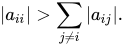
A sufficient (but not necessary) condition for the method to converge is that the matrix A is strictly or irreducibly diagonally dominant . Strict row diagonal dominance means that for each row, the absolute value of the diagonal term is greater than the sum of absolute values of other terms:
|
a
i
i
|
>
∑
j
≠
i
|
a
i
j
|
.
{\displaystyle \left|a_{ii}\right|>\sum _{j\neq i}{\left|a_{ij}\right|}.}
The Jacobi method sometimes converges even if these conditions are not satisfied.
Note that the Jacobi method does not converge for every symmetric positive-definite matrix . For example,
A
=
(
29
2
1
2
6
1
1
1
1
5
)
⇒
D
−
1
(
L
+
U
)
=
(
0
2
29
1
29
1
3
0
1
6
5
5
0
)
⇒
ρ
(
D
−
1
(
L
+
U
)
)
≈
1.0661
.
{\displaystyle A={\begin{pmatrix}29&2&1\\2&6&1\\1&1&{\frac {1}{5}}\end{pmatrix}}\quad \Rightarrow \quad D^{-1}(L+U)={\begin{pmatrix}0&{\frac {2}{29}}&{\frac {1}{29}}\\{\frac {1}{3}}&0&{\frac {1}{6}}\\5&5&0\end{pmatrix}}\quad \Rightarrow \quad \rho (D^{-1}(L+U))\approx 1.0661\,.}
Examples [ edit ] Example question [ edit ] A linear system of the form
A
x
=
b
{\displaystyle Ax=b}
x
(
0
)
{\displaystyle x^{(0)}}
A
=
[
2
1
5
7
]
,
b
=
[
11
13
]
and
x
(
0
)
=
[
1
1
]
.
{\displaystyle A={\begin{bmatrix}2&1\\5&7\\\end{bmatrix}},\ b={\begin{bmatrix}11\\13\\\end{bmatrix}}\quad {\text{and}}\quad x^{(0)}={\begin{bmatrix}1\\1\\\end{bmatrix}}.}
We use the equation
x
(
k
+
1
)
=
D
−
1
(
b
−
(
L
+
U
)
x
(
k
)
)
{\displaystyle x^{(k+1)}=D^{-1}(b-(L+U)x^{(k)})}
x
{\displaystyle x}
D
−
1
(
b
−
(
L
+
U
)
x
(
k
)
)
=
T
x
(
k
)
+
C
{\displaystyle D^{-1}(b-(L+U)x^{(k)})=Tx^{(k)}+C}
T
=
−
D
−
1
(
L
+
U
)
{\displaystyle T=-D^{-1}(L+U)}
C
=
D
−
1
b
{\displaystyle C=D^{-1}b}
D
−
1
=
[
1
/
2
0
0
1
/
7
]
,
L
=
[
0
0
5
0
]
and
U
=
[
0
1
0
0
]
.
{\displaystyle D^{-1}={\begin{bmatrix}1/2&0\\0&1/7\\\end{bmatrix}},\ L={\begin{bmatrix}0&0\\5&0\\\end{bmatrix}}\quad {\text{and}}\quad U={\begin{bmatrix}0&1\\0&0\\\end{bmatrix}}.}
we determine
T
=
−
D
−
1
(
L
+
U
)
{\displaystyle T=-D^{-1}(L+U)}
as
T
=
[
1
/
2
0
0
1
/
7
]
{
[
0
0
−
5
0
]
+
[
0
−
1
0
0
]
}
=
[
0
−
1
/
2
−
5
/
7
0
]
.
{\displaystyle T={\begin{bmatrix}1/2&0\\0&1/7\\\end{bmatrix}}\left\{{\begin{bmatrix}0&0\\-5&0\\\end{bmatrix}}+{\begin{bmatrix}0&-1\\0&0\\\end{bmatrix}}\right\}={\begin{bmatrix}0&-1/2\\-5/7&0\\\end{bmatrix}}.}
Further,
C
{\displaystyle C}
is found as
C
=
[
1
/
2
0
0
1
/
7
]
[
11
13
]
=
[
11
/
2
13
/
7
]
.
{\displaystyle C={\begin{bmatrix}1/2&0\\0&1/7\\\end{bmatrix}}{\begin{bmatrix}11\\13\\\end{bmatrix}}={\begin{bmatrix}11/2\\13/7\\\end{bmatrix}}.}
With
T
{\displaystyle T}
and
C
{\displaystyle C}
calculated, we estimate
x
{\displaystyle x}
as
x
(
1
)
=
T
x
(
0
)
+
C
{\displaystyle x^{(1)}=Tx^{(0)}+C}
:
x
(
1
)
=
[
0
−
1
/
2
−
5
/
7
0
]
[
1
1
]
+
[
11
/
2
13
/
7
]
=
[
5.0
8
/
7
]
≈
[
5
1.143
]
.
{\displaystyle x^{(1)}={\begin{bmatrix}0&-1/2\\-5/7&0\\\end{bmatrix}}{\begin{bmatrix}1\\1\\\end{bmatrix}}+{\begin{bmatrix}11/2\\13/7\\\end{bmatrix}}={\begin{bmatrix}5.0\\8/7\\\end{bmatrix}}\approx {\begin{bmatrix}5\\1.143\\\end{bmatrix}}.}
The next iteration yields
x
(
2
)
=
[
0
−
1
/
2
−
5
/
7
0
]
[
5.0
8
/
7
]
+
[
11
/
2
13
/
7
]
=
[
69
/
14
−
12
/
7
]
≈
[
4.929
−
1.714
]
.
{\displaystyle x^{(2)}={\begin{bmatrix}0&-1/2\\-5/7&0\\\end{bmatrix}}{\begin{bmatrix}5.0\\8/7\\\end{bmatrix}}+{\begin{bmatrix}11/2\\13/7\\\end{bmatrix}}={\begin{bmatrix}69/14\\-12/7\\\end{bmatrix}}\approx {\begin{bmatrix}4.929\\-1.714\\\end{bmatrix}}.}
This process is repeated until convergence (i.e., until
‖
A
x
(
n
)
−
b
‖
{\displaystyle \|Ax^{(n)}-b\|}
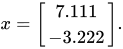
is small). The solution after 25 iterations is
x
=
[
7.111
−
3.222
]
.
{\displaystyle x={\begin{bmatrix}7.111\\-3.222\end{bmatrix}}.}
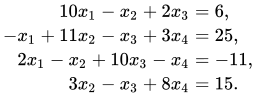
Example question 2 [ edit ] Suppose we are given the following linear system:
10
x
1
−
x
2
+
2
x
3
=
6
,
−
x
1
+
11
x
2
−
x
3
+
3
x
4
=
25
,
2
x
1
−
x
2
+
10
x
3
−
x
4
=
−
11
,
3
x
2
−
x
3
+
8
x
4
=
15.
{\displaystyle {\begin{aligned}10x_{1}-x_{2}+2x_{3}&=6,\\-x_{1}+11x_{2}-x_{3}+3x_{4}&=25,\\2x_{1}-x_{2}+10x_{3}-x_{4}&=-11,\\3x_{2}-x_{3}+8x_{4}&=15.\end{aligned}}}
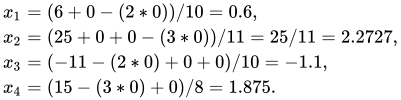
If we choose (0, 0, 0, 0) as the initial approximation, then the first approximate solution is given by
x
1
=
(
6
+
0
−
(
2
∗
0
)
)
/
10
=
0.6
,
x
2
=
(
25
+
0
+
0
−
(
3
∗
0
)
)
/
11
=
25
/
11
=
2.2727
,
x
3
=
(
−
11
−
(
2
∗
0
)
+
0
+
0
)
/
10
=
−
1.1
,
x
4
=
(
15
−
(
3
∗
0
)
+
0
)
/
8
=
1.875.
{\displaystyle {\begin{aligned}x_{1}&=(6+0-(2*0))/10=0.6,\\x_{2}&=(25+0+0-(3*0))/11=25/11=2.2727,\\x_{3}&=(-11-(2*0)+0+0)/10=-1.1,\\x_{4}&=(15-(3*0)+0)/8=1.875.\end{aligned}}}
Using the approximations obtained, the iterative procedure is repeated until the desired accuracy has been reached. The following are the approximated solutions after five iterations.
x
1
{\displaystyle x_{1}}
x
2
{\displaystyle x_{2}}
x
3
{\displaystyle x_{3}}
x
4
{\displaystyle x_{4}}
0.6
2.27272
-1.1
1.875
1.04727
1.7159
-0.80522
0.88522
0.93263
2.05330
-1.0493
1.13088
1.01519
1.95369
-0.9681
0.97384
0.98899
2.0114
-1.0102
1.02135
The exact solution of the system is (1, 2, −1, 1) .
Python example [ edit ] import numpy as np
ITERATION_LIMIT = 1000
# initialize the matrix
A = np . array ([[ 10. , - 1. , 2. , 0. ],
[ - 1. , 11. , - 1. , 3. ],
[ 2. , - 1. , 10. , - 1. ],
[ 0.0 , 3. , - 1. , 8. ]])
# initialize the RHS vector
b = np . array ([ 6. , 25. , - 11. , 15. ])
# prints the system
print ( "System:" )
for i in range ( A . shape [ 0 ]):
row = [ f " { A [ i , j ] } *x { j + 1 } " for j in range ( A . shape [ 1 ])]
print ( f ' { " + " . join ( row ) } = { b [ i ] } ' )
print ()
x = np . zeros_like ( b )
for it_count in range ( ITERATION_LIMIT ):
if it_count != 0 :
print ( f "Iteration { it_count } : { x } " )
x_new = np . zeros_like ( x )
for i in range ( A . shape [ 0 ]):
s1 = np . dot ( A [ i , : i ], x [: i ])
s2 = np . dot ( A [ i , i + 1 :], x [ i + 1 :])
x_new [ i ] = ( b [ i ] - s1 - s2 ) / A [ i , i ]
if x_new [ i ] == x_new [ i - 1 ]:
break
if np . allclose ( x , x_new , atol = 1e-10 , rtol = 0. ):
break
x = x_new
print ( "Solution: " )
print ( x )
error = np . dot ( A , x ) - b
print ( "Error:" )
print ( error )
Weighted Jacobi method [ edit ] The weighted Jacobi iteration uses a parameter
ω
{\displaystyle \omega }
x
(
k
+
1
)
=
ω
D
−
1
(
b
−
(
L
+
U
)
x
(
k
)
)
+
(
1
−
ω
)
x
(
k
)
{\displaystyle \mathbf {x} ^{(k+1)}=\omega D^{-1}(\mathbf {b} -(L+U)\mathbf {x} ^{(k)})+\left(1-\omega \right)\mathbf {x} ^{(k)}}
with
ω
=
2
/
3
{\displaystyle \omega =2/3}
[1]
L
+
U
=
A
−
D
{\displaystyle L+U=A-D}
x
(
k
+
1
)
=
ω
D
−
1
b
+
(
I
−
ω
D
−
1
A
)
x
(
k
)
{\displaystyle \mathbf {x} ^{(k+1)}=\omega D^{-1}\mathbf {b} +\left(I-\omega D^{-1}A\right)\mathbf {x} ^{(k)}}
Convergence in the symmetric positive definite case [ edit ] In case that the system matrix
A
{\displaystyle A}
positive-definite type one can show convergence.
Let
C
=
C
ω
=
I
−
ω
D
−
1
A
{\displaystyle C=C_{\omega }=I-\omega D^{-1}A}
ρ
(
C
ω
)
<
1
⟺
0
<
ω
<
2
λ
max
(
D
−
1
A
)
,
{\displaystyle \rho (C_{\omega })<1\quad \Longleftrightarrow \quad 0<\omega <{\frac {2}{\lambda _{\text{max}}(D^{-1}A)}}\,,}
where
λ
max
{\displaystyle \lambda _{\text{max}}}
The spectral radius can be minimized for a particular choice of
ω
=
ω
opt
{\displaystyle \omega =\omega _{\text{opt}}}
min
ω
ρ
(
C
ω
)
=
ρ
(
C
ω
opt
)
=
1
−
2
κ
(
D
−
1
A
)
+
1
for
ω
opt
:=
2
λ
min
(
D
−
1
A
)
+
λ
max
(
D
−
1
A
)
,
{\displaystyle \min _{\omega }\rho (C_{\omega })=\rho (C_{\omega _{\text{opt}}})=1-{\frac {2}{\kappa (D^{-1}A)+1}}\quad {\text{for}}\quad \omega _{\text{opt}}:={\frac {2}{\lambda _{\text{min}}(D^{-1}A)+\lambda _{\text{max}}(D^{-1}A)}}\,,}
where
κ
{\displaystyle \kappa }
is the
matrix condition number .
See also [ edit ] References [ edit ] External links [ edit ]
Key concepts Problems Hardware Software