Polynomial sequence
Plot of the Jacobi polynomial function
P
n
(
α
,
β
)
{\displaystyle P_{n}^{(\alpha ,\beta )}}
n
=
10
{\displaystyle n=10}
α
=
2
{\displaystyle \alpha =2}
β
=
2
{\displaystyle \beta =2}
−
2
−
2
i
{\displaystyle -2-2i}
2
+
2
i
{\displaystyle 2+2i}
In mathematics , Jacobi polynomials (occasionally called hypergeometric polynomials )
P
n
(
α
,
β
)
(
x
)
{\displaystyle P_{n}^{(\alpha ,\beta )}(x)}
classical orthogonal polynomials . They are orthogonal with respect to the weight
(
1
−
x
)
α
(
1
+
x
)
β
{\displaystyle (1-x)^{\alpha }(1+x)^{\beta }}
[
−
1
,
1
]
{\displaystyle [-1,1]}
Gegenbauer polynomials , and thus also the Legendre , Zernike and Chebyshev polynomials , are special cases of the Jacobi polynomials.[1]
The Jacobi polynomials were introduced by Carl Gustav Jacob Jacobi .
Definitions [ edit ] Via the hypergeometric function [ edit ] The Jacobi polynomials are defined via the hypergeometric function as follows:[2]
P
n
(
α
,
β
)
(
z
)
=
(
α
+
1
)
n
n
!
2
F
1
(
−
n
,
1
+
α
+
β
+
n
;
α
+
1
;
1
2
(
1
−
z
)
)
,
{\displaystyle P_{n}^{(\alpha ,\beta )}(z)={\frac {(\alpha +1)_{n}}{n!}}\,{}_{2}F_{1}\left(-n,1+\alpha +\beta +n;\alpha +1;{\tfrac {1}{2}}(1-z)\right),}
where
(
α
+
1
)
n
{\displaystyle (\alpha +1)_{n}}
Pochhammer's symbol (for the rising factorial). In this case, the series for the hypergeometric function is finite, therefore one obtains the following equivalent expression:
P
n
(
α
,
β
)
(
z
)
=
Γ
(
α
+
n
+
1
)
n
!
Γ
(
α
+
β
+
n
+
1
)
∑
m
=
0
n
(
n
m
)
Γ
(
α
+
β
+
n
+
m
+
1
)
Γ
(
α
+
m
+
1
)
(
z
−
1
2
)
m
.
{\displaystyle P_{n}^{(\alpha ,\beta )}(z)={\frac {\Gamma (\alpha +n+1)}{n!\,\Gamma (\alpha +\beta +n+1)}}\sum _{m=0}^{n}{n \choose m}{\frac {\Gamma (\alpha +\beta +n+m+1)}{\Gamma (\alpha +m+1)}}\left({\frac {z-1}{2}}\right)^{m}.}
Rodrigues' formula [ edit ] An equivalent definition is given by Rodrigues' formula :[1] [3]
P
n
(
α
,
β
)
(
z
)
=
(
−
1
)
n
2
n
n
!
(
1
−
z
)
−
α
(
1
+
z
)
−
β
d
n
d
z
n
{
(
1
−
z
)
α
(
1
+
z
)
β
(
1
−
z
2
)
n
}
.
{\displaystyle P_{n}^{(\alpha ,\beta )}(z)={\frac {(-1)^{n}}{2^{n}n!}}(1-z)^{-\alpha }(1+z)^{-\beta }{\frac {d^{n}}{dz^{n}}}\left\{(1-z)^{\alpha }(1+z)^{\beta }\left(1-z^{2}\right)^{n}\right\}.}
If
α
=
β
=
0
{\displaystyle \alpha =\beta =0}
Legendre polynomials :
P
n
(
z
)
=
1
2
n
n
!
d
n
d
z
n
(
z
2
−
1
)
n
.
{\displaystyle P_{n}(z)={\frac {1}{2^{n}n!}}{\frac {d^{n}}{dz^{n}}}(z^{2}-1)^{n}\;.}
Alternate expression for real argument [ edit ] For real
x
{\displaystyle x}
P
n
(
α
,
β
)
(
x
)
=
∑
s
=
0
n
(
n
+
α
n
−
s
)
(
n
+
β
s
)
(
x
−
1
2
)
s
(
x
+
1
2
)
n
−
s
{\displaystyle P_{n}^{(\alpha ,\beta )}(x)=\sum _{s=0}^{n}{n+\alpha \choose n-s}{n+\beta \choose s}\left({\frac {x-1}{2}}\right)^{s}\left({\frac {x+1}{2}}\right)^{n-s}}
and for integer
n
{\displaystyle n}
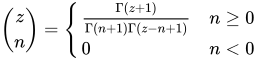
(
z
n
)
=
{
Γ
(
z
+
1
)
Γ
(
n
+
1
)
Γ
(
z
−
n
+
1
)
n
≥
0
0
n
<
0
{\displaystyle {z \choose n}={\begin{cases}{\frac {\Gamma (z+1)}{\Gamma (n+1)\Gamma (z-n+1)}}&n\geq 0\\0&n<0\end{cases}}}
where
Γ
(
z
)
{\displaystyle \Gamma (z)}
gamma function .
In the special case that the four quantities
n
{\displaystyle n}
n
+
α
{\displaystyle n+\alpha }
n
+
β
{\displaystyle n+\beta }
n
+
α
+
β
{\displaystyle n+\alpha +\beta }
P
n
(
α
,
β
)
(
x
)
=
(
n
+
α
)
!
(
n
+
β
)
!
∑
s
=
0
n
1
s
!
(
n
+
α
−
s
)
!
(
β
+
s
)
!
(
n
−
s
)
!
(
x
−
1
2
)
n
−
s
(
x
+
1
2
)
s
.
{\displaystyle P_{n}^{(\alpha ,\beta )}(x)=(n+\alpha )!(n+\beta )!\sum _{s=0}^{n}{\frac {1}{s!(n+\alpha -s)!(\beta +s)!(n-s)!}}\left({\frac {x-1}{2}}\right)^{n-s}\left({\frac {x+1}{2}}\right)^{s}.}
(1 )
The sum extends over all integer values of
s
{\displaystyle s}
Special cases [ edit ]
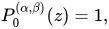
P
0
(
α
,
β
)
(
z
)
=
1
,
{\displaystyle P_{0}^{(\alpha ,\beta )}(z)=1,}
P
1
(
α
,
β
)
(
z
)
=
(
α
+
1
)
+
(
α
+
β
+
2
)
z
−
1
2
,
{\displaystyle P_{1}^{(\alpha ,\beta )}(z)=(\alpha +1)+(\alpha +\beta +2){\frac {z-1}{2}},}
P
2
(
α
,
β
)
(
z
)
=
(
α
+
1
)
(
α
+
2
)
2
+
(
α
+
2
)
(
α
+
β
+
3
)
z
−
1
2
+
(
α
+
β
+
3
)
(
α
+
β
+
4
)
2
(
z
−
1
2
)
2
.
{\displaystyle P_{2}^{(\alpha ,\beta )}(z)={\frac {(\alpha +1)(\alpha +2)}{2}}+(\alpha +2)(\alpha +\beta +3){\frac {z-1}{2}}+{\frac {(\alpha +\beta +3)(\alpha +\beta +4)}{2}}\left({\frac {z-1}{2}}\right)^{2}.}
Basic properties [ edit ] Orthogonality [ edit ] The Jacobi polynomials satisfy the orthogonality condition
∫
−
1
1
(
1
−
x
)
α
(
1
+
x
)
β
P
m
(
α
,
β
)
(
x
)
P
n
(
α
,
β
)
(
x
)
d
x
=
2
α
+
β
+
1
2
n
+
α
+
β
+
1
Γ
(
n
+
α
+
1
)
Γ
(
n
+
β
+
1
)
Γ
(
n
+
α
+
β
+
1
)
n
!
δ
n
m
,
α
,
β
>
−
1.
{\displaystyle \int _{-1}^{1}(1-x)^{\alpha }(1+x)^{\beta }P_{m}^{(\alpha ,\beta )}(x)P_{n}^{(\alpha ,\beta )}(x)\,dx={\frac {2^{\alpha +\beta +1}}{2n+\alpha +\beta +1}}{\frac {\Gamma (n+\alpha +1)\Gamma (n+\beta +1)}{\Gamma (n+\alpha +\beta +1)n!}}\delta _{nm},\qquad \alpha ,\ \beta >-1.}
As defined, they do not have unit norm with respect to the weight. This can be corrected by dividing by the square root of the right hand side of the equation above, when
n
=
m
{\displaystyle n=m}
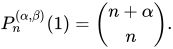
Although it does not yield an orthonormal basis, an alternative normalization is sometimes preferred due to its simplicity:
P
n
(
α
,
β
)
(
1
)
=
(
n
+
α
n
)
.
{\displaystyle P_{n}^{(\alpha ,\beta )}(1)={n+\alpha \choose n}.}
Symmetry relation [ edit ] The polynomials have the symmetry relation
P
n
(
α
,
β
)
(
−
z
)
=
(
−
1
)
n
P
n
(
β
,
α
)
(
z
)
;
{\displaystyle P_{n}^{(\alpha ,\beta )}(-z)=(-1)^{n}P_{n}^{(\beta ,\alpha )}(z);}
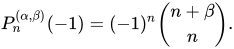
thus the other terminal value is
P
n
(
α
,
β
)
(
−
1
)
=
(
−
1
)
n
(
n
+
β
n
)
.
{\displaystyle P_{n}^{(\alpha ,\beta )}(-1)=(-1)^{n}{n+\beta \choose n}.}
Derivatives [ edit ] The
k
{\displaystyle k}
d
k
d
z
k
P
n
(
α
,
β
)
(
z
)
=
Γ
(
α
+
β
+
n
+
1
+
k
)
2
k
Γ
(
α
+
β
+
n
+
1
)
P
n
−
k
(
α
+
k
,
β
+
k
)
(
z
)
.
{\displaystyle {\frac {d^{k}}{dz^{k}}}P_{n}^{(\alpha ,\beta )}(z)={\frac {\Gamma (\alpha +\beta +n+1+k)}{2^{k}\Gamma (\alpha +\beta +n+1)}}P_{n-k}^{(\alpha +k,\beta +k)}(z).}
Differential equation [ edit ] The Jacobi polynomial
P
n
(
α
,
β
)
{\displaystyle P_{n}^{(\alpha ,\beta )}}
linear homogeneous differential equation [1]
(
1
−
x
2
)
y
″
+
(
β
−
α
−
(
α
+
β
+
2
)
x
)
y
′
+
n
(
n
+
α
+
β
+
1
)
y
=
0.
{\displaystyle \left(1-x^{2}\right)y''+(\beta -\alpha -(\alpha +\beta +2)x)y'+n(n+\alpha +\beta +1)y=0.}
Recurrence relations [ edit ] The recurrence relation for the Jacobi polynomials of fixed
α
{\displaystyle \alpha }
β
{\displaystyle \beta }
[1]
2
n
(
n
+
α
+
β
)
(
2
n
+
α
+
β
−
2
)
P
n
(
α
,
β
)
(
z
)
=
(
2
n
+
α
+
β
−
1
)
{
(
2
n
+
α
+
β
)
(
2
n
+
α
+
β
−
2
)
z
+
α
2
−
β
2
}
P
n
−
1
(
α
,
β
)
(
z
)
−
2
(
n
+
α
−
1
)
(
n
+
β
−
1
)
(
2
n
+
α
+
β
)
P
n
−
2
(
α
,
β
)
(
z
)
,
{\displaystyle {\begin{aligned}&2n(n+\alpha +\beta )(2n+\alpha +\beta -2)P_{n}^{(\alpha ,\beta )}(z)\\&\qquad =(2n+\alpha +\beta -1){\Big \{}(2n+\alpha +\beta )(2n+\alpha +\beta -2)z+\alpha ^{2}-\beta ^{2}{\Big \}}P_{n-1}^{(\alpha ,\beta )}(z)-2(n+\alpha -1)(n+\beta -1)(2n+\alpha +\beta )P_{n-2}^{(\alpha ,\beta )}(z),\end{aligned}}}
for
n
=
2
,
3
,
…
{\displaystyle n=2,3,\ldots }
a
:=
n
+
α
{\displaystyle a:=n+\alpha }
b
:=
n
+
β
{\displaystyle b:=n+\beta }
c
:=
a
+
b
=
2
n
+
α
+
β
{\displaystyle c:=a+b=2n+\alpha +\beta }
a
,
b
,
c
{\displaystyle a,b,c}
2
n
(
c
−
n
)
(
c
−
2
)
P
n
(
α
,
β
)
(
z
)
=
(
c
−
1
)
{
c
(
c
−
2
)
z
+
(
a
−
b
)
(
c
−
2
n
)
}
P
n
−
1
(
α
,
β
)
(
z
)
−
2
(
a
−
1
)
(
b
−
1
)
c
P
n
−
2
(
α
,
β
)
(
z
)
.
{\displaystyle 2n(c-n)(c-2)P_{n}^{(\alpha ,\beta )}(z)=(c-1){\Big \{}c(c-2)z+(a-b)(c-2n){\Big \}}P_{n-1}^{(\alpha ,\beta )}(z)-2(a-1)(b-1)c\;P_{n-2}^{(\alpha ,\beta )}(z).}
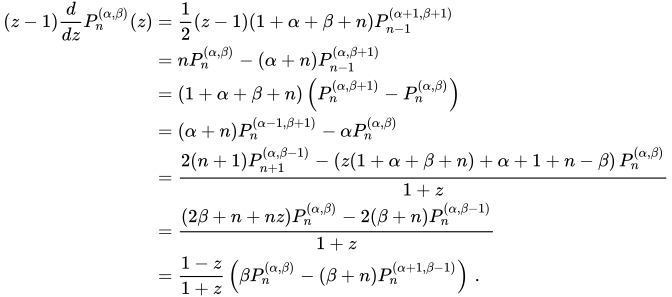
Since the Jacobi polynomials can be described in terms of the hypergeometric function, recurrences of the hypergeometric function give equivalent recurrences of the Jacobi polynomials. In particular, Gauss' contiguous relations correspond to the identities
(
z
−
1
)
d
d
z
P
n
(
α
,
β
)
(
z
)
=
1
2
(
z
−
1
)
(
1
+
α
+
β
+
n
)
P
n
−
1
(
α
+
1
,
β
+
1
)
=
n
P
n
(
α
,
β
)
−
(
α
+
n
)
P
n
−
1
(
α
,
β
+
1
)
=
(
1
+
α
+
β
+
n
)
(
P
n
(
α
,
β
+
1
)
−
P
n
(
α
,
β
)
)
=
(
α
+
n
)
P
n
(
α
−
1
,
β
+
1
)
−
α
P
n
(
α
,
β
)
=
2
(
n
+
1
)
P
n
+
1
(
α
,
β
−
1
)
−
(
z
(
1
+
α
+
β
+
n
)
+
α
+
1
+
n
−
β
)
P
n
(
α
,
β
)
1
+
z
=
(
2
β
+
n
+
n
z
)
P
n
(
α
,
β
)
−
2
(
β
+
n
)
P
n
(
α
,
β
−
1
)
1
+
z
=
1
−
z
1
+
z
(
β
P
n
(
α
,
β
)
−
(
β
+
n
)
P
n
(
α
+
1
,
β
−
1
)
)
.
{\displaystyle {\begin{aligned}(z-1){\frac {d}{dz}}P_{n}^{(\alpha ,\beta )}(z)&={\frac {1}{2}}(z-1)(1+\alpha +\beta +n)P_{n-1}^{(\alpha +1,\beta +1)}\\&=nP_{n}^{(\alpha ,\beta )}-(\alpha +n)P_{n-1}^{(\alpha ,\beta +1)}\\&=(1+\alpha +\beta +n)\left(P_{n}^{(\alpha ,\beta +1)}-P_{n}^{(\alpha ,\beta )}\right)\\&=(\alpha +n)P_{n}^{(\alpha -1,\beta +1)}-\alpha P_{n}^{(\alpha ,\beta )}\\&={\frac {2(n+1)P_{n+1}^{(\alpha ,\beta -1)}-\left(z(1+\alpha +\beta +n)+\alpha +1+n-\beta \right)P_{n}^{(\alpha ,\beta )}}{1+z}}\\&={\frac {(2\beta +n+nz)P_{n}^{(\alpha ,\beta )}-2(\beta +n)P_{n}^{(\alpha ,\beta -1)}}{1+z}}\\&={\frac {1-z}{1+z}}\left(\beta P_{n}^{(\alpha ,\beta )}-(\beta +n)P_{n}^{(\alpha +1,\beta -1)}\right)\,.\end{aligned}}}
Generating function [ edit ] The generating function of the Jacobi polynomials is given by
∑
n
=
0
∞
P
n
(
α
,
β
)
(
z
)
t
n
=
2
α
+
β
R
−
1
(
1
−
t
+
R
)
−
α
(
1
+
t
+
R
)
−
β
,
{\displaystyle \sum _{n=0}^{\infty }P_{n}^{(\alpha ,\beta )}(z)t^{n}=2^{\alpha +\beta }R^{-1}(1-t+R)^{-\alpha }(1+t+R)^{-\beta },}
where
R
=
R
(
z
,
t
)
=
(
1
−
2
z
t
+
t
2
)
1
2
,
{\displaystyle R=R(z,t)=\left(1-2zt+t^{2}\right)^{\frac {1}{2}}~,}
and the branch of square root is chosen so that
R
(
z
,
0
)
=
1
{\displaystyle R(z,0)=1}
[1]
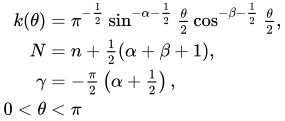
Asymptotics of Jacobi polynomials [ edit ] For
x
{\displaystyle x}
[
−
1
,
1
]
{\displaystyle [-1,1]}
P
n
(
α
,
β
)
{\displaystyle P_{n}^{(\alpha ,\beta )}}
n
{\displaystyle n}
[1]
P
n
(
α
,
β
)
(
cos
θ
)
=
n
−
1
2
k
(
θ
)
cos
(
N
θ
+
γ
)
+
O
(
n
−
3
2
)
,
{\displaystyle P_{n}^{(\alpha ,\beta )}(\cos \theta )=n^{-{\frac {1}{2}}}k(\theta )\cos(N\theta +\gamma )+O\left(n^{-{\frac {3}{2}}}\right),}
where
k
(
θ
)
=
π
−
1
2
sin
−
α
−
1
2
θ
2
cos
−
β
−
1
2
θ
2
,
N
=
n
+
1
2
(
α
+
β
+
1
)
,
γ
=
−
π
2
(
α
+
1
2
)
,
0
<
θ
<
π
{\displaystyle {\begin{aligned}k(\theta )&=\pi ^{-{\frac {1}{2}}}\sin ^{-\alpha -{\frac {1}{2}}}{\tfrac {\theta }{2}}\cos ^{-\beta -{\frac {1}{2}}}{\tfrac {\theta }{2}},\\N&=n+{\tfrac {1}{2}}(\alpha +\beta +1),\\\gamma &=-{\tfrac {\pi }{2}}\left(\alpha +{\tfrac {1}{2}}\right),\\0<\theta &<\pi \end{aligned}}}
and the "
O
{\displaystyle O}
[
ε
,
π
−
ε
]
{\displaystyle [\varepsilon ,\pi -\varepsilon ]}
ε
>
0
{\displaystyle \varepsilon >0}
The asymptotics of the Jacobi polynomials near the points
±
1
{\displaystyle \pm 1}
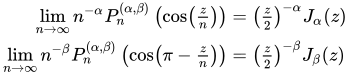
Mehler–Heine formula
lim
n
→
∞
n
−
α
P
n
(
α
,
β
)
(
cos
(
z
n
)
)
=
(
z
2
)
−
α
J
α
(
z
)
lim
n
→
∞
n
−
β
P
n
(
α
,
β
)
(
cos
(
π
−
z
n
)
)
=
(
z
2
)
−
β
J
β
(
z
)
{\displaystyle {\begin{aligned}\lim _{n\to \infty }n^{-\alpha }P_{n}^{(\alpha ,\beta )}\left(\cos \left({\tfrac {z}{n}}\right)\right)&=\left({\tfrac {z}{2}}\right)^{-\alpha }J_{\alpha }(z)\\\lim _{n\to \infty }n^{-\beta }P_{n}^{(\alpha ,\beta )}\left(\cos \left(\pi -{\tfrac {z}{n}}\right)\right)&=\left({\tfrac {z}{2}}\right)^{-\beta }J_{\beta }(z)\end{aligned}}}
where the limits are uniform for
z
{\displaystyle z}
domain .
The asymptotics outside
[
−
1
,
1
]
{\displaystyle [-1,1]}
Applications [ edit ] Wigner d-matrix [ edit ] The expression (1 Wigner d-matrix
d
m
′
,
m
j
(
ϕ
)
{\displaystyle d_{m',m}^{j}(\phi )}
0
≤
ϕ
≤
4
π
{\displaystyle 0\leq \phi \leq 4\pi }
[4]
d
m
′
m
j
(
ϕ
)
=
[
(
j
+
m
)
!
(
j
−
m
)
!
(
j
+
m
′
)
!
(
j
−
m
′
)
!
]
1
2
(
sin
ϕ
2
)
m
−
m
′
(
cos
ϕ
2
)
m
+
m
′
P
j
−
m
(
m
−
m
′
,
m
+
m
′
)
(
cos
ϕ
)
.
{\displaystyle d_{m'm}^{j}(\phi )=\left[{\frac {(j+m)!(j-m)!}{(j+m')!(j-m')!}}\right]^{\frac {1}{2}}\left(\sin {\tfrac {\phi }{2}}\right)^{m-m'}\left(\cos {\tfrac {\phi }{2}}\right)^{m+m'}P_{j-m}^{(m-m',m+m')}(\cos \phi ).}
See also [ edit ]
^ a b c d e f Szegő, Gábor (1939). "IV. Jacobi polynomials.". Orthogonal Polynomials ISBN 978-0-8218-1023-1 MR 0372517 . ^ Abramowitz, Milton ; Stegun, Irene Ann , eds. (1983) [June 1964]. "Chapter 22" . Handbook of Mathematical Functions with Formulas, Graphs, and Mathematical Tables ISBN 978-0-486-61272-0 LCCN 64-60036 . MR 0167642 . LCCN 65-12253 .^ P.K. Suetin (2001) [1994], "Jacobi polynomials" , Encyclopedia of Mathematics EMS Press ^ Biedenharn, L.C.; Louck, J.D. (1981). Angular Momentum in Quantum Physics . Reading: Addison-Wesley.
Further reading [ edit ] Andrews, George E.; Askey, Richard; Roy, Ranjan (1999), Special functions , Encyclopedia of Mathematics and its Applications, vol. 71, Cambridge University Press , ISBN 978-0-521-62321-6 MR 1688958 , ISBN 978-0-521-78988-2 Koornwinder, Tom H.; Wong, Roderick S. C.; Koekoek, Roelof; Swarttouw, René F. (2010), "Orthogonal Polynomials" , in Olver, Frank W. J. ; Lozier, Daniel M.; Boisvert, Ronald F.; Clark, Charles W. (eds.), NIST Handbook of Mathematical Functions ISBN 978-0-521-19225-5 MR 2723248 External links [ edit ]
International National Other



_with_n%3D10_and_a%3D2_and_b%3D2_in_the_complex_plane_from_-2-2i_to_2%2B2i_with_colors_created_with_Mathematica_13.1_function_ComplexPlot3D.svg)



![{\displaystyle [-1,1]}](https://wikimedia.org/api/rest_v1/media/math/render/svg/51e3b7f14a6f70e614728c583409a0b9a8b9de01)


































![{\displaystyle [\varepsilon ,\pi -\varepsilon ]}](https://wikimedia.org/api/rest_v1/media/math/render/svg/a2aec0a4485c35292703c489dbe3b0374cac6edc)




![{\displaystyle d_{m'm}^{j}(\phi )=\left[{\frac {(j+m)!(j-m)!}{(j+m')!(j-m')!}}\right]^{\frac {1}{2}}\left(\sin {\tfrac {\phi }{2}}\right)^{m-m'}\left(\cos {\tfrac {\phi }{2}}\right)^{m+m'}P_{j-m}^{(m-m',m+m')}(\cos \phi ).}](https://wikimedia.org/api/rest_v1/media/math/render/svg/8c078b36a1cb81f94eacdd3ffd60597f378e5847)
