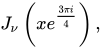
Plot of the Kelvin function ber(z) in the complex plane from -2-2i to 2+2i with colors created with Mathematica 13.1 function ComplexPlot3D In applied mathematics, the Kelvin functions berν x ) and beiν x ) are the real and imaginary parts , respectively, of
J
ν
(
x
e
3
π
i
4
)
,
{\displaystyle J_{\nu }\left(xe^{\frac {3\pi i}{4}}\right),\,}
where x is real, and Jν (z )ν th order Bessel function of the first kind. Similarly, the functions kerν (x ) and keiν (x ) are the real and imaginary parts, respectively, of
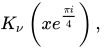
K
ν
(
x
e
π
i
4
)
,
{\displaystyle K_{\nu }\left(xe^{\frac {\pi i}{4}}\right),\,}
where Kν (z )ν th order modified Bessel function of the second kind.
These functions are named after William Thomson, 1st Baron Kelvin .
While the Kelvin functions are defined as the real and imaginary parts of Bessel functions with x taken to be real, the functions can be analytically continued for complex arguments xe iφ φ < 2π .n x ) and bein x ) for integral n , the Kelvin functions have a branch point at x = 0.
Below, Γ(z ) is the gamma function and ψ (z )digamma function .
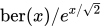
ber(x ) for x between 0 and 20.
b
e
r
(
x
)
/
e
x
/
2
{\displaystyle \mathrm {ber} (x)/e^{x/{\sqrt {2}}}}
x between 0 and 50.For integers n , bern x ) has the series expansion
b
e
r
n
(
x
)
=
(
x
2
)
n
∑
k
≥
0
cos
[
(
3
n
4
+
k
2
)
π
]
k
!
Γ
(
n
+
k
+
1
)
(
x
2
4
)
k
,
{\displaystyle \mathrm {ber} _{n}(x)=\left({\frac {x}{2}}\right)^{n}\sum _{k\geq 0}{\frac {\cos \left[\left({\frac {3n}{4}}+{\frac {k}{2}}\right)\pi \right]}{k!\Gamma (n+k+1)}}\left({\frac {x^{2}}{4}}\right)^{k},}
where Γ(z ) is the gamma function . The special case ber0 (x ), commonly denoted as just ber(x ), has the series expansion
b
e
r
(
x
)
=
1
+
∑
k
≥
1
(
−
1
)
k
[
(
2
k
)
!
]
2
(
x
2
)
4
k
{\displaystyle \mathrm {ber} (x)=1+\sum _{k\geq 1}{\frac {(-1)^{k}}{[(2k)!]^{2}}}\left({\frac {x}{2}}\right)^{4k}}
and asymptotic series
b
e
r
(
x
)
∼
e
x
2
2
π
x
(
f
1
(
x
)
cos
α
+
g
1
(
x
)
sin
α
)
−
k
e
i
(
x
)
π
{\displaystyle \mathrm {ber} (x)\sim {\frac {e^{\frac {x}{\sqrt {2}}}}{\sqrt {2\pi x}}}\left(f_{1}(x)\cos \alpha +g_{1}(x)\sin \alpha \right)-{\frac {\mathrm {kei} (x)}{\pi }}}
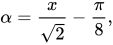
where
α
=
x
2
−
π
8
,
{\displaystyle \alpha ={\frac {x}{\sqrt {2}}}-{\frac {\pi }{8}},}
f
1
(
x
)
=
1
+
∑
k
≥
1
cos
(
k
π
/
4
)
k
!
(
8
x
)
k
∏
l
=
1
k
(
2
l
−
1
)
2
{\displaystyle f_{1}(x)=1+\sum _{k\geq 1}{\frac {\cos(k\pi /4)}{k!(8x)^{k}}}\prod _{l=1}^{k}(2l-1)^{2}}
g
1
(
x
)
=
∑
k
≥
1
sin
(
k
π
/
4
)
k
!
(
8
x
)
k
∏
l
=
1
k
(
2
l
−
1
)
2
.
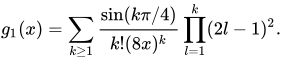
{\displaystyle g_{1}(x)=\sum _{k\geq 1}{\frac {\sin(k\pi /4)}{k!(8x)^{k}}}\prod _{l=1}^{k}(2l-1)^{2}.}
Plot of the Kelvin function bei(z) in the complex plane from -2-2i to 2+2i with colors created with Mathematica 13.1 function ComplexPlot3D bei(x ) for x between 0 and 20.
b
e
i
(
x
)
/
e
x
/
2
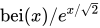
{\displaystyle \mathrm {bei} (x)/e^{x/{\sqrt {2}}}}
x between 0 and 50.For integers n , bein x ) has the series expansion
b
e
i
n
(
x
)
=
(
x
2
)
n
∑
k
≥
0
sin
[
(
3
n
4
+
k
2
)
π
]
k
!
Γ
(
n
+
k
+
1
)
(
x
2
4
)
k
.
{\displaystyle \mathrm {bei} _{n}(x)=\left({\frac {x}{2}}\right)^{n}\sum _{k\geq 0}{\frac {\sin \left[\left({\frac {3n}{4}}+{\frac {k}{2}}\right)\pi \right]}{k!\Gamma (n+k+1)}}\left({\frac {x^{2}}{4}}\right)^{k}.}
The special case bei0 (x ), commonly denoted as just bei(x ), has the series expansion
Plot of the Kelvin function ker(z) in the complex plane from -2-2i to 2+2i with colors created with Mathematica 13.1 function ComplexPlot3D
b
e
i
(
x
)
=
∑
k
≥
0
(
−
1
)
k
[
(
2
k
+
1
)
!
]
2
(
x
2
)
4
k
+
2
{\displaystyle \mathrm {bei} (x)=\sum _{k\geq 0}{\frac {(-1)^{k}}{[(2k+1)!]^{2}}}\left({\frac {x}{2}}\right)^{4k+2}}
and asymptotic series
b
e
i
(
x
)
∼
e
x
2
2
π
x
[
f
1
(
x
)
sin
α
−
g
1
(
x
)
cos
α
]
−
k
e
r
(
x
)
π
,
{\displaystyle \mathrm {bei} (x)\sim {\frac {e^{\frac {x}{\sqrt {2}}}}{\sqrt {2\pi x}}}[f_{1}(x)\sin \alpha -g_{1}(x)\cos \alpha ]-{\frac {\mathrm {ker} (x)}{\pi }},}
where α,
f
1
(
x
)
{\displaystyle f_{1}(x)}
g
1
(
x
)
{\displaystyle g_{1}(x)}
x ).
ker(x ) for x between 0 and 14.
k
e
r
(
x
)
e
x
/
2
{\displaystyle \mathrm {ker} (x)e^{x/{\sqrt {2}}}}
x between 0 and 50.For integers n , kern x ) has the (complicated) series expansion
k
e
r
n
(
x
)
=
−
ln
(
x
2
)
b
e
r
n
(
x
)
+
π
4
b
e
i
n
(
x
)
+
1
2
(
x
2
)
−
n
∑
k
=
0
n
−
1
cos
[
(
3
n
4
+
k
2
)
π
]
(
n
−
k
−
1
)
!
k
!
(
x
2
4
)
k
+
1
2
(
x
2
)
n
∑
k
≥
0
cos
[
(
3
n
4
+
k
2
)
π
]
ψ
(
k
+
1
)
+
ψ
(
n
+
k
+
1
)
k
!
(
n
+
k
)
!
(
x
2
4
)
k
.
{\displaystyle {\begin{aligned}&\mathrm {ker} _{n}(x)=-\ln \left({\frac {x}{2}}\right)\mathrm {ber} _{n}(x)+{\frac {\pi }{4}}\mathrm {bei} _{n}(x)\\&+{\frac {1}{2}}\left({\frac {x}{2}}\right)^{-n}\sum _{k=0}^{n-1}\cos \left[\left({\frac {3n}{4}}+{\frac {k}{2}}\right)\pi \right]{\frac {(n-k-1)!}{k!}}\left({\frac {x^{2}}{4}}\right)^{k}\\&+{\frac {1}{2}}\left({\frac {x}{2}}\right)^{n}\sum _{k\geq 0}\cos \left[\left({\frac {3n}{4}}+{\frac {k}{2}}\right)\pi \right]{\frac {\psi (k+1)+\psi (n+k+1)}{k!(n+k)!}}\left({\frac {x^{2}}{4}}\right)^{k}.\end{aligned}}}
Plot of the Kelvin function kei(z) in the complex plane from -2-2i to 2+2i with colors created with Mathematica 13.1 function ComplexPlot3D The special case ker0 (x ), commonly denoted as just ker(x ), has the series expansion
k
e
r
(
x
)
=
−
ln
(
x
2
)
b
e
r
(
x
)
+
π
4
b
e
i
(
x
)
+
∑
k
≥
0
(
−
1
)
k
ψ
(
2
k
+
1
)
[
(
2
k
)
!
]
2
(
x
2
4
)
2
k
{\displaystyle \mathrm {ker} (x)=-\ln \left({\frac {x}{2}}\right)\mathrm {ber} (x)+{\frac {\pi }{4}}\mathrm {bei} (x)+\sum _{k\geq 0}(-1)^{k}{\frac {\psi (2k+1)}{[(2k)!]^{2}}}\left({\frac {x^{2}}{4}}\right)^{2k}}
and the asymptotic series
k
e
r
(
x
)
∼
π
2
x
e
−
x
2
[
f
2
(
x
)
cos
β
+
g
2
(
x
)
sin
β
]
,
{\displaystyle \mathrm {ker} (x)\sim {\sqrt {\frac {\pi }{2x}}}e^{-{\frac {x}{\sqrt {2}}}}[f_{2}(x)\cos \beta +g_{2}(x)\sin \beta ],}
where
β
=
x
2
+
π
8
,
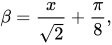
{\displaystyle \beta ={\frac {x}{\sqrt {2}}}+{\frac {\pi }{8}},}
f
2
(
x
)
=
1
+
∑
k
≥
1
(
−
1
)
k
cos
(
k
π
/
4
)
k
!
(
8
x
)
k
∏
l
=
1
k
(
2
l
−
1
)
2
{\displaystyle f_{2}(x)=1+\sum _{k\geq 1}(-1)^{k}{\frac {\cos(k\pi /4)}{k!(8x)^{k}}}\prod _{l=1}^{k}(2l-1)^{2}}
g
2
(
x
)
=
∑
k
≥
1
(
−
1
)
k
sin
(
k
π
/
4
)
k
!
(
8
x
)
k
∏
l
=
1
k
(
2
l
−
1
)
2
.
{\displaystyle g_{2}(x)=\sum _{k\geq 1}(-1)^{k}{\frac {\sin(k\pi /4)}{k!(8x)^{k}}}\prod _{l=1}^{k}(2l-1)^{2}.}
kei(x ) for x between 0 and 14.
k
e
i
(
x
)
e
x
/
2
{\displaystyle \mathrm {kei} (x)e^{x/{\sqrt {2}}}}
x between 0 and 50.For integer n , kein x ) has the series expansion
k
e
i
n
(
x
)
=
−
ln
(
x
2
)
b
e
i
n
(
x
)
−
π
4
b
e
r
n
(
x
)
−
1
2
(
x
2
)
−
n
∑
k
=
0
n
−
1
sin
[
(
3
n
4
+
k
2
)
π
]
(
n
−
k
−
1
)
!
k
!
(
x
2
4
)
k
+
1
2
(
x
2
)
n
∑
k
≥
0
sin
[
(
3
n
4
+
k
2
)
π
]
ψ
(
k
+
1
)
+
ψ
(
n
+
k
+
1
)
k
!
(
n
+
k
)
!
(
x
2
4
)
k
.
{\displaystyle {\begin{aligned}&\mathrm {kei} _{n}(x)=-\ln \left({\frac {x}{2}}\right)\mathrm {bei} _{n}(x)-{\frac {\pi }{4}}\mathrm {ber} _{n}(x)\\&-{\frac {1}{2}}\left({\frac {x}{2}}\right)^{-n}\sum _{k=0}^{n-1}\sin \left[\left({\frac {3n}{4}}+{\frac {k}{2}}\right)\pi \right]{\frac {(n-k-1)!}{k!}}\left({\frac {x^{2}}{4}}\right)^{k}\\&+{\frac {1}{2}}\left({\frac {x}{2}}\right)^{n}\sum _{k\geq 0}\sin \left[\left({\frac {3n}{4}}+{\frac {k}{2}}\right)\pi \right]{\frac {\psi (k+1)+\psi (n+k+1)}{k!(n+k)!}}\left({\frac {x^{2}}{4}}\right)^{k}.\end{aligned}}}
The special case kei0 (x ), commonly denoted as just kei(x ), has the series expansion
k
e
i
(
x
)
=
−
ln
(
x
2
)
b
e
i
(
x
)
−
π
4
b
e
r
(
x
)
+
∑
k
≥
0
(
−
1
)
k
ψ
(
2
k
+
2
)
[
(
2
k
+
1
)
!
]
2
(
x
2
4
)
2
k
+
1
{\displaystyle \mathrm {kei} (x)=-\ln \left({\frac {x}{2}}\right)\mathrm {bei} (x)-{\frac {\pi }{4}}\mathrm {ber} (x)+\sum _{k\geq 0}(-1)^{k}{\frac {\psi (2k+2)}{[(2k+1)!]^{2}}}\left({\frac {x^{2}}{4}}\right)^{2k+1}}
and the asymptotic series
k
e
i
(
x
)
∼
−
π
2
x
e
−
x
2
[
f
2
(
x
)
sin
β
+
g
2
(
x
)
cos
β
]
,
{\displaystyle \mathrm {kei} (x)\sim -{\sqrt {\frac {\pi }{2x}}}e^{-{\frac {x}{\sqrt {2}}}}[f_{2}(x)\sin \beta +g_{2}(x)\cos \beta ],}
where β , f 2 (x ), and g 2 (x ) are defined as for ker(x ).
Abramowitz, Milton ; Stegun, Irene Ann , eds. (1983) [June 1964]. "Chapter 9" . Handbook of Mathematical Functions with Formulas, Graphs, and Mathematical Tables ISBN 978-0-486-61272-0 LCCN 64-60036 . MR 0167642 . LCCN 65-12253 .Olver, F. W. J.; Maximon, L. C. (2010), "Bessel functions" , in Olver, Frank W. J. ; Lozier, Daniel M.; Boisvert, Ronald F.; Clark, Charles W. (eds.), NIST Handbook of Mathematical Functions ISBN 978-0-521-19225-5 MR 2723248 Weisstein, Eric W. "Kelvin Functions." From MathWorld—A Wolfram Web Resource. [1]
GPL-licensed C/C++ source code for calculating Kelvin functions at codecogs.com: [2] 



_in_the_complex_plane_from_-2-2i_to_2%2B2i_with_colors_created_with_Mathematica_13.1_function_ComplexPlot3D.svg)


![{\displaystyle \mathrm {ber} _{n}(x)=\left({\frac {x}{2}}\right)^{n}\sum _{k\geq 0}{\frac {\cos \left[\left({\frac {3n}{4}}+{\frac {k}{2}}\right)\pi \right]}{k!\Gamma (n+k+1)}}\left({\frac {x^{2}}{4}}\right)^{k},}](https://wikimedia.org/api/rest_v1/media/math/render/svg/ef0cd93458b54421e6ad2cc1a1d7642427b33221)
![{\displaystyle \mathrm {ber} (x)=1+\sum _{k\geq 1}{\frac {(-1)^{k}}{[(2k)!]^{2}}}\left({\frac {x}{2}}\right)^{4k}}](https://wikimedia.org/api/rest_v1/media/math/render/svg/0b0382d07ebb15b81d9f6d57b4a4c39d727bd7dd)


_in_the_complex_plane_from_-2-2i_to_2%2B2i_with_colors_created_with_Mathematica_13.1_function_ComplexPlot3D.svg)


![{\displaystyle \mathrm {bei} _{n}(x)=\left({\frac {x}{2}}\right)^{n}\sum _{k\geq 0}{\frac {\sin \left[\left({\frac {3n}{4}}+{\frac {k}{2}}\right)\pi \right]}{k!\Gamma (n+k+1)}}\left({\frac {x^{2}}{4}}\right)^{k}.}](https://wikimedia.org/api/rest_v1/media/math/render/svg/c08343a9ce9fef41ac36a7add2de1ef813cc3ec3)

_in_the_complex_plane_from_-2-2i_to_2%2B2i_with_colors_created_with_Mathematica_13.1_function_ComplexPlot3D.svg)
![{\displaystyle \mathrm {bei} (x)=\sum _{k\geq 0}{\frac {(-1)^{k}}{[(2k+1)!]^{2}}}\left({\frac {x}{2}}\right)^{4k+2}}](https://wikimedia.org/api/rest_v1/media/math/render/svg/f69dab8cb68e3d5e5a8dccfdf3f6c798775a0490)
![{\displaystyle \mathrm {bei} (x)\sim {\frac {e^{\frac {x}{\sqrt {2}}}}{\sqrt {2\pi x}}}[f_{1}(x)\sin \alpha -g_{1}(x)\cos \alpha ]-{\frac {\mathrm {ker} (x)}{\pi }},}](https://wikimedia.org/api/rest_v1/media/math/render/svg/64ac7c7ceb46b3e4f8fe6307064ff05eeb980e04)


![{\displaystyle {\begin{aligned}&\mathrm {ker} _{n}(x)=-\ln \left({\frac {x}{2}}\right)\mathrm {ber} _{n}(x)+{\frac {\pi }{4}}\mathrm {bei} _{n}(x)\\&+{\frac {1}{2}}\left({\frac {x}{2}}\right)^{-n}\sum _{k=0}^{n-1}\cos \left[\left({\frac {3n}{4}}+{\frac {k}{2}}\right)\pi \right]{\frac {(n-k-1)!}{k!}}\left({\frac {x^{2}}{4}}\right)^{k}\\&+{\frac {1}{2}}\left({\frac {x}{2}}\right)^{n}\sum _{k\geq 0}\cos \left[\left({\frac {3n}{4}}+{\frac {k}{2}}\right)\pi \right]{\frac {\psi (k+1)+\psi (n+k+1)}{k!(n+k)!}}\left({\frac {x^{2}}{4}}\right)^{k}.\end{aligned}}}](https://wikimedia.org/api/rest_v1/media/math/render/svg/c861946c574b893b798807b4d330a08838a82c03)
_in_the_complex_plane_from_-2-2i_to_2%2B2i_with_colors_created_with_Mathematica_13.1_function_ComplexPlot3D.svg)
![{\displaystyle \mathrm {ker} (x)=-\ln \left({\frac {x}{2}}\right)\mathrm {ber} (x)+{\frac {\pi }{4}}\mathrm {bei} (x)+\sum _{k\geq 0}(-1)^{k}{\frac {\psi (2k+1)}{[(2k)!]^{2}}}\left({\frac {x^{2}}{4}}\right)^{2k}}](https://wikimedia.org/api/rest_v1/media/math/render/svg/e620fcd5ca5f6cba6b4ba993439a8e6878b3505c)
![{\displaystyle \mathrm {ker} (x)\sim {\sqrt {\frac {\pi }{2x}}}e^{-{\frac {x}{\sqrt {2}}}}[f_{2}(x)\cos \beta +g_{2}(x)\sin \beta ],}](https://wikimedia.org/api/rest_v1/media/math/render/svg/6156e93597225fc773d61fff4b8c7b9b2ddc16f2)




![{\displaystyle {\begin{aligned}&\mathrm {kei} _{n}(x)=-\ln \left({\frac {x}{2}}\right)\mathrm {bei} _{n}(x)-{\frac {\pi }{4}}\mathrm {ber} _{n}(x)\\&-{\frac {1}{2}}\left({\frac {x}{2}}\right)^{-n}\sum _{k=0}^{n-1}\sin \left[\left({\frac {3n}{4}}+{\frac {k}{2}}\right)\pi \right]{\frac {(n-k-1)!}{k!}}\left({\frac {x^{2}}{4}}\right)^{k}\\&+{\frac {1}{2}}\left({\frac {x}{2}}\right)^{n}\sum _{k\geq 0}\sin \left[\left({\frac {3n}{4}}+{\frac {k}{2}}\right)\pi \right]{\frac {\psi (k+1)+\psi (n+k+1)}{k!(n+k)!}}\left({\frac {x^{2}}{4}}\right)^{k}.\end{aligned}}}](https://wikimedia.org/api/rest_v1/media/math/render/svg/8a32a3a0932238e7433d48965287b3ab97f0f245)
![{\displaystyle \mathrm {kei} (x)=-\ln \left({\frac {x}{2}}\right)\mathrm {bei} (x)-{\frac {\pi }{4}}\mathrm {ber} (x)+\sum _{k\geq 0}(-1)^{k}{\frac {\psi (2k+2)}{[(2k+1)!]^{2}}}\left({\frac {x^{2}}{4}}\right)^{2k+1}}](https://wikimedia.org/api/rest_v1/media/math/render/svg/a84894452aa4ac878be50e50a42b2a91bd3bce86)
![{\displaystyle \mathrm {kei} (x)\sim -{\sqrt {\frac {\pi }{2x}}}e^{-{\frac {x}{\sqrt {2}}}}[f_{2}(x)\sin \beta +g_{2}(x)\cos \beta ],}](https://wikimedia.org/api/rest_v1/media/math/render/svg/7cb3fd63059e08690345a00b76f7425ba1bcc768)