


Keystone (architecture)
.png)

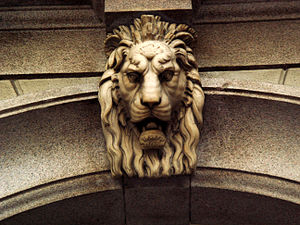
A keystone (or capstone) is the wedge-shaped stone at the apex of a masonry arch or typically round-shaped one at the apex of a vault. In both cases it is the final piece placed during construction and locks all the stones into position, allowing the arch or vault to bear weight.[1][2][3] In arches and vaults (such as quasi-domes) keystones are often enlarged beyond the structural requirements and decorated. A variant in domes and crowning vaults is a lantern. A portion of the arch surrounding the keystone is called a crown.[4]
Keystones or their suggested form are sometimes placed for decorative effect in the centre of the flat top of doors, recesses and windows, so as to form an upward projection of a lintel, as a hallmark of strength or good architecture.
Although a masonry arch or vault cannot be self-supporting until the keystone is placed, the keystone experiences the least stress of any of the voussoirs, due to its position at the apex.[citation needed] Old keystones can decay due to vibration, a condition known as bald arch.
Architecture[edit]
In a rib-vaulted ceiling, keystones commonly mark the intersections of any two or more arched ribs. For aesthetics, keystones are often larger than ribs in vaults and many of the voussoirs (arch stones) in arches, or embellished with a boss.
A "dropped keystone" is one where the keystone projects lower than the other voussoirs. Following Giulio Romano, Mannerist architects of the 16th century often designed arches with enlarged and slightly dropped keystones, as in the "church house" entrance portal at Colditz Castle. Numerous examples are found in the work of Sebastiano Serlio, a 16th-century Italian Mannerist architect.
Metaphor[edit]
Keystone is often used metaphorically for an essential part on which the whole depends or as an acme of the whole.
The U.S. state of Pennsylvania calls itself the "Keystone State", because during early American history, it held a crucial central position among the Thirteen Colonies geographically, economically, and politically, like the keystone in an arch.[5] A keystone is a symbol of Pennsylvania, being used in the logos of many Pennsylvania government departments, in Pennsylvania state route signs, and on Pennsylvania car license plates, and the Shoulder Sleeve Insignia of the Pennsylvania National Guard's 28th Infantry Division (United States), a Red Keystone, first adopted during World War I in October 1918.
In Christianity, Psalms 118:22,[6] translated in the Authorized Version as "The stone which the builders refused is become the head stone of the corner", is taken to refer to Jesus.
Referring to the Book of Mormon, Joseph Smith said that it "was the most correct of any book on earth, and the keystone of our religion, and a man would get nearer to God by abiding by its precepts, than by any other book."[7] Ezra Taft Benson, the 13th president of the Church of Jesus Christ of Latter-day Saints, said it "is my prayer that the Book of Mormon may become the keystone of our lives."[8]
Gallery[edit]
-
-
 Keystone much enlarged for decorative effect, and carrying a coat of arms, Barcelona
 -
 The York Minster Chapter House rib-vault ceiling with central and peripheral keystones
 -
 A boss depicting Jesus Christ decorates the keystone in the rib-vaulting at Chapel of St. Anne in Malbork, 14th century.
 -
 Bossed keystone in the ceiling of an apse chapel (Toulouse Cathedral)
 -

-

-
 Dropped keystone on a German church
 -
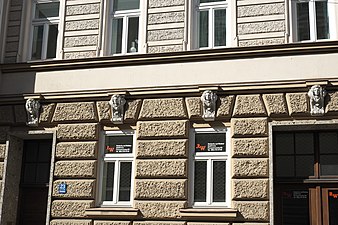 Doors and windows with decorated keystones, Munich
 -
 A range of plain but enlarged keystones by Giulio Romano for his house in Mantua
 -
 The keystone is the symbol of the Order of Mark Master Masons
 -
![As a metaphor, the navicular bone, shown in green, is known as the keystone of the foot[9]](//upload.wikimedia.org/wikipedia/commons/thumb/4/4a/Navicular_bone12.png/225px-Navicular_bone12.png) As a metaphor, the navicular bone, shown in green, is known as the keystone of the foot[9]
As a metaphor, the navicular bone, shown in green, is known as the keystone of the foot[9]
_-_Dettaglio_-_Foto_Giovanni_Dall%27Orto,_31-Aug-2007.jpg)
_(cropped).jpg)
.jpg)


-testo_e_photo_Paolo_Villa-nA2-tesi_Accademia_Belle_Arti_Bologna-portone_di_Palazzo_Giusti.jpg)


![As a metaphor, the navicular bone, shown in green, is known as the keystone of the foot[9]](/wiki/File:Navicular_bone12.png)
See also[edit]
- Architectural sculpture
- Coping (architecture)
- List of classical architecture terms
- Oculus compression ring
Notes[edit]
- ^ Ching, Francis D.K. (1995). A Visual Dictionary of Architecture. New York: John Wiley & Sons, Inc. p. 12. ISBN 0-471-28451-3.
- ^ "Glossary of Medieval Art and Architecture – Keystone". University of Pittsburgh. Retrieved 2007-06-25.
- ^ "keystone". Merriam Webster. Retrieved 2007-06-25.
- ^ Wilkins 1879, p. 292.
- ^ "State Symbols". PA.gov. Commonwealth of Pennsylvania. Retrieved 12 January 2024.
- ^ Ps 118:22
- ^ "Chapter 27". History of the Church Volume 4. Salt Lake City: Deseret News. 1908. p. 461. Retrieved 12 January 2024.
- ^ "'Keystone of our religion'". Church News. 17 August 2013. Retrieved 12 January 2024.
- ^ "UpToDate". www.uptodate.com. Retrieved 2022-06-11.
Sources[edit]
- Wilkins, H.S.C. (1879). A treatise on mountain roads, live loads, and bridges. E. & F.N. Spon. Retrieved 2023-12-16.
External links[edit]

 Media related to keystones at Wikimedia Commons
