


Lax–Wendroff method
The Lax–Wendroff method, named after Peter Lax and Burton Wendroff,[1] is a numerical method for the solution of hyperbolic partial differential equations, based on finite differences. It is second-order accurate in both space and time. This method is an example of explicit time integration where the function that defines the governing equation is evaluated at the current time.
Definition
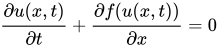
[edit]Suppose one has an equation of the following form: where x and t are independent variables, and the initial state, u(x, 0) is given.
Linear case
[edit]In the linear case, where f(u) = Au, and A is a constant,[2] Here refers to the dimension and refers to the dimension. This linear scheme can be extended to the general non-linear case in different ways. One of them is letting
![{\displaystyle u_{i}^{n+1}=u_{i}^{n}-{\frac {\Delta t}{2\Delta x}}A\left[u_{i+1}^{n}-u_{i-1}^{n}\right]+{\frac {\Delta t^{2}}{2\Delta x^{2}}}A^{2}\left[u_{i+1}^{n}-2u_{i}^{n}+u_{i-1}^{n}\right].}](https://wikimedia.org/api/rest_v1/media/math/render/svg/4896aba31477fc792026cfbdb84375689c1a6b55)


Non-linear case
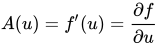
[edit]The conservative form of Lax-Wendroff for a general non-linear equation is then: where is the Jacobian matrix evaluated at .
![{\displaystyle u_{i}^{n+1}=u_{i}^{n}-{\frac {\Delta t}{2\Delta x}}\left[f(u_{i+1}^{n})-f(u_{i-1}^{n})\right]+{\frac {\Delta t^{2}}{2\Delta x^{2}}}\left[A_{i+1/2}\left(f(u_{i+1}^{n})-f(u_{i}^{n})\right)-A_{i-1/2}\left(f(u_{i}^{n})-f(u_{i-1}^{n})\right)\right].}](https://wikimedia.org/api/rest_v1/media/math/render/svg/1e351ecf692b371d283629cae7354a5598f3ae2f)

Jacobian free methods
[edit]To avoid the Jacobian evaluation, use a two-step procedure.
Richtmyer method
[edit]What follows is the Richtmyer two-step Lax–Wendroff method. The first step in the Richtmyer two-step Lax–Wendroff method calculates values for f(u(x, t)) at half time steps, tn + 1/2 and half grid points, xi + 1/2. In the second step values at tn + 1 are calculated using the data for tn and tn + 1/2.
First (Lax) steps:


Second step:
![{\displaystyle u_{i}^{n+1}=u_{i}^{n}-{\frac {\Delta t}{\Delta x}}\left[f(u_{i+1/2}^{n+1/2})-f(u_{i-1/2}^{n+1/2})\right].}](https://wikimedia.org/api/rest_v1/media/math/render/svg/a1fe928153382db4b465a4cc76bb7b3ccc2fe2d1)
MacCormack method
[edit]Another method of this same type was proposed by MacCormack. MacCormack's method uses first forward differencing and then backward differencing:
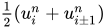
First step: Second step:

![{\displaystyle u_{i}^{n+1}={\frac {1}{2}}(u_{i}^{n}+u_{i}^{*})-{\frac {\Delta t}{2\Delta x}}\left[f(u_{i}^{*})-f(u_{i-1}^{*})\right].}](https://wikimedia.org/api/rest_v1/media/math/render/svg/56975847eca9241721582a2ae4fae89abcd32dc3)
Alternatively, First step: Second step:

![{\displaystyle u_{i}^{n+1}={\frac {1}{2}}(u_{i}^{n}+u_{i}^{*})-{\frac {\Delta t}{2\Delta x}}\left[f(u_{i+1}^{*})-f(u_{i}^{*})\right].}](https://wikimedia.org/api/rest_v1/media/math/render/svg/28b1232af80fd0fc25fae13893fd5c13fac9fcf0)
References
[edit]- ^ P.D Lax; B. Wendroff (1960). "Systems of conservation laws" (PDF). Commun. Pure Appl. Math. 13 (2): 217–237. doi:10.1002/cpa.3160130205. Archived from the original on September 25, 2017.
- ^ LeVeque, Randall J. (1992). Numerical Methods for Conservation Laws (PDF). Boston: Birkhäuser. p. 125. ISBN 0-8176-2723-5.
- Michael J. Thompson, An Introduction to Astrophysical Fluid Dynamics, Imperial College Press, London, 2006.
- Press, WH; Teukolsky, SA; Vetterling, WT; Flannery, BP (2007). "Section 20.1. Flux Conservative Initial Value Problems". Numerical Recipes: The Art of Scientific Computing (3rd ed.). New York: Cambridge University Press. p. 1040. ISBN 978-0-521-88068-8.