


Upper set


In mathematics, an upper set (also called an upward closed set, an upset, or an isotone set in X)[1] of a partially ordered set is a subset with the following property: if s is in S and if x in X is larger than s (that is, if ), then x is in S. In other words, this means that any x element of X that is to some element of S is necessarily also an element of S. The term lower set (also called a downward closed set, down set, decreasing set, initial segment, or semi-ideal) is defined similarly as being a subset S of X with the property that any element x of X that is to some element of S is necessarily also an element of S.


Definition[edit]
Let be a preordered set. An upper set in (also called an upward closed set, an upset, or an isotone set)[1] is a subset that is "closed under going up", in the sense that


- for all and all if then


The dual notion is a lower set (also called a downward closed set, down set, decreasing set, initial segment, or semi-ideal), which is a subset that is "closed under going down", in the sense that

- for all and all if then


The terms order ideal or ideal are sometimes used as synonyms for lower set.[2][3][4] This choice of terminology fails to reflect the notion of an ideal of a lattice because a lower set of a lattice is not necessarily a sublattice.[2]
Properties[edit]
- Every partially ordered set is an upper set of itself.
- The intersection and the union of any family of upper sets is again an upper set.
- The complement of any upper set is a lower set, and vice versa.
- Given a partially ordered set the family of upper sets of ordered with the inclusion relation is a complete lattice, the upper set lattice.
- Given an arbitrary subset of a partially ordered set the smallest upper set containing is denoted using an up arrow as (see upper closure and lower closure).
- Dually, the smallest lower set containing is denoted using a down arrow as
- A lower set is called principal if it is of the form where is an element of
- Every lower set of a finite partially ordered set is equal to the smallest lower set containing all maximal elements of
- where denotes the set containing the maximal elements of
- A directed lower set is called an order ideal.
- For partial orders satisfying the descending chain condition, antichains and upper sets are in one-to-one correspondence via the following bijections: map each antichain to its upper closure (see below); conversely, map each upper set to the set of its minimal elements. This correspondence does not hold for more general partial orders; for example the sets of real numbers and are both mapped to the empty antichain.







Upper closure and lower closure[edit]
Given an element of a partially ordered set the upper closure or upward closure of denoted by or is defined by






The sets and are, respectively, the smallest upper and lower sets containing as an element. More generally, given a subset define the upper/upward closure and the lower/downward closure of denoted by and respectively, as


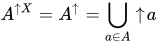
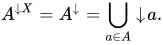
In this way, and where upper sets and lower sets of this form are called principal. The upper closure and lower closure of a set are, respectively, the smallest upper set and lower set containing it.


The upper and lower closures, when viewed as functions from the power set of to itself, are examples of closure operators since they satisfy all of the Kuratowski closure axioms. As a result, the upper closure of a set is equal to the intersection of all upper sets containing it, and similarly for lower sets. (Indeed, this is a general phenomenon of closure operators. For example, the topological closure of a set is the intersection of all closed sets containing it; the span of a set of vectors is the intersection of all subspaces containing it; the subgroup generated by a subset of a group is the intersection of all subgroups containing it; the ideal generated by a subset of a ring is the intersection of all ideals containing it; and so on.)
Ordinal numbers[edit]
An ordinal number is usually identified with the set of all smaller ordinal numbers. Thus each ordinal number forms a lower set in the class of all ordinal numbers, which are totally ordered by set inclusion.
See also[edit]
- Abstract simplicial complex (also called: Independence system) - a set-family that is downwards-closed with respect to the containment relation.
- Cofinal set – a subset of a partially ordered set that contains for every element some element such that


References[edit]
- ^ a b Dolecki & Mynard 2016, pp. 27–29.
- ^ a b Brian A. Davey; Hilary Ann Priestley (2002). Introduction to Lattices and Order (2nd ed.). Cambridge University Press. pp. 20, 44. ISBN 0-521-78451-4. LCCN 2001043910.
- ^ Stanley, R.P. (2002). Enumerative combinatorics. Cambridge studies in advanced mathematics. Vol. 1. Cambridge University Press. p. 100. ISBN 978-0-521-66351-9.
- ^ Lawson, M.V. (1998). Inverse semigroups: the theory of partial symmetries. World Scientific. p. 22. ISBN 978-981-02-3316-7.
- Blanck, J. (2000). "Domain representations of topological spaces" (PDF). Theoretical Computer Science. 247 (1–2): 229–255. doi:10.1016/s0304-3975(99)00045-6.
- Dolecki, Szymon; Mynard, Frederic (2016). Convergence Foundations Of Topology. New Jersey: World Scientific Publishing Company. ISBN 978-981-4571-52-4. OCLC 945169917.
- Hoffman, K. H. (2001), The low separation axioms (T0) and (T1)