


Steinhaus–Moser notation
In mathematics, Steinhaus–Moser notation is a notation for expressing certain large numbers. It is an extension (devised by Leo Moser) of Hugo Steinhaus's polygon notation.[1]
Definitions
[edit] a number n in a triangle means nn.

 a number n in a square is equivalent to "the number n inside n triangles, which are all nested."

 a number n in a pentagon is equivalent to "the number n inside n squares, which are all nested."

etc.: n written in an (m + 1)-sided polygon is equivalent to "the number n inside n nested m-sided polygons". In a series of nested polygons, they are associated inward. The number n inside two triangles is equivalent to nn inside one triangle, which is equivalent to nn raised to the power of nn.
Steinhaus defined only the triangle, the square, and the circle  , which is equivalent to the pentagon defined above.
Special values
[edit]Steinhaus defined:
- mega is the number equivalent to 2 in a circle: ②
- megiston is the number equivalent to 10 in a circle: ⑩
Moser's number is the number represented by "2 in a megagon". Megagon is here the name of a polygon with "mega" sides (not to be confused with the polygon with one million sides).
Alternative notations:
- use the functions square(x) and triangle(x)
- let M(n, m, p) be the number represented by the number n in m nested p-sided polygons; then the rules are:
- and
- mega =
- megiston =
- moser =






Mega
[edit]A mega, ②, is already a very large number, since ② = square(square(2)) = square(triangle(triangle(2))) = square(triangle(22)) = square(triangle(4)) = square(44) = square(256) = triangle(triangle(triangle(...triangle(256)...))) [256 triangles] = triangle(triangle(triangle(...triangle(256256)...))) [255 triangles] ~ triangle(triangle(triangle(...triangle(3.2317 × 10616)...))) [255 triangles] ...
Using the other notation:
mega =

With the function we have mega = where the superscript denotes a functional power, not a numerical power.


We have (note the convention that powers are evaluated from right to left):
- ≈




Similarly:

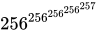

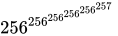

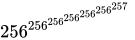
etc.
Thus:
- mega = , where denotes a functional power of the function .



Rounding more crudely (replacing the 257 at the end by 256), we get mega ≈ , using Knuth's up-arrow notation.

After the first few steps the value of is each time approximately equal to . In fact, it is even approximately equal to (see also approximate arithmetic for very large numbers). Using base 10 powers we get:


- ( is added to the 616)
- ( is added to the , which is negligible; therefore just a 10 is added at the bottom)





...
- mega = , where denotes a functional power of the function . Hence




Moser's number
[edit]It has been proven that in Conway chained arrow notation,

and, in Knuth's up-arrow notation,

Therefore, Moser's number, although incomprehensibly large, is vanishingly small compared to Graham's number:[2]

See also
[edit]References
[edit]- ^ Hugo Steinhaus, Mathematical Snapshots, Oxford University Press 19693, ISBN 0195032675, pp. 28-29
- ^ Proof that G >> M
External links
[edit]- Robert Munafo's Large Numbers
- Factoid on Big Numbers
- Megistron at mathworld.wolfram.com (Steinhaus referred to this number as "megiston" with no "r".)
- Circle notation at mathworld.wolfram.com
- Steinhaus-Moser Notation - Pointless Large Number Stuff