


Murals in Northern Ireland
Murals in Northern Ireland have become symbols of Northern Ireland, depicting the region's past and present political and religious divisions.
Belfast and Derry contain arguably the most famous political murals in Europe. It is believed that almost 2,000 murals have been documented since the 1970s. In 2014, the book The Belfast Mural Guide estimated that, in Belfast, there were approximately 300 quality murals on display, with many more in varying degrees of age and decay. Murals commemorate, communicate and display aspects of culture and history. The themes of murals often reflect what is important to a particular community. A mural therefore exists to express an idea or message and could generally be seen as reflecting values held dear to that community.
In Irish republican areas the themes of murals include the 1981 Irish hunger strike, with particular emphasis on strike leader Bobby Sands, murals of international solidarity with revolutionary groups, and murals highlighting a particular issue, for example the Ballymurphy Massacre or the McGurk's Bar bombing. In working class unionist communities, murals are used to promote Ulster loyalist paramilitary groups such as the Ulster Defence Association and Ulster Volunteer Force and commemorate their deceased members. However, traditional themes such as William of Orange and the Battle of the Boyne, the Battle of the Somme and the 36th Ulster Division are equally common.[1]
History
[edit]
Murals can be described as a mirror of political change, as they have been painted throughout the last century and display all important historic as well as political developments in the scope of unique wall paintings. In 1908 Ulster loyalists started to portray William of Orange on a white horse in order to strengthen the Orange identity of Ulster Protestants. Irish republican wall-paintings started in the late 1970s and can be seen in particular as a visual display of a social movement, which was radicalized after the IRA began to fight for a greater political voice and a United Ireland.[2] Unionist murals quickly forewent general commemoration and became explicit signage of loyalist paramilitaries, a fixture that remained following the peace process although alongside an increase in commemorative murals.[3] Republican murals, while often drawing upon the likes of Bobby Sands and the IRA, are less squarely militrastic featuring a broader repertoire that extends to Celtic mythology and international revolutionaries; their scope includes style, ranging from "anti-fascist propaganda to commercial film posters".[3][4]
Murals are for the most part located in working class areas of Northern Ireland, primarily in Belfast and Derry. Arguably the most well-known and easily identified mural is that of Bobby Sands, on the side wall of Sinn Féin's Falls Road office. A close second is the collection of Irish republican and international-themed murals which are located at what is known as 'The International Wall', also in Belfast. In Derry, Free Derry Corner, where the slogan "You Are Now Entering Free Derry" was painted in 1969 shortly after the Battle of the Bogside, is prominent. Free Derry Corner has been used as a model for other murals in Northern Ireland, including the "You Are Now Entering Loyalist Sandy Row" mural in Belfast, which was a response to the republican message of Free Derry Corner, and the "You Are Now Entering Derry Journal Country" mural, which is an advertisement for a Derry publication.
Not all murals in Northern Ireland are directly political or sectarian in nature, with some commemorating events such as the Great Irish Famine, and other moments in Irish history. Many portray events from Irish mythology, and images from Irish myths are often incorporated into political murals. A few murals avoid the subject of Ireland altogether, instead focusing on such neutral subjects as litter prevention and the C. S. Lewis novel The Lion, the Witch and the Wardrobe. In Derry's city centre, a mural depicting the five principal characters from the TV show Derry Girls was painted on the side of a pub,[5][6] with the mural being updated during the COVID-19 pandemic in 2020 and prior to the airing of the show's final series in 2022.[7][8] Murals representing peace and tolerance are becoming increasingly popular with school groups who have children either design or actually paint murals in areas around their schools. With many paramilitaries now involved in community work, there has been a move to decommission many of the hard-edged murals across Northern Ireland (although this trend is reversed in times of tension).[9] This change was further highlighted in 2007, when the Bogside Artists were invited to Washington, D.C. for the Smithsonian Folk Life Festival. The three artists were invited to recreate murals in the Washington Mall.[10]
Examples
[edit]Republican
[edit]-
 A Provisional IRA mural in Belfast
 -
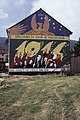 A mural in Belfast depicting the Easter Rising of 1916
 -
 A Great Famine mural in Belfast.
 -
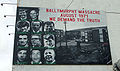 A mural in Belfast depicting the Ballymurphy Massacre
 -
 A mural in Belfast depicting the 1981 hunger strike
 -
 A mural in Belfast dedicated to Cumann na mBan
 -
 A mural in Belfast dedicated to the IRA volunteers killed in Operation Flavius
 -
 A mural in Short Strand saying "Slán Abhaile" or "Safe Home" to British troops
 -
 A mural in Belfast showing support for Palestine


Loyalist
[edit]-
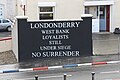 A mural in a loyalist enclave of Derry
 -
 A loyalist mural in Belfast
 -
 A loyalist mural in Belfast
 -
 Loyalist murals on Thorndyke Street, Belfast
 -

-
 An Ulster Volunteers/UVF mural in Bangor
 -
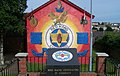 A Red Hand Commandos mural in Bangor
 -
 Another RHC mural in Bangor
 -
 A RHC mural in Ballybeen housing estate
 -
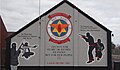 A RHC mural in Rathcoole
 -
 A mural in Belfast, commemorating William of Orange and the Battle of the Boyne
 -
 A mural in Belfast depicting William of Orange
 -
 A mural in Belfast showing solidarity with the Portadown Orangemen
 -
 A mural in Belfast depicting republican killings
 -
 A mural in Belfast depicting republican killings
 -
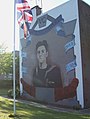 A mural dedicated to James Joseph Magennis in east Belfast.
 -
 A mural dedicated to Edward Carson
 -
 Loyalist mural in Ballymacarrett Road, east Belfast.
 -
 Ulster Volunteers mural in Newtownabbey
 -
 Ulster Volunteers mural in Belfast
 -
 Loyalist mural in Newtownabbey
 -
 A loyalist in Belfast mural critical of the Good Friday Agreement
.JPG)


Other
[edit]-
 A mural in a republican area dedicated to George Best
 -
 A mural dedicated to the sinking of RMS Titanic
 -

-
 A mural commemorating US President James Buchanan
 -
 A civil rights mural in Bogside, Derry
 -


See also
[edit]References
[edit]- ^ Maxamillian Rapp: Murals in Ulster: Symbol kultureller Revolution im nordirischen Bürgerkrieg. In: KultuRRevolution Nr. 61/62 2012.
- ^ Maximilian Rapp and Markus Rhomberg: The importance of Murals during the Troubles: Analyzing the republican use of wall paintings in Northern Ireland. In: Machin, D. (Ed.) Visual Communication Reader. De Gruyter.
- ^ a b Rolston, Bill (2004). "The War of the Walls: political murals in Northern Ireland". Museum International. 56 (3): 38–45. doi:10.1111/j.1350-0775.2004.00480.x. ISSN 1350-0775. S2CID 154188559.
- ^ Forker, Martin; McCormick, Jonathan (2009). "Walls of history: the use of mythomoteurs in Northern Ireland murals". Irish Studies Review. 17 (4): 423–465. doi:10.1080/09670880903315898. ISSN 0967-0882. S2CID 143454753.
- ^ "Derry Girls immortalised in paint for giant city centre mural". The Irish News. 25 January 2019. Retrieved 12 April 2022.
- ^ Thomas, Cónal (29 January 2019). "The giant Derry Girls mural has been completed - and here it is". TheJournal.ie. Retrieved 12 April 2022.
- ^ O'Connor, Rachael (24 April 2020). "Iconic Derry Girls mural gets a makeover to remind people of importance of social distancing". The Irish Post. Retrieved 12 April 2022.
- ^ Keenan, Shaun (7 April 2022). "Derry Girls mural receives 'temporary' update ahead of third and final series". Belfast Live. Retrieved 12 April 2022.
- ^ "Old masters change murals". BBC News. 31 May 2005. Retrieved 28 November 2008.
- ^ Taggart, Maggie (22 June 2007). "Painting a New Image of NI". BBC News. Retrieved 28 November 2008.
Further reading
[edit]- B. Rolston (1991). Politics And Painting: Murals and Conflict in Northern Ireland. New Jersey: Associated University Presses.
- B. Rolston (1992). Drawing Support: Murals in the North of Ireland. Belfast.
{{cite book}}: CS1 maint: location missing publisher (link) - Oona Woods (1995). Seeing is Believing? Murals in Derry. Guildhall: Printing Press. ISBN 0-946451-31-1.
- B. Rolston (1995). Drawing Support 2: Murals of War and Peace. Belfast.
{{cite book}}: CS1 maint: location missing publisher (link) - B. Rolston (2003). Drawing Support 3: Murals and Transition in the North of Ireland. Belfast.
{{cite book}}: CS1 maint: location missing publisher (link) - Robert Kerr (2008). Republican Belfast: A Political Tourists Guide. Belfast: MSF Press. ISBN 978-0956026408. – Download a chapter from the University of Ulster's CAIN website
- Robert Kerr (2014). The Belfast Mural Guide (Locate Series). Belfast: MSF Press. ISBN 978-0956806918.
- Robert Kerr (2014). An Treoir Mhurphictiúir Bhéal Feirste (Irish language edition of 'The Belfast Mural Guide') (Locate Series). Belfast: MSF Press. ISBN 978-0956806925.
- Maximilian Rapp: Murals in Nordirland: Symbol der ethno-kulturellen Identität und Spiegel des politischen Wandels. Nomos, Baden-Baden, 2014, ISBN 978-3-8487-1419-3.
External links
[edit]
- Map of murals
- Map of current Belfast murals
- Peter Moloney Collection – Murals
- Extramural Activity – Blog and illustrated history of murals, graffiti, and street art
- Claremont Digital Collection
- CAIN (Conflict Archive on the INternet) Mural Collection
- Northern Ireland political murals Flickr group
- Belfast Wall Murals Flickr Photo Pool
- Bill Rolston
- Videos of Belfast murals
- Take an online tour of the murals in Belfast, Northern Ireland
- Documentary about Devenny/Ervine collaborations
- Routes of Reconciliation: Visiting Sites of Cultural Trauma in the U.S. South, Northern Ireland, and South Africa by Charles Regan Wilson, Southern Spaces, 26 March 2009
| Culture | |
|---|---|
| Types | |
| Lists of artists | |
| Photographers | |
| Places |
|
| Events | |
| Related | |
