


Virulent Newcastle disease
 | This article needs more reliable medical references for verification or relies too heavily on primary sources. (February 2023) |  |
| Avian orthoavulavirus 1 | |
|---|---|

| |
| Avian orthoavulavirus 1 (stained in brown) in the conjunctiva of a chicken | |
Virus classification 
| |
| (unranked): | Virus |
| Realm: | Riboviria |
| Kingdom: | Orthornavirae |
| Phylum: | Negarnaviricota |
| Class: | Monjiviricetes |
| Order: | Mononegavirales |
| Family: | Paramyxoviridae |
| Genus: | Orthoavulavirus |
| Species: | Avian orthoavulavirus 1
|
Virulent Newcastle disease (VND), formerly exotic Newcastle disease,[1] is a contagious viral avian disease affecting many domestic and wild bird species; it is transmissible to humans.[2] Though it can infect humans, most cases are non-symptomatic; rarely it can cause a mild fever and influenza-like symptoms and/or conjunctivitis in humans. Its effects are most notable in domestic poultry due to their high susceptibility and the potential for severe impacts of an epizootic on the poultry industries. It is endemic to many countries. No treatment for VND is known, but the use of prophylactic vaccines[3] and sanitary measures reduces the likelihood of outbreaks.
The disease is caused by Newcastle disease virus (NDV), an avulavirus. Strains of Newcastle disease virus have been used to treat cancer in humans, since the virus appears to preferentially infect and kill cancerous cells. Strains of Newcastle disease virus have also been used to create viral vector vaccine candidates against Ebola and Covid-19.[4][5]
History[edit]
Newcastle disease was first identified in Java, Indonesia, in 1926, and in Newcastle upon Tyne, England, in 1927. However, it may have been prevalent as early as 1898, when a disease wiped out all the domestic fowl in northwest Scotland.[6]
The policy of slaughter ceased in England and Wales on 31 March 1963, except for the peracute form of Newcastle disease and for fowl plague. In Scotland the slaughter policy continued for all types of fowl pest.[7]
Interest in the use of NDV as an anticancer agent has arisen from the ability of NDV to selectively kill human tumour cells with limited toxicity to normal cells.[8][9]
Since May 2018, California Department of Food and Agriculture staff and the United States Department of Agriculture have been working on eliminating VND in South California and more than 400 birds have been confirmed to have VND.[10][11] On February 27, 2019, the California state veterinarian, Annette Jones, increased the quarantine area in Southern California and on March 15, 2019 and April 5, 2019, cases of VND in Northern California and Arizona respectively.[12]
Causal agent[edit]
The causal agent, Newcastle disease virus (NDV), is a variant of avian orthoavulavirus 1, a negative-sense, single-stranded RNA virus. NDV belongs to the subfamily Avulavirinae, which infect birds. Transmission occurs by exposure to faecal and other excretions from infected birds, and through contact with contaminated food, water, equipment, and clothing.
Strains[edit]
NDV strains can be categorised as velogenic (highly virulent), mesogenic (intermediate virulence), or lentogenic (nonvirulent). Velogenic strains produce severe nervous and respiratory signs, spread rapidly, and cause up to 90% mortality. Mesogenic strains cause coughing, affect egg quality and production, and result in up to 10% mortality. Lentogenic strains produce mild signs with negligible mortality.
Transmission[edit]
NDV is spread primarily through direct contact between healthy birds and the bodily discharges of infected birds. The disease is transmitted through infected birds' droppings and secretions from the nose, mouth, and eyes. NDV spreads rapidly among birds kept in confinement, such as commercially raised chickens.
High concentrations of the NDV are found in birds' bodily discharges; therefore, the disease can be spread easily by mechanical means. Virus-bearing material can be picked up on shoes and clothing and carried from an infected flock to a healthy one.
NDV can survive for several weeks in a warm and humid environment on birds' feathers, manure, and other materials. It can survive indefinitely in frozen material. However, the virus is destroyed rapidly by dehydration and by the ultraviolet rays in sunlight. Smuggled pet birds, especially Amazon parrots from Latin America, pose a great risk of introducing NDV into the US. Amazon parrots are carriers of the disease, but do not show symptoms, and are capable of shedding NDV for more than 400 days.
Clinical findings[edit]
Clinical signs[edit]

Signs of infection with NDV vary greatly depending on factors such as the strain of virus and the health, age and species of the host.
The incubation period for the disease ranges from 4 to 6 days. An infected bird may exhibit several signs, including respiratory signs (gasping, coughing), nervous signs (depression, inappetence, muscular tremors, drooping wings, twisting of head and neck, circling, complete paralysis), swelling of the tissues around the eyes and neck, greenish, watery diarrhoea, misshapen, rough- or thin-shelled eggs and reduced egg production.
In acute cases, the death is very sudden, and, in the beginning of the outbreak, the remaining birds do not seem to be sick. In flocks with good immunity, however, the signs (respiratory and digestive) are mild and progressive, and are followed after 7 days by nervous symptoms, especially twisted heads.
-
 Torticollis in a mallard
 -
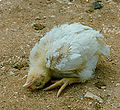 Same symptom in a broiler
 -
 PM lesions on proventriculus, gizzard, and duodenum


Postmortem lesions[edit]
Petechiae in the proventriculus and on the submucosae of the gizzard are typical; also, severe enteritis of the duodenum occurs. The lesions are scarce in hyperacute cases (first day of outbreak).
Diagnosis[edit]
Immunological tests[edit]
Enzyme-linked immunosorbent assay, polymerase chain reaction, and sequence technology tests have been developed.
Virus isolation[edit]
Samples[edit]
For routine isolation of NDV from chickens, turkeys, and other birds, samples are obtained by swabbing the trachea and the cloaca. Cotton swabs can be used. The virus can also be isolated from the lungs, brain, spleen, liver, and kidneys.
Handling[edit]
Prior to shipping, samples should be stored at 4 °C (refrigerator). Samples must be shipped in a padded envelope or box. Samples may be sent by regular mail, but overnight is recommended.[13]
Prevention[edit]
Any animals showing symptoms of Newcastle disease should be isolated immediately. New birds should also be vaccinated before being introduced to a flock. An inactivated viral vaccine is available, as well as various combination vaccines.[3][14][15] A thermotolerant vaccine is available for controlling Newcastle disease in underdeveloped countries.[16] Schiappacasse et al 2020 demonstrates successful, complete inactivation of the virus in a space using a nonthermal plasma generator.[17]
History of NDV in cancer research[edit]
Though the oncolytic effect of NDV was already documented in the 1950s, later advances in research into using viruses in cancer therapy came with the advent of reverse genetics technologies.[18] Later on it was Csatary LK and his colleagues to document anti-cancer effects in patients with brain gliomas.[19][20]
One of the main issues using NDV would be the host/patient immune response against the virus itself, which prior to the time of the reverse genetics technology, decreased the potential applicability of NDV as a cancer treatment.[18][21]
As of 2018[update] there had been several clinical studies into the use of NDV for cancer treatment, but the research quality was low and the outcomes inconclusive.[22]
References[edit]
- ^ "Virulent Newcastle Disease (vND)". United States Department of Agriculture. Retrieved 6 April 2019.
- ^ Nelson CB, Pomeroy, BS, Schrall, K, Park, WE, Lindeman, RJ (Jun 1952). "An outbreak of conjunctivitis due to Newcastle disease virus (NDV) occurring in poultry workers". American Journal of Public Health and the Nation's Health. 42 (6): 672–8. doi:10.2105/ajph.42.6.672. PMC 1526237. PMID 14924001.
- ^ a b FAO Manual on Vaccines
- ^ Kim SH, Samal SK (4 July 2016). "Newcastle Disease Virus as a Vaccine Vector for Development of Human and Veterinary Vaccines". Viruses. 8 (7): 183. doi:10.3390/v8070183. PMC 4974518. PMID 27384578.
- ^ Zimmer C (2021-04-05). "Researchers Are Hatching a Low-Cost Coronavirus Vaccine". The New York Times.
- ^ Macpherson LW (May 1956). "Some Observations On The Epizootiology Of NewCastle Disease". Canadian Journal of Comparative Medicine and Veterinary Science. 20 (5): 155–68. PMC 1614269. PMID 17648892.
- ^ "Newcastle disease: Newcastle disease outbreaks in Great Britain". DEFRA. Archived from the original on 2007-06-27.
- ^ "Newcastle Disease Virus (PDQ®)–Health Professional Version". National Cancer Institute. 22 Aug 2018. Retrieved 7 April 2021.
- ^ Reichard KW, Lorence RM, Cascino CJ, Peeples ME, Walter RJ, Fernando MB, Reyes HM, Greager JA (May 1992). "Newcastle disease virus selectively kills human tumor cells". The Journal of Surgical Research. 52 (5): 448–453. doi:10.1016/0022-4804(92)90310-v. PMID 1619912.
- ^ "California modifies virulent Newcastle disease quarantine boundaries". Feedstuffs. 27 February 2019. Retrieved 6 April 2019.
- ^ "USDA confirms virulent Newcastle disease in Arizona". Feedstuffs. 5 April 2019. Retrieved 6 April 2019.
- ^ "Virulent Newcastle Disease". California Department of Food and Agriculture. Retrieved 6 April 2019.
- ^ Newcastle Disease Virus (NDV) Archived 2017-11-01 at the Wayback Machine. avianbiotech.com
- ^ Newcastle Disease Vaccine, B1 Type, B1 Strain, Live Virus. drugs.com
- ^ Merck/Intervet Vaccine
- ^ Robyn Alders, Spradbrow P (2001). Controlling Newcastle disease in village chickens : a field manual. Canberra: ACIAR. ISBN 978-1-86320-307-4.
- ^ Berry G, Parsons A, Morgan M, Rickert J, Cho H (2022). "A review of methods to reduce the probability of the airborne spread of COVID-19 in ventilation systems and enclosed spaces". Environmental Research. 203. Elsevier: 111765. Bibcode:2022ER....203k1765B. doi:10.1016/j.envres.2021.111765. ISSN 0013-9351. PMC 8317458. PMID 34331921.
- ^ a b Mullen JT, Tanabe KK (2002). "Viral oncolysis". Oncologist. 7 (2): 106–19. doi:10.1634/theoncologist.7-2-106. PMID 11961194. S2CID 3853142.
- ^ Csatary LK, Moss RW, et al. (Jan–Feb 1999). "Beneficial treatment of patients with advanced cancer using a Newcastle disease virus vaccine (MTH-68/H)". Anticancer Research. 19 (1B): 635–8. PMID 10216468.
- ^ Csatary LK, Bakács T (5 May 1999). "Use of Newcastle disease virus vaccine (MTH-68/H) in a patient with high-grade glioblastoma". JAMA. 281 (17): 1588–9. doi:10.1001/jama.281.17.1588-a. PMID 10235150.
- ^ Kuruppu D, Tanabe, KK (May 2005). "Viral oncolysis by herpes simplex virus and other viruses". Cancer Biology & Therapy. 4 (5): 524–31. doi:10.4161/cbt.4.5.1820. PMID 15917655.
- ^ "Newcastle Disease Virus (PDQ®)–Health Professional Version". National Cancer Institute. 22 August 2018.
External links[edit]

- Current status of Newcastle disease worldwide at OIE. WAHID Interface - OIE World Animal Health Information Database
- Disease card
- Department of Environment, Food and Rural Affairs, UK
- Newcastle Disease, Iowa State University, Center for Food Security and Public Health
- Newcastle Disease in Poultry, Merck Veterinary Manual
- Species Profile—Virulent Newcastle Disease, National Invasive Species Information Center, United States National Agricultural Library. Lists general information and resources for Exotic Newcastle Disease.
| Authority control databases: National |
|---|
