


Ovipositor
 | This article needs additional citations for verification. (October 2008) |


The ovipositor is a tube-like organ used by some animals, especially insects, for the laying of eggs. In insects, an ovipositor consists of a maximum of three pairs of appendages. The details and morphology of the ovipositor vary, but typically its form is adapted to functions such as preparing a place for the egg, transmitting the egg, and then placing it properly. For most insects, the organ is used merely to attach the egg to some surface, but for many parasitic species (primarily in wasps and other Hymenoptera), it is a piercing organ as well.
Some ovipositors only retract partly when not in use, and the basal part that sticks out is known as the scape, or more specifically oviscape, the word scape deriving from the Latin word scāpus, meaning "stalk" or "shaft".
In insects[edit]

The process of oviposition in Dolichomitus imperator:
1. Tapping with her antennae, the wasp listens for the vibrations that indicate a host is present
2. With the longer ovipositor, the wasp drills a hole through the bark
3. The wasp inserts the ovipositor into the cavity which contains the host larva
4. Making corrections
5-6. Depositing the eggs
Grasshoppers use their ovipositors to force a burrow into the earth to receive the eggs. Cicadas pierce the wood of twigs with their ovipositors to insert the eggs. Sawflies slit the tissues of plants by means of the ovipositor and so do some species of long-horned grasshoppers. In the ichneumon wasp genus Megarhyssa, the females have a slender ovipositor (terebra) several inches long that is used to drill into the wood of tree trunks.[1] These species are parasitic in the larval stage on the larvae of horntail wasps, hence the egg must be deposited directly into the host's body as it is feeding. The ovipositors of Megarhyssa are among the longest egg-laying organs (relative to body size) known.[2]
The stingers of the Aculeata (wasps, hornets, bees, and ants) are ovipositors, highly modified and with associated venom glands. They are used to paralyze prey, or as defensive weapons. The penetrating sting plus venom allows the wasp to lay eggs with less risk of injury from the host. In some cases, the injection also introduces virus particles that suppress the host's immune system and prevent it from destroying the eggs.[3] However, in virtually all stinging Hymenoptera, the ovipositor is no longer used for egg-laying. An exception is the family Chrysididae, members of the Hymenoptera, in which species such as Chrysis ignita have reduced stinging apparatus and a functional ovipositor.
Fig wasp ovipositors have specialized serrated teeth to penetrate fruits, but gall wasps have either uniform teeth or no teeth on their ovipositors, meaning the morphology of the organ is related to the life history. [4]
Members of the Dipteran (fly) families Tephritidae and Pyrgotidae have well-developed ovipositors that are partly retracted when not in use, with the part that sticks out being the oviscape. Oestridae, another family within Diptera, often have short hairy ovipositors, the species Cuterebra fontinella has one of the shortest within the family.[5]
Ovipositors exist not only in winged insects, but also in Apterygota, where the ovipositor has an additional function in gathering the spermatophore during mating. Little is known about the egg-laying habits of these insects in the wild. [6]
In fish[edit]
Female bitterlings in the genus Rhodeus have an ovipositor in the form of a tubular extension of the genital orifice. During breeding season, they use it when depositing eggs in the mantle cavity of freshwater mussels, where their eggs develop in reasonable security. Seahorses have an ovipositor for introducing eggs into the brood pouch of the male, who carries them until it is time to release the fry into a suitable situation in the open water.
In amphibians[edit]
The marbled newt, or Triturus marmoratus, females participate in parental investment by ovipositing their eggs. They carefully wrap them in aquatic leaves as a form of protection, scattering them throughout a pond to avoid predation. Females are not able to breathe during the oviposition process; therefore, the benefit to wrapping the eggs outweigh the cost of holding their breath. [7]
Images[edit]
-
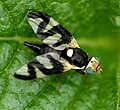 A female fly in the family Tephritidae, with the ovipositor retracted and only the scape showing.
 -
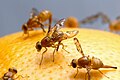 Ovipositing Mexican fruit flies showing the scapes of the extended ovipositors.
 -
 Female Megarhyssa laying eggs with her ovipositor.
 -
 Dolichomitus sp. laying eggs into a nest of Osmia sp..
 -
 Leucospis dorsigera laying eggs into a nest of Osmia sp..


References[edit]
- ^ Sezen, Uzay (22 July 2012). "Two ichneumon wasps competing to oviposit". Retrieved 24 July 2012.
- ^ Sezen, Uzay. "Giant ichneumon wasp ovipositing". Retrieved 15 February 2016.
- ^ "Evolutionary Genetics". www.zoology.ubc.ca.
- ^ Elias, Larissa; Kjellberg, Finn; Farache, Fernando Henriche Antoniolli; Almeida, Eduardo; Rasplus, Jean-Yves; Cruaud, Astrid; Peng, Yan-Quiong; Yang, Da-Rong; Pereira, Rodrigo Augusto Santinelo (July 2018). "Ovipositor morphology correlates with life history evolution in agaonid fig wasps" (PDF). Acta Oecologica. 90: 109–116. Bibcode:2018AcO....90..109E. doi:10.1016/j.actao.2017.10.007. S2CID 90329549.
- ^ Hadwen S (1915). "A description the egg and ovipositor of Cuterebra fontinella, Clark (Cottontail Bot.)". Journal of the Entomological Society of British Columbia. 5: 88–91.
- ^ Matushkina, Natalia A. (January 2011). "Ovipositor Internal Microsculpture in the Relic Silverfish Tricholepidion gertschi (Insecta: Zygentoma)" (PDF). Psyche: A Journal of Entomology. 2011: 1–8. doi:10.1155/2011/563852. Archived (PDF) from the original on 2022-10-09. Retrieved 22 August 2020.
- ^ Díaz-Paniagua, Carmen (1989). "Oviposition Behavior of Triturus marmoratus pygmaeus". Journal of Herpetology. 23 (2): 159–163. doi:10.2307/1564022. ISSN 0022-1511. JSTOR 1564022.
External links[edit]
 Media related to Ovipositor at Wikimedia Commons
