


Ploceidae
| Weavers | |
|---|---|
_male_nest_building.jpg)
| |
| A male village weaver (Ploceus cucullatus bohndorffi), building his nest | |
Scientific classification 
| |
| Domain: | Eukaryota |
| Kingdom: | Animalia |
| Phylum: | Chordata |
| Class: | Aves |
| Order: | Passeriformes |
| Superfamily: | Passeroidea |
| Family: | Ploceidae Sundevall, 1836 |
| Genera | |
|
See text. | |
Ploceidae is a family of small passerine birds, many of which are called weavers, weaverbirds, weaver finches, or bishops. These names come from the nests of intricately woven vegetation created by birds in this family. In most recent classifications, the Ploceidae are a clade that excludes some birds that have historically been placed in the family, such as some of the sparrows, but which includes the monotypic subfamily Amblyospizinae. The family is believed to have originated in the mid-Miocene.[1] All birds of the Ploceidae are native to the Old World, most in Africa south of the Sahara, though a few live in tropical areas of Asia. A few species have been introduced outside their native range.[2]
Taxonomy and systematics
[edit]The family Ploceidae was introduced (as Ploceïdes) by Swedish zoologist Carl Jakob Sundevall in 1836.[3][4] Phylogenetic studies have shown that the family is sister to a clade containing the families Viduidae and Estrildidae[5] Their common ancestor lived in the middle Miocene around 18 million years ago.[6]
A 2017 molecular phylogenetic study by Thilina de Silva and collaborators, as well as an expanded study by the same group published in 2019 have indicated that the genus Ploceus as currently defined is polyphyletic.[7][8] A cladogram based on these results is shown below.[8]
| Ploceidae |
| |||||||||||||||||||||||||||||||||||||||||||||||||||||||||||||||||||||||||||||||||
Genera
[edit]The family includes 15 genera with a total of 122 species.[9] For more detail, see list of Ploceidae species.
| Image | Genus | Species |
|---|---|---|

|
Bubalornis A. Smith, 1836 |
|

|
Dinemellia Reichenbach, 1863 |
|

|
Plocepasser A. Smith, 1836 |
|

|
Histurgops Reichenow, 1887 |
|
.jpg)
|
Pseudonigrita Reichenow, 1903 |
|
.jpg)
|
Philetairus A. Smith, 1837 |
|

|
Sporopipes Cabanis, 1847 |
|

|
Amblyospiza Sundevall, 1850 |
|
_male.jpg)
|
Ploceus Cuvier, 1816 |
|
.jpg)
|
Malimbus Vieillot, 1805 |
|

|
Quelea Reichenbach, 1850 |
|

|
Anaplectes Reichenbach, 1863 |
|
.jpg)
|
Foudia Reichenbach, 1850 |
|
| Brachycope Reichenow, 1900 |
| |

|
Euplectes Swainson, 1829 |
|
Description
[edit]The males of many species in this family are brightly coloured, usually in red or yellow and black. Some species show variation in colour only in the breeding season. These are seed-eating birds with rounded conical bills.
Distribution and habitat
[edit]The weaverbird colonies may be found close to bodies of water.
Behaviour and ecology
[edit]Weavers are named for their elaborately woven nests. The nests vary in size, shape, material used, and construction techniques from species to species. Materials used for building nests include fine leaf fibers, grass, and twigs. Many species weave very fine nests using thin strands of leaf fiber, though some, like the buffalo-weavers, form massive untidy stick nests in their colonies, which may have spherical woven nests within. The sociable weavers of Africa build apartment-house nests, in which 100 to 300 pairs have separate flask-shaped chambers entered by tubes at the bottom. The sparrow weavers live in family units that employ cooperative breeding.[10] Most species weave nests that have narrow entrances, facing downward.
Many weaver species are gregarious and breed colonially.[2] The birds build their nests together for protection, often several to a branch. Usually the male birds weave the nests and use them as a form of display to lure prospective females.
Relationship to humans
[edit]They sometimes cause crop damage, notably the red-billed quelea, reputed to be the world's most numerous bird.[11][12]
Gallery
[edit]-
 A nest in the early stages of construction
 -
 Weaverbirds at West Bengal
 -
 Adult Sporopipes at its spherical grass nest, placed in a shrub
 -
![Plocepasser nest in Namibia, for year-round occupation.[10]](//upload.wikimedia.org/wikipedia/commons/thumb/2/29/Nids_de_Plocepasser_mahali_%28Namibie%29_%283%29.jpg/315px-Nids_de_Plocepasser_mahali_%28Namibie%29_%283%29.jpg) Plocepasser nest in Namibia, for year-round occupation.[10]
Plocepasser nest in Namibia, for year-round occupation.[10] -
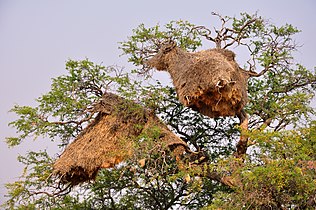 Communal Philetairus nests in central Namibia
 -
 Pseudonigrita nest in Kenya, with entrance below
 -
 Black-breasted weaver nest suspended from grass, India
 -
 A baya weaver on his unfinished nest, northern India
 -
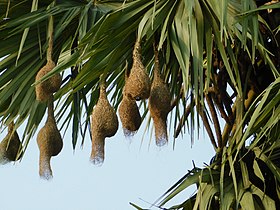 Nests of a baya weaver colony suspended from a palm tree, India
 -

-
 Red bishop constructing a nest in reeds, South Africa
 -
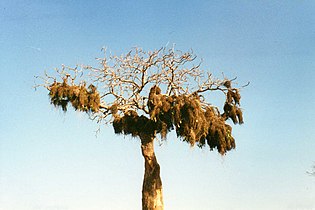 Nests of a colony of Sakalava weavers, Madagascar
 -
 Spherical village weaver nests suspended from a palm tree, West Africa
 -
 A southern masked weaver building his nest, Namibia
 -
 Hanging nest, Hargeysa, Somaliland, July 2019.


![Plocepasser nest in Namibia, for year-round occupation.[10]](/wiki/File:Nids_de_Plocepasser_mahali_(Namibie)_(3).jpg)


_(6041539514).jpg)
.jpg)
.jpg)
.jpg)


References
[edit]- ^ De Silva, Thilina N.; Peterson, A. Townsend; Bates, John M.; Fernando, Sumudu W.; Girard, Matthew G. (2017). "Phylogenetic relationships of weaverbirds (Aves: Ploceidae): A first robust phylogeny based on mitochondrial and nuclear markers". Molecular Phylogenetics and Evolution. 109: 21–32. Bibcode:2017MolPE.109...21D. doi:10.1016/j.ympev.2016.12.013. PMID 28012957. S2CID 205841906.
- ^ a b Craig, Adrian J.F.K. (2010). "Family Ploceidae (Weavers)". In del Hoyo, J.; Elliott, A.; Christie, D.A. (eds.). Handbook of the Birds of the World. Vol. 15: Weavers to New World Warblers. Barcelona, Spain: Lynx Edicions. pp. 73–197. ISBN 978-84-96553-68-2.
- ^ Bock, Walter J. (1994). "History and Nomenclature of Avian Family-Group Names". Bulletin of the American Museum of Natural History. No. 222. New York: American Museum of Natural History. pp. 157, 260. hdl:2246/830.
- ^ Sundevall, Carl Jakob (1836). "Ornithologiskt system". Kongliga Svenska Vetenskapsakademiens Handlingar. 23: 43–130 [74].
- ^ De Silva TN, Peterson AT, Perktas U (1 July 2019). "An extensive molecular phylogeny of weaverbirds (Aves: Ploceidae) unveils broad nonmonophyly of traditional genera and new relationships". The Auk. 136 (3). doi:10.1093/auk/ukz041.
- ^ Oliveros, C.H.; et al. (2019). "Earth history and the passerine superradiation". Proceedings of the National Academy of Sciences of the United States. 116 (16): 7916–7925. Bibcode:2019PNAS..116.7916O. doi:10.1073/pnas.1813206116. PMC 6475423. PMID 30936315.
- ^ De Silva, T.N.; Peterson, A.T.; Bates, J.M.; Fernando, S.W.; Girard, M.G. (2017). "Phylogenetic relationships of weaverbirds (Aves: Ploceidae): A first robust phylogeny based on mitochondrial and nuclear markers". Molecular Phylogenetics and Evolution. 109: 21–32. Bibcode:2017MolPE.109...21D. doi:10.1016/j.ympev.2016.12.013. PMID 28012957. S2CID 205841906.
- ^ a b De Silva, T.N.; Peterson, A.T.; Perktas, U. (2019). "An extensive molecular phylogeny of weaverbirds (Aves: Ploceidae) unveils broad nonmonophyly of traditional genera and new relationships". The Auk. 136 (ukz041). doi:10.1093/auk/ukz041.
- ^ Gill, Frank; Donsker, David; Rasmussen, Pamela, eds. (December 2023). "Old World sparrows, snowfinches, weavers". IOC World Bird List Version 14.1. International Ornithologists' Union. Retrieved 9 February 2024.
- ^ a b Lewis, Dale M. (3 April 2008). "Cooperative breeding in a population of White-browed Weavers Plocepasser mahali". Ibis. 124 (4): 511–522. doi:10.1111/j.1474-919X.1982.tb03795.x.
- ^ Fry, C.H. & Keith, S. (2004) The birds of Africa vol. VII. Christopher Helm, London
- ^ BirdLife International (2018). "Quelea quelea". IUCN Red List of Threatened Species. 2018: e.T22719128A132125738. doi:10.2305/IUCN.UK.2018-2.RLTS.T22719128A132125738.en. Retrieved 12 November 2021.
Further reading
[edit]
- De Silva, T.N.; Peterson, A.T.; Perktas, U. (2019). "An extensive molecular phylogeny of weaverbirds (Aves: Ploceidae) unveils broad nonmonophyly of traditional genera and new relationships". The Auk. 20 (3): 1–21. doi:10.1093/auk/ukz041.
