


Pontryagin class
In mathematics, the Pontryagin classes, named after Lev Pontryagin, are certain characteristic classes of real vector bundles. The Pontryagin classes lie in cohomology groups with degrees a multiple of four.
Definition[edit]
Given a real vector bundle over , its -th Pontryagin class is defined as



where:
- denotes the -th Chern class of the complexification of ,
- is the -cohomology group of with integer coefficients.





The rational Pontryagin class is defined to be the image of in , the -cohomology group of with rational coefficients.


Properties[edit]
The total Pontryagin class

is (modulo 2-torsion) multiplicative with respect to Whitney sum of vector bundles, i.e.,

for two vector bundles and over . In terms of the individual Pontryagin classes ,




and so on.
The vanishing of the Pontryagin classes and Stiefel–Whitney classes of a vector bundle does not guarantee that the vector bundle is trivial. For example, up to vector bundle isomorphism, there is a unique nontrivial rank 10 vector bundle over the 9-sphere. (The clutching function for arises from the homotopy group .) The Pontryagin classes and Stiefel-Whitney classes all vanish: the Pontryagin classes don't exist in degree 9, and the Stiefel–Whitney class of vanishes by the Wu formula . Moreover, this vector bundle is stably nontrivial, i.e. the Whitney sum of with any trivial bundle remains nontrivial. (Hatcher 2009, p. 76)




Given a -dimensional vector bundle we have

where denotes the Euler class of , and denotes the cup product of cohomology classes.


Pontryagin classes and curvature[edit]
As was shown by Shiing-Shen Chern and André Weil around 1948, the rational Pontryagin classes

can be presented as differential forms which depend polynomially on the curvature form of a vector bundle. This Chern–Weil theory revealed a major connection between algebraic topology and global differential geometry.
For a vector bundle over a -dimensional differentiable manifold equipped with a connection, the total Pontryagin class is expressed as

![{\displaystyle p=\left[1-{\frac {{\rm {Tr}}(\Omega ^{2})}{8\pi ^{2}}}+{\frac {{\rm {Tr}}(\Omega ^{2})^{2}-2{\rm {Tr}}(\Omega ^{4})}{128\pi ^{4}}}-{\frac {{\rm {Tr}}(\Omega ^{2})^{3}-6{\rm {Tr}}(\Omega ^{2}){\rm {Tr}}(\Omega ^{4})+8{\rm {Tr}}(\Omega ^{6})}{3072\pi ^{6}}}+\cdots \right]\in H_{dR}^{*}(M),}](https://wikimedia.org/api/rest_v1/media/math/render/svg/398b2d853e577a27bd8eefa3fc8264df98c8a61a)
where denotes the curvature form, and denotes the de Rham cohomology groups.[1]


Pontryagin classes of a manifold[edit]
The Pontryagin classes of a smooth manifold are defined to be the Pontryagin classes of its tangent bundle.
Novikov proved in 1966 that if two compact, oriented, smooth manifolds are homeomorphic then their rational Pontryagin classes in are the same.


If the dimension is at least five, there are at most finitely many different smooth manifolds with given homotopy type and Pontryagin classes.
Pontryagin classes from Chern classes[edit]
The Pontryagin classes of a complex vector bundle is completely determined by its Chern classes. This follows from the fact that , the Whitney sum formula, and properties of Chern classes of its complex conjugate bundle. That is, and . Then, this given the relation





for example, we can apply this formula to find the Pontryagin classes of a complex vector bundle on a curve and a surface. For a curve, we have

so all of the Pontryagin classes of complex vector bundles are trivial. On a surface, we have

showing . On line bundles this simplifies further since by dimension reasons.


Pontryagin classes on a Quartic K3 Surface[edit]
Recall that a quartic polynomial whose vanishing locus in is a smooth subvariety is a K3 surface. If we use the normal sequence


we can find
![{\displaystyle {\begin{aligned}c({\mathcal {T}}_{X})&={\frac {c({\mathcal {T}}_{\mathbb {CP} ^{3}}|_{X})}{c({\mathcal {O}}(4))}}\\&={\frac {(1+[H])^{4}}{(1+4[H])}}\\&=(1+4[H]+6[H]^{2})\cdot (1-4[H]+16[H]^{2})\\&=1+6[H]^{2}\end{aligned}}}](https://wikimedia.org/api/rest_v1/media/math/render/svg/29142a0afed50bb796bc43e205bffd1c70672393)
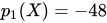
showing and . Since corresponds to four points, due to Bezout's lemma, we have the second chern number as . Since in this case, we have

![{\displaystyle c_{2}(X)=6[H]^{2}}](https://wikimedia.org/api/rest_v1/media/math/render/svg/8a7521387bcea6b649cee551172417c4298ee2e6)
![{\displaystyle [H]^{2}}](https://wikimedia.org/api/rest_v1/media/math/render/svg/46055fd0a533d44b58327dbeb0087ecbdd27913e)


. This number can be used to compute the third stable homotopy group of spheres.[3]
Pontryagin numbers[edit]
Pontryagin numbers are certain topological invariants of a smooth manifold. Each Pontryagin number of a manifold vanishes if the dimension of is not divisible by 4. It is defined in terms of the Pontryagin classes of the manifold as follows:
Given a smooth -dimensional manifold and a collection of natural numbers

- such that ,


the Pontryagin number is defined by

![{\displaystyle P_{k_{1},k_{2},\dots ,k_{m}}=p_{k_{1}}\smile p_{k_{2}}\smile \cdots \smile p_{k_{m}}([M])}](https://wikimedia.org/api/rest_v1/media/math/render/svg/176640f7fd7c32d30f974a94992542b49fcb4b7c)
where denotes the -th Pontryagin class and the fundamental class of .
![{\displaystyle [M]}](https://wikimedia.org/api/rest_v1/media/math/render/svg/e5ca74e595b2281c0aef1897ecafa282d1f182e2)
Properties[edit]
- Pontryagin numbers are oriented cobordism invariant; and together with Stiefel-Whitney numbers they determine an oriented manifold's oriented cobordism class.
- Pontryagin numbers of closed Riemannian manifolds (as well as Pontryagin classes) can be calculated as integrals of certain polynomials from the curvature tensor of a Riemannian manifold.
- Invariants such as signature and -genus can be expressed through Pontryagin numbers. For the theorem describing the linear combination of Pontryagin numbers giving the signature see Hirzebruch signature theorem.

Generalizations[edit]
There is also a quaternionic Pontryagin class, for vector bundles with quaternion structure.
See also[edit]
References[edit]
- ^ "De Rham Cohomology - an overview | ScienceDirect Topics". www.sciencedirect.com. Retrieved 2022-02-02.
- ^ Mclean, Mark. "Pontryagin Classes" (PDF). Archived (PDF) from the original on 2016-11-08.
- ^ "A Survey of Computations of Homotopy Groups of Spheres and Cobordisms" (PDF). p. 16. Archived (PDF) from the original on 2016-01-22.
- Milnor John W.; Stasheff, James D. (1974). Characteristic classes. Annals of Mathematics Studies. Princeton, New Jersey; Tokyo: Princeton University Press / University of Tokyo Press. ISBN 0-691-08122-0.
- Hatcher, Allen (2009). Vector Bundles & K-Theory (2.1 ed.).
External links[edit]
- "Pontryagin class". Encyclopedia of Mathematics. EMS Press. 2001 [1994].