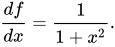
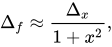
The uncertainty u can be expressed in a number of ways.
It may be defined by the absolute errorΔx. Uncertainties can also be defined by the relative error(Δx)/x, which is usually written as a percentage.
Most commonly, the uncertainty on a quantity is quantified in terms of the standard deviation, σ, which is the positive square root of the variance. The value of a quantity and its error are then expressed as an interval x ± u.
However, the most general way of characterizing uncertainty is by specifying its probability distribution.
If the probability distribution of the variable is known or can be assumed, in theory it is possible to get any of its statistics. In particular, it is possible to derive confidence limits to describe the region within which the true value of the variable may be found. For example, the 68% confidence limits for a one-dimensional variable belonging to a normal distribution are approximately ± one standard deviation σ from the central value x, which means that the region x ± σ will cover the true value in roughly 68% of cases.
If the uncertainties are correlated then covariance must be taken into account. Correlation can arise from two different sources. First, the measurement errors may be correlated. Second, when the underlying values are correlated across a population, the uncertainties in the group averages will be correlated.[1]
In a general context where a nonlinear function modifies the uncertain parameters (correlated or not), the standard tools to propagate uncertainty, and infer resulting quantity probability distribution/statistics, are sampling techniques from the Monte Carlo method family.[2] For very expansive data or complex functions, the calculation of the error propagation may be very expansive so that a surrogate model[3] or a parallel computing strategy[4][5][6] may be necessary.
In some particular cases, the uncertainty propagation calculation can be done through simplistic algebraic procedures. Some of these scenarios are described below.
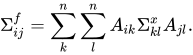
Then, the variance–covariance matrix of f is given by
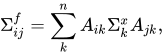
In component notation, the equation
reads
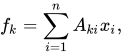
This is the most general expression for the propagation of error from one set of variables onto another. When the errors on x are uncorrelated, the general expression simplifies to
where is the variance of k-th element of the x vector.
Note that even though the errors on x may be uncorrelated, the errors on f are in general correlated; in other words, even if is a diagonal matrix, is in general a full matrix.
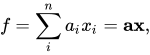
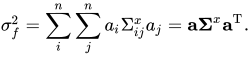
The general expressions for a scalar-valued function f are a little simpler (here a is a row vector):
Each covariance term can be expressed in terms of the correlation coefficient by , so that an alternative expression for the variance of f is
In the case that the variables in x are uncorrelated, this simplifies further to
In the simple case of identical coefficients and variances, we find
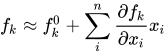
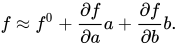
When f is a set of non-linear combination of the variables x, an interval propagation could be performed in order to compute intervals which contain all consistent values for the variables. In a probabilistic approach, the function f must usually be linearised by approximation to a first-order Taylor series expansion, though in some cases, exact formulae can be derived that do not depend on the expansion as is the case for the exact variance of products.[7] The Taylor expansion would be:
where denotes the partial derivative of fk with respect to the i-th variable, evaluated at the mean value of all components of vector x. Or in matrix notation,
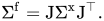
where J is the Jacobian matrix. Since f0 is a constant it does not contribute to the error on f. Therefore, the propagation of error follows the linear case, above, but replacing the linear coefficients, Aki and Akj by the partial derivatives, and . In matrix notation,[8]
That is, the Jacobian of the function is used to transform the rows and columns of the variance-covariance matrix of the argument.
Note this is equivalent to the matrix expression for the linear case with .
Neglecting correlations or assuming independent variables yields a common formula among engineers and experimental scientists to calculate error propagation, the variance formula:[9]
where represents the standard deviation of the function , represents the standard deviation of , represents the standard deviation of , and so forth.
It is important to note that this formula is based on the linear characteristics of the gradient of and therefore it is a good estimation for the standard deviation of as long as are small enough. Specifically, the linear approximation of has to be close to inside a neighbourhood of radius .[10]
Error estimates for non-linear functions are biased on account of using a truncated series expansion. The extent of this bias depends on the nature of the function. For example, the bias on the error calculated for log(1+x) increases as x increases, since the expansion to x is a good approximation only when x is near zero.
For highly non-linear functions, there exist five categories of probabilistic approaches for uncertainty propagation;[12] see Uncertainty quantification for details.
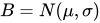
In the special case of the inverse or reciprocal , where follows a standard normal distribution, the resulting distribution is a reciprocal standard normal distribution, and there is no definable variance.[13]
However, in the slightly more general case of a shifted reciprocal function for following a general normal distribution, then mean and variance statistics do exist in a principal value sense, if the difference between the pole and the mean is real-valued.[14]
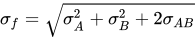
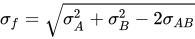
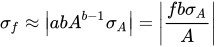
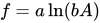
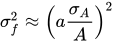
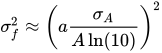
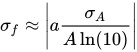
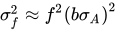
This table shows the variances and standard deviations of simple functions of the real variables with standard deviations covariance and correlation The real-valued coefficients and are assumed exactly known (deterministic), i.e.,
In the right-hand columns of the table, and are expectation values, and is the value of the function calculated at those values.
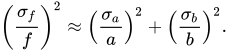
For uncorrelated variables (, ) expressions for more complicated functions can be derived by combining simpler functions. For example, repeated multiplication, assuming no correlation, gives
For the case we also have Goodman's expression[7] for the exact variance: for the uncorrelated case it is
If A and B are uncorrelated, their difference A − B will have more variance than either of them. An increasing positive correlation () will decrease the variance of the difference, converging to zero variance for perfectly correlated variables with the same variance. On the other hand, a negative correlation () will further increase the variance of the difference, compared to the uncorrelated case.
For example, the self-subtraction f = A − A has zero variance only if the variate is perfectly autocorrelated (). If A is uncorrelated, then the output variance is twice the input variance, And if A is perfectly anticorrelated, then the input variance is quadrupled in the output, (notice for f = aA − aA in the table above).
Given the measured variables with uncertainties, I ± σI and V ± σV, and neglecting their possible correlation, the uncertainty in the computed quantity, σR, is:
^Lin, Y.; Wang, F.; Liu, B. (2018). "Random number generators for large-scale parallel Monte Carlo simulations on FPGA". Journal of Computational Physics. 360: 93–103. Bibcode:2018JCoPh.360...93L. doi:10.1016/j.jcp.2018.01.029.
^Clifford, A. A. (1973). Multivariate error analysis: a handbook of error propagation and calculation in many-parameter systems. John Wiley & Sons. ISBN978-0470160558.[page needed]
^Lee, S. H.; Chen, W. (2009). "A comparative study of uncertainty propagation methods for black-box-type problems". Structural and Multidisciplinary Optimization. 37 (3): 239–253. doi:10.1007/s00158-008-0234-7. S2CID119988015.
^Johnson, Norman L.; Kotz, Samuel; Balakrishnan, Narayanaswamy (1994). Continuous Univariate Distributions, Volume 1. Wiley. p. 171. ISBN0-471-58495-9.
^Lecomte, Christophe (May 2013). "Exact statistics of systems with uncertainties: an analytical theory of rank-one stochastic dynamic systems". Journal of Sound and Vibration. 332 (11): 2750–2776. doi:10.1016/j.jsv.2012.12.009.
Bevington, Philip R.; Robinson, D. Keith (2002), Data Reduction and Error Analysis for the Physical Sciences (3rd ed.), McGraw-Hill, ISBN978-0-07-119926-1









![{\displaystyle {\boldsymbol {\Sigma }}^{x}=E[(\mathbf {x} -{\boldsymbol {\mu }})\otimes (\mathbf {x} -{\boldsymbol {\mu }})]={\begin{pmatrix}\sigma _{1}^{2}&\sigma _{12}&\sigma _{13}&\cdots \\\sigma _{21}&\sigma _{2}^{2}&\sigma _{23}&\cdots \\\sigma _{31}&\sigma _{32}&\sigma _{3}^{2}&\cdots \\\vdots &\vdots &\vdots &\ddots \end{pmatrix}}={\begin{pmatrix}{\Sigma }_{11}^{x}&{\Sigma }_{12}^{x}&{\Sigma }_{13}^{x}&\cdots \\{\Sigma }_{21}^{x}&{\Sigma }_{22}^{x}&{\Sigma }_{23}^{x}&\cdots \\{\Sigma }_{31}^{x}&{\Sigma }_{32}^{x}&{\Sigma }_{33}^{x}&\cdots \\\vdots &\vdots &\vdots &\ddots \end{pmatrix}}.}](https://wikimedia.org/api/rest_v1/media/math/render/svg/143aa284a44e10481120beb884f3730d0f2dd8fe)


![{\displaystyle {\boldsymbol {\Sigma }}^{f}=E[(\mathbf {f} -E[\mathbf {f} ])\otimes (\mathbf {f} -E[\mathbf {f} ])]=E[\mathbf {A} (\mathbf {x} -{\boldsymbol {\mu }})\otimes \mathbf {A} (\mathbf {x} -{\boldsymbol {\mu }})]=\mathbf {A} E[(\mathbf {x} -{\boldsymbol {\mu }})\otimes (\mathbf {x} -{\boldsymbol {\mu }})]\mathbf {A} ^{\mathrm {T} }=\mathbf {A} {\boldsymbol {\Sigma }}^{x}\mathbf {A} ^{\mathrm {T} }.}](https://wikimedia.org/api/rest_v1/media/math/render/svg/158670f5881c2ed8c7b831e1b3ad61ff56046fe9)












































![{\displaystyle \sigma _{f}^{2}\approx f^{2}\left[\left({\frac {\sigma _{A}}{A}}\right)^{2}+\left({\frac {\sigma _{B}}{B}}\right)^{2}+2{\frac {\sigma _{AB}}{AB}}\right]}](https://wikimedia.org/api/rest_v1/media/math/render/svg/9499339791864087918a8411cfc3d6d3d64adb4d)


![{\displaystyle \sigma _{f}^{2}\approx f^{2}\left[\left({\frac {\sigma _{A}}{A}}\right)^{2}+\left({\frac {\sigma _{B}}{B}}\right)^{2}-2{\frac {\sigma _{AB}}{AB}}\right]}](https://wikimedia.org/api/rest_v1/media/math/render/svg/1443509fb7b51ea477c6c24a17910bde4e81863a)













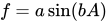
![{\displaystyle \sigma _{f}^{2}\approx \left[ab\cos(bA)\sigma _{A}\right]^{2}}](https://wikimedia.org/api/rest_v1/media/math/render/svg/02967f1c0ff2eb7edac9b2fad3bb020fb7fad0cf)

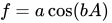
![{\displaystyle \sigma _{f}^{2}\approx \left[ab\sin(bA)\sigma _{A}\right]^{2}}](https://wikimedia.org/api/rest_v1/media/math/render/svg/4f4d187dd08f03fd8b03cf3606cc9f166e5656aa)

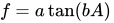
![{\displaystyle \sigma _{f}^{2}\approx \left[ab\sec ^{2}(bA)\sigma _{A}\right]^{2}}](https://wikimedia.org/api/rest_v1/media/math/render/svg/4308e87b0ada5699f04d64d6088e12e18fc7511f)


![{\displaystyle \sigma _{f}^{2}\approx f^{2}\left[\left({\frac {B}{A}}\sigma _{A}\right)^{2}+\left(\ln(A)\sigma _{B}\right)^{2}+2{\frac {B\ln(A)}{A}}\sigma _{AB}\right]}](https://wikimedia.org/api/rest_v1/media/math/render/svg/977fba6a8423710573203b5286497b3ceffeb60e)