


Red-legged honeycreeper
| Red-legged honeycreeper | |
|---|---|
_male.jpg)
| |
| Adult male, Panama | |
.jpg)
| |
| Female | |
Scientific classification 
| |
| Domain: | Eukaryota |
| Kingdom: | Animalia |
| Phylum: | Chordata |
| Class: | Aves |
| Order: | Passeriformes |
| Family: | Thraupidae |
| Genus: | Cyanerpes |
| Species: | C. cyaneus
|
| Binomial name | |
| Cyanerpes cyaneus (Linnaeus, 1766)
| |

| |
| Synonyms | |
|
Certhia cyanea Linnaeus, 1766 | |
The red-legged honeycreeper (Cyanerpes cyaneus) is a small songbird species in the tanager family (Thraupidae). It is found in the tropical New World from southern Mexico south to Peru, Bolivia and central Brazil, Trinidad and Tobago, and on Cuba, where possibly introduced. It is also rarely found in southern Texas.[2]
Taxonomy
[edit]The red-legged honeycreeper was formally described by the Swedish naturalist Carl Linnaeus in 1766 in the twelfth edition of his Systema Naturae under the binomial name Certhia cyanea.[3][4] Linnaeus based his description on "The Black and Blue Creeper" that had been described and illustrated in 1760 by the English naturalist George Edwards from a specimen collected in Suriname.[5] The red-legged honeycreeper is now placed in the genus Cyanerpes that was introduced in 1899 by the American ornithologist Harry C. Oberholser.[6][7] The specific epithet cyaneus is a Latin word meaning "dark-blue".[8]
Eleven subspecies are recognised:[7]
- C. c. carneipes (Sclater, PL, 1860) – east Mexico to Panama
- C. c. pacificus Chapman, 1915 – west Colombia and w Ecuador
- C. c. gigas Thayer & Bangs, 1905 – Gorgona Island (off west Colombia)
- C. c. gemmeus Wetmore, 1941 – extreme north Colombia
- C. c. eximius (Cabanis, 1851) – north, north-central Colombia to north Venezuela
- C. c. tobagensis Hellmayr & Seilern, 1914 – Tobago
- C. c. cyaneus (Linnaeus, 1766) – Trinidad, east Venezuela, the Guianas and north Brazil
- C. c. dispar Zimmer, JT, 1942 – southeast Colombia and southwest Venezuela to northeast Peru
- C. c. violaceus Zimmer, JT, 1942 – southeast Peru and west Brazil to central Bolivia
- C. c. brevipes (Cabanis, 1851) – central Brazil
- C. c. holti Parkes, 1977 – east Brazil
Description
[edit]The red-legged honeycreeper is on average 12.2 cm (4.8 in) long, weighs 14 g (0.49 oz) and has a medium-long black, slightly decurved, bill. The male is violet-blue with black wings, tail and back, and bright red legs. The crown of its head is turquoise, and the underwing, visible only in flight, is lemon yellow. After the breeding season, the male moults into an eclipse plumage, mainly greenish with black wings.
Females and immatures are mainly green, with paler, faintly streaked underparts. The legs are red-brown in the female, and brown in young birds.
The call of red-legged honeycreeper is a thin, high-pitched tsip.
Several subspecies are known. Differences are generally slight, with the Tobago race C. c. tobagensis being slightly larger than the mainland forms for example.
The purplish honeycreeper (Chlorophanes purpurascens), a bird from Venezuela known only from the type specimen, is considered to be an intergeneric hybrid between the green honeycreeper and either the red-legged honeycreeper or the blue dacnis.[9]
Distribution and habitat
[edit]This is a species of forest edge, open woodland, and cocoa and citrus plantations. The red-legged honeycreeper is often found in small groups. It feeds on insects and some seeds,[10] fruit[11] and nectar.[12] It responds readily to the (easily imitated) call of the ferruginous pygmy owl (Glaucidium brasilianum).
Behaviour and ecology
[edit]Breeding
[edit]In Costa Rica red-legged honeycreepers generally breed between April and June. The nest is built entirely by the female and is placed in a shrub or tree several meters above the ground. The cup-shaped nest has thin side walls and is formed of stiff fibres. It is attached to the supporting twigs with cobwebs. The clutch consists of two eggs that are laid in early morning on consecutive days. They are 13.4 mm × 19.1 mm (0.53 in × 0.75 in) in size and have a white background with brown speckles forming a ring around the larger end. The female incubates the eggs for 12 or 13 days. When they first hatch the nestlings have their eyes closed and are covered with tuffs of grey down. They are brooded by the female but fed by both parents. They fledge after around 14 days.[13][14]
A specimen studied in the Parque Nacional de La Macarena of Colombia was found to be free of blood parasites.[15]
Common and widespread, the red-legged honeycreeper is not considered a threatened species by the IUCN.[1]
Gallery
[edit]-
 Female (foreground) and male
 -
 In Chocó Department, Colombia
 -
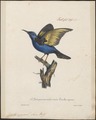 Illustration



References
[edit]- ^ a b BirdLife International. (2021). "Cyanerpes cyaneus". IUCN Red List of Threatened Species. 2021: e.T22723012A167828935. doi:10.2305/IUCN.UK.2021-3.RLTS.T22723012A167828935.en. Retrieved 12 November 2021.
- ^ Red-legged Honeycreeper, Red-legged Honeycreeper. "Red-legged Honeycreeper". Texas Birds Records Committee. Retrieved 27 November 2014.
- ^ Linnaeus, Carl (1766). Systema naturae : per regna tria natura, secundum classes, ordines, genera, species, cum characteribus, differentiis, synonymis, locis (in Latin). Vol. 1, Part 1 (12th ed.). Holmiae (Stockholm): Laurentii Salvii. p. 188.
- ^ Paynter, Raymond A. Jr, ed. (1970). Check-List of Birds of the World. Vol. 13. Cambridge, Massachusetts: Museum of Comparative Zoology. p. 396.
- ^ Edwards, George (1758–1764). Gleanings of Natural History, exhibiting figures of quadrupeds, birds, insects, plants &c... (in English and French). Vol. Part 2. London: Printed for the author, at the College of Physicians. pp. 114–115 Plate 264.
- ^ Oberholser, Harry C. (1899). "A synopsis of the blue honey-creepers of tropical America". Auk. 16 (1): 31–35 [32]. doi:10.2307/4069264. JSTOR 4069264.
- ^ a b Gill, Frank; Donsker, David; Rasmussen, Pamela, eds. (July 2020). "Tanagers and allies". IOC World Bird List Version 10.2. International Ornithologists' Union. Retrieved 26 November 2020.
- ^ Jobling, James A. (2010). The Helm Dictionary of Scientific Bird Names. London: Christopher Helm. p. 126. ISBN 978-1-4081-2501-4.
- ^ Storer, Robert W. (1957). "The hybrid origin of Chlorophanes purpurascens" (PDF). The Auk. 74 (4): 507. doi:10.2307/4081756. JSTOR 4081756.
- ^ "Cyanerpes cyaneus (Red-legged Honeycreeper)" (PDF). The Online Guide to the Animals of Trinidad and Tobago. UWI.
- ^ e.g. of Trophis racemosa (Moraceae): Foster, Mercedes S. (2007). "The potential of fruit trees to enhance converted habitats for migrating birds in southern Mexico". Bird Conservation International. 17: 45–61. doi:10.1017/S0959270906000554.
- ^ e.g. of Dimorphandra sp.: O'Shea, B.J.; Milensky, Christopher M.; Claramunt, Santiago; Schmidt, Brian K.; Gebhard, Christina A.; Schmitt, C. Gregory; Erskine, Kristine T. (2007). "New records for Guyana, with description of the voice of Roraiman Nightjar Caprimulgus whitelyi" (PDF). Bulletin of the British Ornithologists' Club. 127 (2): 118–128.
- ^ Skutch, Alexander F. (1954). "Blue honeycreeper" (PDF). Life Histories of Central American Birds. Pacific Coast Avifauna, Number 31. Berkeley, California: Cooper Ornithological Society. pp. 387–403.
- ^ Skutch, Alexander F. (1962). "Life histories of honeycreepers" (PDF). The Condor. 64 (2): 92–116 [106–111]. doi:10.2307/1365479. JSTOR 1365479.
- ^ Basto, Natalia; Rodríguez, Oscar A.; Marinkelle, Cornelis J.; Gutierrez, Rafael; Matta, Nubia Estela (2006). "Haematozoa in birds from la Macarena National Natural Park (Colombia)" (PDF). Caldasia. 28 (2): 371–377.
External links
[edit]

- "Red-legged honeycreeper media". Internet Bird Collection.
- Red-legged honeycreeper Stamps[usurped] from British Honduras (now Belize), Costa Rica, Nicaragua, Paraguay & Suriname at bird-stamps.org[usurped]
- Red-legged honeycreeper photo gallery at VIREO (Drexel University)
- Trip Report from birdtours.co.uk featuring a Red-legged honeycreeper photo
- Red-legged honeycreeper species account at Neotropical Birds (Cornell Lab of Ornithology)
- Interactive range map of Cyanerpes cyaneus at IUCN Red List maps
- Audio recordings of Red-legged honeycreeper on Xeno-canto.