


Reichsadler


The Reichsadler (German pronunciation: [ˈra͜içs|aːdlɐ]; "Imperial Eagle") is the heraldic eagle, derived from the Roman eagle standard, used by the Holy Roman Emperors and in modern coats of arms of Germany, including those of the Second German Empire (1871–1918), the Weimar Republic (1919–1933) and Nazi Germany (1933–1945).
The same design has remained in use by the Federal Republic of Germany since 1950, albeit under the name Bundesadler ("Federal Eagle").
History[edit]
Holy Roman Empire[edit]
The Reichsadler, i. e. the German Imperial Eagle, originated from a proto-heraldic emblem that was believed to have been used by Charlemagne, the first Frankish ruler whom the Pope crowned as Holy Roman Emperor in AD 800, and derived ultimately from the Aquila, i. e. eagle standard, of the ancient Roman army.
An eagle statue was erected on the roof of the Carolingian palace, and an eagle was placed on the orb of Emperor Otto III. Emperor Frederick Barbarossa popularised use of the eagle as the Imperial emblem by using it in all his banners, coats of arms, coins, and insignia.[1]
The Ottonian and Salian Emperors had themselves depicted with the Roman "eagle sceptre", and Emperor Frederick II depicted the Imperial Eagle on his coins. Before the mid-13th century, however, the Imperial Eagle was an Imperial symbol in its own right, and not used yet as a heraldic charge in a coat of arms.
An early depiction of a double-headed Imperial Eagle in a heraldic shield, attributed to Frederick II of Hohenstaufen, is found in the Chronica Majora by Matthew Paris (circa 1250). Segar's Roll (circa 1280) likewise depicts the double-headed Imperial Eagle as the coat of arms of the King of Germany.
The Imperial Eagle also is depicted in the seals of free Imperial cities, including that of Kaiserswerth in the 13th century, Lübeck in the 14th century, Besançon[year needed], Cheb[year needed], and others.
Use of the Imperial Eagle in the Imperial coat of arms of a reigning emperor dates to after the interregnum. Sigismund of Luxembourg used a black double-headed Imperial Eagle after he was crowned as Holy Roman Emperor in 1433; thereafter the single-headed Imperial Eagle represented the title of King of the Romans and the double-headed one the title of Emperor.[1] During the following century, Albert II of Germany was the final King-Elect of Germany who did not progress to coronation as Emperor. After the German Reformation, beginning with Ferdinand I (1558), the Holy Roman Emperors ceased to be crowned by the Pope.
The Teutonic Order under Hermann von Salza had the privilege of displaying the Imperial Eagle in its coat of arms, which privilege Emperor Frederick II granted it.[citation needed][dubious ] The black Imperial Eagle was later adopted when the Teutonic State was transformed into the Duchy of Prussia in 1525,[clarification needed] and a modified version was used in the arms of Royal Prussia (1466–1772).
Modern use[edit]
In 1804, Holy Roman Emperor Francis II established the Austrian Empire from the lands of the Habsburg monarchy, and adopted the double-headed eagle, aggrandized by an inescutcheon emblem of the House of Habsburg-Lorraine and the Order of the Golden Fleece, as its coat of arms; the Holy Roman Empire was subsequently dissolved in 1806. Since 1919 the coat of arms of Austria has depicted a single-headed eagle. Although not a national symbol in the modern sense, the Reichsadler evoked sentiments of loyalty to the empire.[2]
Following the revolutions of 1848 in the German states, the Reichsadler was restored as a symbol of national unity: it became the coat of arms of the short-lived German Empire and subsequently the German Confederation from its restoration in 1850 until its dissolution in 1866. It was once again restored in 1871 when a single-headed eagle with a Prussian inescutcheon became the insignia of the German Empire; the single head was used to represent the so-called Kleindeutschland, i.e. it excluded Austria. After World War I the Weimar Republic under President Friedrich Ebert assumed a plain version of the Reichsadler, which remained in use until 1935.
During Nazi rule, a stylised eagle combined with the Nazi swastika was made the national emblem (Hoheitszeichen) by order of Adolf Hitler in 1935. Despite its medieval origin, the term "Reichsadler" in common English understanding is mostly associated with this specific Nazi-era version. The Nazi Party had used a very similar symbol for itself, called the Parteiadler ("Party's eagle"). These two insignia can be distinguished as the Reichsadler looks to its right shoulder whereas the Parteiadler looks to its left shoulder.
After World War II the Federal Republic of Germany re-implemented the eagle used by the Weimar Republic by enactment of President Theodor Heuss in 1950.
Gallery[edit]
Holy Roman Empire[edit]
-
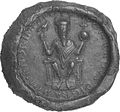 Seal of Conrad II (1029), with a depiction of the eagle-sceptre.
 -
 Imperial eagle on a coin of Frederick II (r. 1197–1250)
 -
 Arms of Otto IV as shown in Chronica Maiora (ca. 1250), early depiction of a double-headed Reichsadler
 -
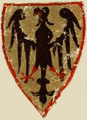 Imperial coat of arms attributed to Henry VI (r. 1191–1197) from Codex Manesse (c. 1304).
 -
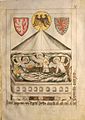 Tomb of Henry VII (d. 1313), with the emperor's coats of arms and the imperial eagle (Codex Balduini Trevirorum, c. 1340).
 -
 Imperial eagle in a seal used by Charles IV in 1349.
 -
 Double-headed imperial eagle in the seal used by Sigismund of Luxembourg in 1433
 -
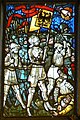 The Reichssturmfahne in a stained glass window in Bern Minster, ca. 1450.
 -
 Imperial coat of arms of Frederick III (r. 1452–1493) in the Wernigerode Armorial (ca. 1490)
 -
 Quaternion Eagle c. 1510, the eagle displaying the imperial quaternions on its remiges.
 -
 Imperial arms by Virgil Solis (ca. 1540)
 -
 Depiction of the Reichssturmfahne in a 1545 woodcut
 -

-
 The imperial eagle depicted with one, two and three heads (after Conrad Grünenberg 1483, copy of 1602/4)
 -
 Imperial arms of Mathias (r. 1612–1619) by Hans Ulrich Fisch (1627)


Modern history[edit]
-
 Coat of arms of the short-lived German Empire (1848–49); the German Confederation used a similar eagle.
 -
 Coat of arms of the Austrian Empire (1804–1867); also used as the lesser arms of Austria-Hungary (1867–1915).
 -
 Reichsadler (official design 1888–1918) of the (Second) German Empire
 -
 Reichsadler (1919–1928) of the Weimar Republic
 -
 Parteiadler of the Nazi Party (1933–1945), with head looking to its left
 -
 Parteiadler of the Nazi Party (1933–1945), with head looking to its left, variant
 -
 Reichsadler (1935–1945) of Nazi Germany, with head looking to its right
 -

-
 Reichsadler (1928–1935) of the Weimar Republic and Bundesadler (1950–present) of the Federal Republic of Germany
 -
 "Bundesadler" of the Republic of Austria since 1945
 -
 The previous design, without the broken chains symbolizing the end of fascism, was used 1919–1934
.svg)
.svg)

.svg)
.svg)
_(andere).svg)
.svg)
.svg)


See also[edit]
- Armorial of the Holy Roman Empire
- Quaternion Eagle
- Imperial Eagle beaker
- Aquila (Roman)
- Byzantine heraldry
- Coat of arms of Austria
- Coat of arms of Brandenburg
- Coat of arms of Germany
- Coat of arms of Prussia
- Coat of arms of Russia
- Double-headed eagle
- Coat of arms of Bogotá
References[edit]
- ^ a b Brian A. Pavlac; Elizabeth S. Lott (2019). The Holy Roman Empire: A Historical Encyclopedia [2 volumes]. ABC-CLIO. p. 199. ISBN 978-1440848568.
- ^ Selzer, Stephan. Deutsche Söldner im Italien des Trecento. Niemeyer: Tübingen, 2001. Page 167.
- Norbert Weyss: "Der Doppeladler – Geschichte eines Symbols", Adler 3, 1986, 78ff.
- Franz Gall: "Zur Entwicklung des Doppeladlers auf den kaiserlichen Siegeln", Adler 8 (1970), 281ff.
- Vladimir Monakhov: Новые-старые цвета России, или Как возвращали орла, ГЕРАЛЬДИКА СЕГОДНЯ (2003).
- Michael Göbl, "Staatssymbole des Habsburger-Reiches - ab 1867 mit besonderer Berücksichtigung des Staatswappens", in: Österreichs politische Symbole (1994), 11ff.
External links[edit]

- P. Diem, Die Entwicklung des österreichischen Doppeladlers (in German)