


Semicomputable function
In computability theory, a semicomputable function is a partial function that can be approximated either from above or from below by a computable function.

More precisely a partial function is upper semicomputable, meaning it can be approximated from above, if there exists a computable function , where is the desired parameter for and is the level of approximation, such that:



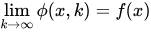

Completely analogous a partial function is lower semicomputable if and only if is upper semicomputable or equivalently if there exists a computable function such that:



If a partial function is both upper and lower semicomputable it is called computable.
See also[edit]
References[edit]
- Ming Li and Paul Vitányi, An Introduction to Kolmogorov Complexity and Its Applications, pp 37–38, Springer, 1997.
 | This mathematical logic-related article is a stub. You can help Wikipedia by expanding it. |