


Spruance-class destroyer
 USS Briscoe on 21 March 2003
| |
| Class overview | |
|---|---|
| Name | Spruance class |
| Builders | Ingalls Shipbuilding, Pascagoula, Mississippi |
| Operators |  United States Navy United States Navy |
| Preceded by | Charles F. Adams class |
| Succeeded by | |
| Built | 1972–1983 |
| In commission | 1975–2005 |
| Completed | 31 |
| Active | 1 (Paul F. Foster) as SDTS |
| Retired | 30 |
| General characteristics | |
| Type | Destroyer |
| Displacement | 8,040 (long) tons full load |
| Length | 529 ft (161 m) waterline; 563 ft (172 m) overall |
| Beam | 55 ft (16.8 m) |
| Draft | 29 ft (8.8 m) |
| Propulsion | 4 × General Electric LM2500 gas turbines, 2 shafts, 80,000 shp (60 MW) |
| Speed | 32.5 knots (60.2 km/h; 37.4 mph) |
| Range |
|
| Complement | 19 officers, 315 enlisted |
| Sensors and processing systems |
|
| Electronic warfare & decoys |
|
| Armament |
|
| Aircraft carried | 2 × Sikorsky SH-60 Seahawk LAMPS III helicopters. |
| Aviation facilities | Flight deck and enclosed hangar for up to two medium-lift helicopters |
The Spruance-class destroyer was developed by the United States to replace the many World War II–built Allen M. Sumner- and Gearing-class destroyers, and was the primary destroyer built for the United States Navy during the 1970s and 1980s. It was named in honor of U.S. Navy Admiral Raymond A. Spruance, who successfully led major naval battles in the Asiatic-Pacific Theater during World War II such as the Battle of Midway and the Battle of the Philippine Sea.
Introduced in 1975, the class was designed with gas-turbine propulsion, a flight deck and hangar for up to two medium-lift helicopters, all-digital weapons, and automated 127 mm (5-inch) guns. The Spruance class was originally designed to escort a carrier group, primarily for anti-submarine warfare (ASW), with point-defense anti-aircraft warfare (AAW) missiles and limited anti-ship capabilities. Two dozen members of the class were upgraded with Tomahawk cruise missiles for land attack.[1][2] The Navy retired the class somewhat earlier than planned, decommissioning the last ship in 2005. Most Spruances were broken up or destroyed as targets.[3] Its hull form and propulsion plant were adopted as the foundation of the Ticonderoga-class cruisers constructed in the 1980s. The class was succeeded as the main U.S. destroyer by the Arleigh Burke-class destroyer.
History[edit]
Design[edit]
Much larger than other destroyers of the era, the Spruances were comparable in size to contemporary guided-missile cruisers (CG and CGN) and U.S. Navy light cruisers (CL) in World War II. This allowed them to accommodate a helicopter flight deck, a first for a U.S. Navy destroyer, and an enclosed hangar with space for up to two medium-lift helicopters, a first for a U.S. Navy destroyer or cruiser.[4] The "Spru-cans" were the first large U.S. Navy ships to use gas turbine propulsion: four General Electric LM2500 gas turbines that generated about 80,000 horsepower (60 MW). This configuration (developed in the 1960s by the Royal Canadian Navy for the Iroquois-class destroyers and known as COmbined Gas And Gas, or COGAG) was very successful and used on most subsequent U.S. warships. As of 2010, all U.S. Navy surface combatants (except nuclear-powered aircraft carriers and the LCS-1) used the LM2500 COGAG arrangement, usually with two turbines per shaft.[5]
The ships were initially controversial, especially among members of the United States Congress who believed that their unimposing looks, and their original armament of two guns and an ASROC and Sea Sparrow missile launcher, implied that the vessels were weak compared to Soviet designs that carried large numbers of anti-ship missiles.[1] The Spruance class was also unfavorably compared to earlier U.S. designs that had more visible guns or launchers for Standard medium-range missiles. Their advocates noted that they were successful in their intended ASW role due to their seaworthiness, quiet operation, and ability to operate two helicopters.[5]
The Spruance class received the "DD" designation in the hull classification symbol system which was previously applied to gun destroyers, though their primary armament as designed was missiles. However, their original complement of 8 Sea Sparrow anti-aircraft missiles was only sufficient for point defense, compared to other American destroyers designated as DDG which were designed to provide anti-aircraft warfare screening to the fleet, while some newer DDG ships further added surface-to-surface capabilities for anti-ship or land strike. In the early 1980s, the class received quadruple Harpoon missile launchers that were installed amidships. Six members of the class received Armored Box Launchers Tomahawk surface-to-surface missiles, while a major update from the mid-1980s for 24 members of the class added a 61-cell Vertical Launch Missile System (VLS) for the Tomahawk. Despite these upgrades, the class remained their DD classification because they continued to lack the area anti-aircraft capabilities of guided-missile cruisers (CG and CGN) and destroyers (DDG).[5]
Contracts[edit]
Until the class was named for Admiral Spruance, the acquisition effort had been known as the DX program. It aimed to award the production contract for the entire class of 30 ships to a single shipyard, under the Total Package Procurement concept originated by the Whiz Kids of Robert McNamara's Pentagon. The idea was to reap the benefits of mass construction. After a selection process "noted for political influence and shifting rules," the entire contract was awarded on 23 June 1970 to the Litton-Ingalls shipyard in Pascagoula, Mississippi.[6] Labor and technical problems caused cost overruns and delayed construction.[7][8]
.jpg)
One additional ship, USS Hayler, was ordered on 29 September 1979. Hayler was originally planned as a DDH (Destroyer, Helicopter) design, which would carry more anti-submarine helicopters than the standard design of the Spruance class. Eventually this plan to build a DDH was scrapped and a slightly modified DD-963 class hull was put in commission.[citation needed]
Four additional ships were built originally for the Iranian Navy with the Mark 26/Standard AAW missile system and commissioned as the Kidds for the U.S. Navy. The Kidd-class destroyers used the same hull as the Spruances but they were more advanced general-purpose ships with area anti-air warfare capabilities that the Spruance class lacked. It was once planned to build all of the Spruance class up to this standard, but it was too expensive. A slightly lengthened version of the hull was also used for the Ticonderoga-class cruisers, originally planned as DDG-47-class destroyers but redesignated as cruisers in 1980 to emphasize the additional capability provided by the ships' Aegis combat systems, and their flag facilities suitable for an admiral and his staff.[9]
An air-capable mini V/STOL aircraft carrier with fighters and ASW helicopters based on the Spruance hull was seriously considered but not produced.[10][11]
Upgrades[edit]
The Spruance design is modular in nature, allowing for easy installation of entire subsystems within the ship. Although originally designed for anti-submarine warfare, seven vessels—Comte de Grasse, Merrill, Conolly, John Rodgers, Leftwich, Deyo, and Ingersoll—were initially upgraded with the installation of pair of four-round Armored Box Launchers (ABL) for the Tomahawk cruise missile, one each side of the ASROC launcher, giving them a land attack capability. 23 of the remaining vessels then received a more comprehensive upgrade with the installation of a 61-cell Mark 41 Vertical Launch Missile System (VLS) forward, replacing the ASROC launcher and allowing for a greater weapons load to be carried. One of the ABL ships, Deyo, also received the VLS upgrade while Harry W. Hill was the only Spruance that did not receive the Tomahawk as its VLS upgrade was cancelled. Hill and the remaining 6 ABL-equipped ships were the first of the class to be withdrawn from service.
- Merrill served as the Navy's test platform for the Tomahawk Cruise Missile Program receiving armored box launchers and test launching a Tomahawk on 19 March 1980. Merrill carried two ABLs and an ASROC launcher into the 1990s until the ASROC launcher was removed.[citation needed]
- David R. Ray tested the RAM system in the 1980s, but had the system removed after the tests.[citation needed]
- Oldendorf was the test platform for the AN/SPQ-9B Anti-ship Missile Defense (ASMD) Fire control Radar to be outfitted on the San Antonio-class amphibious transport docks. The AN/SPQ-9B is used to detect all known and projected sea-skimming missiles.[citation needed]
- Arthur W. Radford tested the Advanced Enclosed Mast/Sensor system which helped in the mast design of the San Antonio-class amphibious transport dock ships.[citation needed]
At least ten VLS ships, including Cushing, O'Bannon, and Thorn, had a 21-cell Mark 49 RIM-116 Rolling Airframe Missile launcher mounted on the starboard fantail.[citation needed]
Spruance-class destroyers fired 112 land attack Tomahawks during Operation Desert Storm.[12]
Decommissioning[edit]
In order to save $28 million a year, the Navy accelerated the decommissioning of the Spruance class, though they could have served to 2019 had they been maintained and updated.[13] Despite the recent modifications to the Spruance and Kidd classes, they were still considered expensive and manpower-intensive to operate, while the succeeding Arleigh Burke class were more capable and versatile due to their Aegis combat system while also being more cost-efficient, and by the end of the 1990s, many Arleigh Burke-class destroyers had entered the fleet. While the early Flight I Arleigh Burke ships only had a flight deck, Flight IIA and subsequent vessels added the enclosed hangar which made their aviation facilities comparable to the Spruance class.[citation needed]
The Navy planned to replace its current destroyers and cruisers with the new Zumwalt-class (DDG-1000) destroyers, but the 2010 Defense budget funded the construction of only three DDG-1000s.[14] Production of Arleigh Burke class continued and it became the U.S. Navy's only operational class of destroyers after the USS Cushing, the last Spruance-class destroyer on active service, was decommissioned on 21 September 2005.[15] Cushing was unsuccessfully offered to the Pakistan Navy before being sunk as a target on 29 April 2009. The four Kidd-class destroyers were decommissioned in 1998 and were sold to Taiwan in 2005 and 2006.[citation needed]
Few Spruances were preserved in storage like some older classes or offered up for sale to foreign navies. Some were broken up and most of the rest were sunk as targets in various fleet exercises. One exception is the ex-Paul F. Foster, which replaced the ex-Decatur in 2005 as the Self Defense Test Ship. The remote-controlled SDTS tows a target barge, allowing crews to fire live weapons at a ship-like moving target.[16][17]
Ships in class[edit]
| Name | Hull no. | Crest | Laid down | Launched | Commissioned | Decommissioned | Disposition | Ref |
|---|---|---|---|---|---|---|---|---|
| Spruance | DD-963 | 
|
27 November 1972 | 10 November 1973 | 20 September 1975 | 23 March 2005 | Sunk as target, 8 December 2006 | [18] |
| Paul F. Foster | DD-964 | 
|
6 February 1973 | 22 February 1974 | 21 February 1976 | 27 March 2003 | Struck 6 April 2004; in use as a Self Defense Test Ship | [19][20] |
| Kinkaid | DD-965 | 
|
19 April 1973 | 25 May 1974 | 10 July 1976 | 7 January 2003 | Sunk as target, 14 July 2004 | [21] |
| Hewitt | DD-966 | 
|
23 July 1973 | 24 August 1974 | 25 September 1976 | 19 July 2001 | Sold for scrap, 9 August 2001 | [22] |
| Elliot | DD-967 | _insignia,_circa_1976_(NH_85499-KN).png)
|
15 October 1973 | 19 December 1974 | 22 January 1977 | 2 December 2003 | Sunk as target, 25 June 2005 | [23] |
| Arthur W. Radford | DD-968 | 
|
31 January 1974 | 1 March 1975 | 16 April 1977 | 18 March 2003 | Scuttled as artificial reef off coast of Delaware, 10 August 2011 | [24] |
| Peterson | DD-969 | 
|
29 April 1974 | 21 June 1975 | 9 July 1977 | 4 October 2002 | Sunk as target, 16 February 2004 | [25] |
| Caron | DD-970 | 
|
1 July 1974 | 24 June 1975 | 1 October 1977 | 15 October 2001 | Sunk as target, 4 December 2002 | [26] |
| David R. Ray | DD-971 | 
|
23 September 1974 | 23 August 1975 | 19 November 1977 | 28 February 2002 | Sunk as target, 11 July 2008 | [27] |
| Oldendorf | DD-972 | 
|
27 December 1974 | 21 October 1975 | 4 March 1978 | 20 June 2003 | Sunk as target, 22 August 2005 | [28] |
| John Young | DD-973 | 
|
17 February 1975 | 6 January 1976 | 20 May 1978 | 30 September 2002 | Sunk as target, 13 April 2004 | [29] |
| Comte de Grasse | DD-974 | 
|
4 April 1975 | 26 March 1976 | 5 August 1978 | 5 June 1998 | Sunk as target, 7 June 2006 | [30] |
| O'Brien | DD-975 | 
|
9 May 1975 | 8 July 1976 | 3 December 1977 | 24 September 2004 | Sunk as target, 9 February 2006 | [31] |
| Merrill | DD-976 | 
|
16 June 1975 | 1 September 1976 | 11 March 1978 | 26 March 1998 | Sunk as target, 1 August 2003 | [32] |
| Briscoe | DD-977 | _patch.png)
|
21 July 1975 | 28 December 1976 | 3 June 1978 | 2 October 2003 | Sunk as target, 25 August 2005 | [33] |
| Stump | DD-978 | 
|
25 August 1975 | 1 January 1977 | 19 August 1978 | 22 October 2004 | Sunk as target, 7 June 2006 | [34] |
| Conolly | DD-979 | 
|
29 September 1975 | 3 June 1977 | 14 October 1978 | 18 September 1998 | Sunk as target, 29 April 2009 | [35] |
| Moosbrugger | DD-980 | 
|
3 November 1975 | 23 July 1977 | 16 December 1978 | 15 December 2000 | Scrapped, 2006 | [36] |
| John Hancock | DD-981 | 
|
16 January 1976 | 29 October 1977 | 10 March 1979 | 16 October 2000 | Scrapped, 2007 | [37] |
| Nicholson | DD-982 | 
|
20 February 1976 | 11 November 1977 | 12 May 1979 | 20 December 2002 | Sunk as target, 30 July 2004 | [38] |
| John Rodgers | DD-983 | 
|
12 August 1976 | 25 February 1978 | 14 July 1979 | 4 September 1998 | Scrapped, 2006 | [39] |
| Leftwich | DD-984 | 
|
12 November 1976 | 8 April 1978 | 25 August 1979 | 27 March 1998 | Sunk as target, 1 August 2003 | [40] |
| Cushing | DD-985 | _crest.png)
|
2 February 1977 | 17 June 1978 | 21 September 1979 | 21 September 2005 | Sunk as target, 14 July 2008 | [41] |
| Harry W. Hill | DD-986 | 
|
1 April 1977 | 10 August 1978 | 17 November 1979 | 29 May 1998 | Sunk as target, 15 July 2004 | [42] |
| O'Bannon | DD-987 | 
|
21 February 1977 | 25 September 1978 | 15 December 1979 | 19 August 2005 | Sunk as target, 6 October 2008 | [43] |
| Thorn | DD-988 | 
|
29 August 1977 | 3 February 1979 | 16 February 1980 | 25 August 2004 | Sunk as target, 22 July 2006 | [44] |
| Deyo | DD-989 | _crest.png)
|
14 October 1977 | 20 January 1979 | 22 March 1980 | 6 November 2003 | Sunk as target, 25 August 2005 | [45] |
| Ingersoll | DD-990 | _crest_1978.png)
|
5 December 1977 | 10 March 1979 | 12 April 1980 | 24 July 1998 | Sunk as target, 29 July 2003 | [46] |
| Fife | DD-991 | _crest.png)
|
6 March 1978 | 1 May 1979 | 31 May 1980 | 28 February 2003 | Sunk as target, 23 August 2005 | [47] |
| Fletcher | DD-992 | _crest.png)
|
24 April 1978 | 16 June 1979 | 12 July 1980 | 1 October 2004 | Sunk as target, 16 July 2008 | [48] |
| Hayler | DD-997 | _crest.png)
|
20 October 1980 | 2 March 1982 | 5 March 1983 | 25 August 2003 | Sunk as target, 13 November 2004 | [49] |
Gallery[edit]
-
 starboard quarter view of Fife
 -
 Ingersoll with only ASROC launcher forward, as all destroyers were initially built. Image also shows an example of black masts and no Phalanx CIWS
 -
 Deyo with ASROC and ABL's forward.
 -
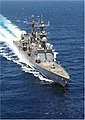 starboard bow view of Deyo, VLS equipped
 -
 Kidd class (left) compared to Spruance class
 -
 Ticonderoga-class cruiser (right) compared to the Spruance class
 -
 Arthur W. Radford with experimental mast
 -
 Cushing with VLS forward and RAM launcher on fantail
 -
 Hayler, the last Spruance destroyer to be built, is sunk


.jpg)


_and_USS_Ticonderoga_(CG-47)_at_Naval_Station_Norfolk_on_8_October_1983_(6397938).jpg)
_arrives_at_Crete.jpg)

_detonate_aboard_the_U.S._Navy%27s_decommissioned_destroyer_Hayler_(DD_997),_during_a_Sink_Exercise.jpg)
See also[edit]
References[edit]
- ^ a b "The Abandoned Destroyer Class : Curse of the Spruances". 10 November 2013.
- ^ "DD-963 SPRUANCE-class". www.globalsecurity.org.
- ^ "Military Officers Association of America". www.moaa.org. 19 March 2019. Archived from the original on 20 September 2010.
- ^ "Bigger, Costlier Destroyers". The Morning Record. Meriden, Connecticut. 15 July 1970.
- ^ a b c Bishop, Chris. Encyclopedia of World Sea Power. 1988. ISBN 0-517-65342-7. Page 94-95
- ^ Peniston, Bradley (2013). No higher honor : saving the USS Samuel B. Roberts in the Persian Gulf. Annapolis, Md.: U.S. Naval Institute. ISBN 978-1-59114-676-6. OCLC 816165773.
- ^ "Spruance Akin to Vacation Cruise". Times Daily. Florence, Alabama. Associated Press. 18 September 1975.
DD-963 ... is a year behind schedule due to a strike, a drydock accident and other instances of what Ingalls calls "excusable delays."
- ^ "Shipyard Begins Design Work on Sub for Saudis". Times Daily. Florence, Alabama. Associated Press. 23 October 1975.
The Litton-owned shipyard has come under heavy fire from the Navy and Congress for delays and cost overruns on U.S. destroyers and assault ships.
- ^ "RIP: 6 U.S. Navy Ticonderoga-Class Cruisers Could be Headed to the Scrapper". 21 March 2019.
- ^ "Historical Review of Cruiser Characteristics, Roles and Missions". Aandc.org.
- ^ John Pike. "CG-47 Ticonderoga-class". Globalsecurity.org.
- ^ "DD-963 SPRUANCE-class – Navy Ships". Fas.org.
- ^ Dunnigan, James F. (2 August 2008). "USN Abandons New Ship Designs". Strategypage.com.
- ^ Bennett, John T. and Kris Osborn. "Gates Reveals DoD Program Overhaul"[dead link]. Defense News, 6 April 2009.
- ^ "US guided missile destroyer to visit Subic Bay Tuesday". The Philippine Star. 4 February 2013. Retrieved 4 March 2013.
- ^ "Paul F Foster EDD-964 Final DOI Naval Vessel Historical Evaluation" (PDF). navsea.navy.mil. 5 March 2013. Archived from the original (PDF) on 27 February 2015.
- ^ John Pike. "Global Security information". Globalsecurity.org.
- ^ "USS Spruance". Naval Vessel Register.
- ^ "USS Paul F. Foster". Naval Vessel Register.
- ^ "USS Paul F. Foster (EDD-964)". Naval Vessel Register.
- ^ "USS Kinkaid". Naval Vessel Register.
- ^ "USS Hewitt". Naval Vessel Register.
- ^ "USS Elliot". Naval Vessel Register.
- ^ "USS Arthur W. Radford". Naval Vessel Register.
- ^ "USS Peterson". Naval Vessel Register.
- ^ "USS Caron". Naval Vessel Register.
- ^ "USS David R. Ray". Naval Vessel Register.
- ^ "USS Oldendorf". Naval Vessel Register.
- ^ "USS John Young". Naval Vessel Register.
- ^ "USS Comte de Grasse". Naval Vessel Register.
- ^ "USS O'Brien". Naval Vessel Register.
- ^ "USS Merrill". Naval Vessel Register.
- ^ "USS 'Briscoe". Naval Vessel Register.
- ^ "USS Stump". Naval Vessel Register.
- ^ "USS Conolly". Naval Vessel Register.
- ^ "USS Moosbrugger". Naval Vessel Register.
- ^ "USS John Hancock". Naval Vessel Register.
- ^ "USS Nicholson". Naval Vessel Register.
- ^ "USS John Rodgers". Naval Vessel Register.
- ^ "USS Leftwich". Naval Vessel Register.
- ^ "USS Cushing". Naval Vessel Register.
- ^ "USS Harry W. Hill". Naval Vessel Register.
- ^ "USS O'Bannon". Naval Vessel Register.
- ^ "USS Thorn". Naval Vessel Register.
- ^ "USS Deyo". Naval Vessel Register.
- ^ "USS Ingersoll". Naval Vessel Register.
- ^ "USS Fife". Naval Vessel Register.
- ^ "USS Fletcher". Naval Vessel Register.
- ^ "USS Hayler". Naval Vessel Register.
External links[edit]
