


Saint Florian
Saint Florian | |
|---|---|
 St Florian by Francesco del Cossa, 1473 | |
| Soldier | |
| Born | AD 250 Aelium Cetium (present-day Sankt Pölten, Austria), Roman Empire |
| Died | c. AD 304 Enns (river) |
| Venerated in | Catholic Church Eastern Orthodox Church[1] |
| Feast | 4 May |
| Attributes | depicted as a Roman officer or soldier; pitcher of water; pouring water over fire; invoked against fire, floods and drowning[2] |
| Patronage | Linz, Austria & Upper Austria; Kraków, Poland; chimneysweeps; firefighters; soap boilers |
Florian (Latin: Florianus; AD 250 – c. 304) was a Christian holy man and the patron saint of chimney sweeps; soapmakers, and firefighters. His feast day is 4 May. Florian is also the patron saint of Poland, the city of Linz, Austria, and Upper Austria, jointly with Leopold III, Margrave of Austria.
Life[edit]
Florian was born around AD 250 in the ancient Roman city of Aelium Cetium, present-day Sankt Pölten, Austria. He joined the Roman Army and advanced in the ranks,[3] rising to commander of the imperial army in the Roman province of Noricum. In addition to his military duties, he was also responsible for organizing and leading firefighting brigades. Florian organized and trained an elite group of soldiers whose sole duty was to fight fires.[4]
During the Diocletianic Persecution of Christians, reports reached Rome that Florian was not enforcing the proscriptions against Christians in his territory. Aquilinus was sent to investigate these reports. When Aquilinus ordered Florian to offer sacrifice to the Roman gods in accordance with Roman religion, Florian refused. Florian was sentenced to be burned at the stake. Standing on the funeral pyre, Florian is reputed to have challenged the Roman soldiers to light the fire, saying "If you wish to know that I am not afraid of your torture, light the fire, and in the name of the Lord I will climb onto it."[5] Apprehensive of his words, the soldiers did not burn Florian, but executed him by drowning him in the Enns River with a millstone tied around his neck instead.[3][4]
His body was later retrieved by Christians and buried at an Augustinian monastery near Lorch. Later a woman named Valeria had a vision in which she saw him; Florian, in this vision, declared his intent to be buried in a more appropriate location.[citation needed]
Veneration[edit]
Florian is very widely venerated in Central Europe.[6] The Austrian town of Sankt Florian is named after him. According to legend, his body was interred at St. Florian Monastery, around which the town grew up.
Florian was adopted as patron saint of Poland in 1184, when Pope Lucius III consented to the request of Prince Casimir II to send relics of Florian to that country.[3] Kraków thus claims some of his relics.[6]
A statue of Florian by Josef Josephu was unveiled in Vienna in 1935. It stood at the main firehouse of Vienna, in the city's main square, Am Hof. After the firehouse was bombed in 1945 during World War II the statue was moved on to the Fire Brigade Museum (Wiener Feuerwehrmuseum).[2]
Seeking the sponsorship of a helpful saint was and still is a part of the namegiving practice in Catholic areas. In the southern, Catholic, parts of the German Empire (mainly present Bavaria and Austria), peasants regularly have used the name, Florian, as one of the given names for at least one of their male children: to secure the saint's patronage against fire. Hence the given name is still widespread in these areas.[7]
In Austria and Germany, fire services use Florian in radio communications as universal call sign for fire stations and fire trucks. The call sign Florentine for firefighting-related, handheld radio equipment is also derived, somewhat inaccurately, from that usage.[citation needed]
Patronage[edit]
Florian is a patron saint of Upper Austria and Poland; also firefighters, chimneysweeps, and brewers. Florian is associated with brewers because of a legendary incident in which he miraculously stopped a fire with a single pitcher of water. That is why he is often depicted holding a pitcher. Florian is also the patron of chimney sweeps, Austria, Poland and soap boilers.
Florian is invoked against fires, floods, lightning, and the pains of Purgatory.[8]
A famous St. Florian's Church is located in Kraków, Poland. His veneration has been particularly intense since 1528, when a fire burned the neighborhood without destroying the church.[9]
In contemporary culture[edit]
The "Florian Principle" (known in German language areas as "Sankt-Florians-Prinzip") is named after a somewhat ironic prayer to Saint Florian: "O heiliger Sankt Florian, verschon' mein Haus, zünd' and're an," equivalent to "O Holy St. Florian, please spare my house, set fire to another one". This saying is used in German much like the English "not in my back yard", when the speaker wants to point out that some person tries to get out of an unpleasant situation by an action that will put others in that very same situation.[10][11][12]
In Germany, "Florian" is the call sign for fire engines.[13][14]
The protagonist in Felix Salten's novel Florian: The Emperor’s Stallion was named after Florian, as the animal was born on 4 May 1901 in Lipizza, Austria.[15]
Alfred Schnittke's Symphony No. 2, is subtitled "St. Florian".[16]
In multiple cities across Slovakia, streets are named after Saint Florian, often in correlation with local fire departments. Florian Street (Floriánska ulica) occurs in historic boroughs of major cities: currently in Košice (Staré Mesto) and also formerly in Bratislava (Staré Mesto).[17][18]
Gallery[edit]
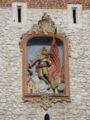
-
 St. Florian in St. Andrew's Church in Andraž nad Polzelo (Slovenia)
 -
-

-
-
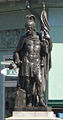
 Statue of St. Florian at a crossroads near Komarówka Podlaska (Poland)
 -
 Statue of Saint Florian, located above the altar at Saint Florian Catholic Church in Ino, Wisconsin, United States
 -
![The Firefighter's Cross, sometimes mistakenly referred to as a St. Florian Cross [19]](//upload.wikimedia.org/wikipedia/commons/thumb/f/f9/FlorianCross_1.svg/120px-FlorianCross_1.svg.png) The Firefighter's Cross, sometimes mistakenly referred to as a St. Florian Cross [19]
The Firefighter's Cross, sometimes mistakenly referred to as a St. Florian Cross [19] -
 Firefighter's Cross variant


.jpg)


![The Firefighter's Cross, sometimes mistakenly referred to as a St. Florian Cross [19]](/wiki/File:FlorianCross_1.svg)

See also[edit]
- St. Florian's Church in Kraków, the resting place of St. Florian's relics
References[edit]
- ^ (in Greek)Ὁ Ἅγιος Φλωριανὸς ὁ Μάρτυρας. 4 Μαΐου. ΜΕΓΑΣ ΣΥΝΑΞΑΡΙΣΤΗΣ.
- ^ a b Mendler, Mitch. "Saint Florian – the patron saint of the fire service". Retrieved 16 January 2019.
- ^ a b c "St. Florian", Saint Florian Roman Catholic Church
- ^ a b "St. Florian History", Brookline Firefighters Association, Brookline, Massachusetts.
- ^ Turkalj, Nikola (2018). Rimski vojnik i vatrogasac. Split: Redak. p. 19. ISBN 978-953-336-489-6.
- ^ a b St Florian, Catholic.org. Accessed 27 September 2022
- ^ For the frequency of this given name in Germany type "Florian" Archived 25 September 2013 at the Wayback Machine, gen-evolu.de. Accessed 27 September 2022.
- ^ Lanzi, Fernando and Lanzi, Gioia: "Florian of Lorch, Martyr", Saints and Their Symbols: Recognizing Saints in Art and in Popular Images, pg. 86. Liturgical Press, 2004; ISBN 0-8146-2970-9
- ^ Internetowa Liturgia Godzin, brewiarz.pl; accessed 29 June 2020 (in Polish).
- ^ Ritter, Adolf Martin (2012). Studia Chrysostomica. Tübingen: Morh Siebeck. p. 2.
- ^ Versnel, Henk (1981). Faith, Hope and Worship: Aspects of Religious Mentality in the Ancient World. Leiden: Brill. p. 19.
- ^ Weszkalnys, Gisa (2010). Berlin, Alexanderplatz: Transforming Place in a Unified Germany. New York: Berghahn.
- ^ Hegemann, Jan-Erik (4 May 2022). "St. Florian: Weit mehr als ein Heiliger". Feuerwehr-Magazin. Retrieved 9 December 2022.
- ^ Funkrufnamenverzeichnis für den UKW-Sprechfunkdienst der nichtpolizeilichen Behörden und Organisationen mit Sicherheitsaufgaben (BOS) (PDF). Mainz: Ministerium des Innern und für Sport des Landes Rheinland-Pfalz. 2007. p. 12. Retrieved 9 December 2022.
- ^ Salten, Felix (1934). Florian: The Emperor's Stallion. Translated by Erich Posselt and Michel Kraike. Indianapolis: The Bobbs-Merrill Company. p. 17.
- ^ Ivashkin, Alexander: Alfred Schnittke, p. 141. London: Phaidon Press Limited, 1996. ISBN 0-7148-3169-7
- ^ "Katalóg ulíc :: Oficiálne stránky mesta Košice". www.kosice.sk (in Slovak). Retrieved 29 March 2022.
- ^ "Stará mapa Floriánska - ulica (Staré Mesto) - mapa Bratislava rok 1960 - StareMapy.sk". www.staremapy.sk. Retrieved 29 March 2022.
- ^ "The Myth of the "Maltese" Cross in the American Fire Service". 9 August 2020.
External links[edit]


- Delehaye, Hippolyte (1911). . Encyclopædia Britannica. Vol. 10 (11th ed.). p. 539.
- Catholic Online article
- The Cult of St. Florian (with primary sources)
- St. Florian's Abbey in Austria
- Saint Florian the patron saint of the fire service
- Saints of Suds
- Firefighter's Cross symbols on historic firefighting objects, Staten Island Historical Society Online Collections Database
- Saint Florian at the Christian Iconography web site
- / "The Myth of the 'Maltese' Cross in the American Fire Service"
| International | |
|---|---|
| National | |
| People | |
