


Standard basis
 | This article includes a list of references, related reading, or external links, but its sources remain unclear because it lacks inline citations. (July 2016) |

In mathematics, the standard basis (also called natural basis or canonical basis) of a coordinate vector space (such as or ) is the set of vectors, each of whose components are all zero, except one that equals 1.[1] For example, in the case of the Euclidean plane formed by the pairs (x, y) of real numbers, the standard basis is formed by the vectors





Here the vector ex points in the x direction, the vector ey points in the y direction, and the vector ez points in the z direction. There are several common notations for standard-basis vectors, including {ex, ey, ez}, {e1, e2, e3}, {i, j, k}, and {x, y, z}. These vectors are sometimes written with a hat to emphasize their status as unit vectors (standard unit vectors).
These vectors are a basis in the sense that any other vector can be expressed uniquely as a linear combination of these.[2] For example, every vector v in three-dimensional space can be written uniquely as



In the n-dimensional Euclidean space , the standard basis consists of n distinct vectors

Standard bases can be defined for other vector spaces, whose definition involves coefficients, such as polynomials and matrices. In both cases, the standard basis consists of the elements of the space such that all coefficients but one are 0 and the non-zero one is 1. For polynomials, the standard basis thus consists of the monomials and is commonly called monomial basis. For matrices , the standard basis consists of the m×n-matrices with exactly one non-zero entry, which is 1. For example, the standard basis for 2×2 matrices is formed by the 4 matrices


Properties[edit]
By definition, the standard basis is a sequence of orthogonal unit vectors. In other words, it is an ordered and orthonormal basis.
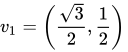
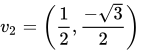
However, an ordered orthonormal basis is not necessarily a standard basis. For instance the two vectors representing a 30° rotation of the 2D standard basis described above, i.e. ,
Generalizations[edit]
There is a standard basis also for the ring of polynomials in n indeterminates over a field, namely the monomials.
All of the preceding are special cases of the indexed family



Other usages[edit]
The existence of other 'standard' bases has become a topic of interest in algebraic geometry, beginning with work of Hodge from 1943 on Grassmannians. It is now a part of representation theory called standard monomial theory. The idea of standard basis in the universal enveloping algebra of a Lie algebra is established by the Poincaré–Birkhoff–Witt theorem.
Gröbner bases are also sometimes called standard bases.
In physics, the standard basis vectors for a given Euclidean space are sometimes referred to as the versors of the axes of the corresponding Cartesian coordinate system.
See also[edit]
Citations[edit]
- ^ Roman 2008, p. 47, ch. 1.
- ^ Axler (2015) p. 39-40, §2.29
- ^ Roman 2008, p. 131, ch. 5.
References[edit]
- Axler, Sheldon (2015) [18 December 2014]. Linear Algebra Done Right. Undergraduate Texts in Mathematics (3rd ed.). Springer Publishing. ISBN 978-3-319-11079-0.
- Roman, Stephen (2008). Advanced Linear Algebra. Graduate Texts in Mathematics (Third ed.). Springer. ISBN 978-0-387-72828-5. (page 47)
- Ryan, Patrick J. (2000). Euclidean and non-Euclidean geometry: an analytical approach. Cambridge; New York: Cambridge University Press. ISBN 0-521-27635-7. (page 198)
- Schneider, Philip J.; Eberly, David H. (2003). Geometric tools for computer graphics. Amsterdam; Boston: Morgan Kaufmann Publishers. ISBN 1-55860-594-0. (page 112)