


Symphony No. 1 (Sibelius)
| Symphony No. 1 | |
|---|---|
| by Jean Sibelius | |
 The composer (c. 1900) | |
| Key | E minor |
| Opus | 39 |
| Composed | 1898–1899, rev. 1900 |
| Publisher | Fazer & Westerlund (1902)[1][a] |
| Duration | 38 mins.[3] |
| Movements | 4 |
| Premiere | |
| Date | 26 April 1899[4] |
| Location | Helsinki, Grand Duchy of Finland |
| Conductor | Jean Sibelius |
| Performers | Helsinki Philharmonic Society |
The Symphony No. 1 in E minor, Op. 39, is a four-movement work for orchestra written from 1898 to 1899 by the Finnish composer Jean Sibelius.
The work was first performed on 26 April 1899 by the Helsinki Orchestral Society, conducted by the composer, in an original version which has not survived. After the premiere, Sibelius made some revisions, resulting in the version performed today. The revised version was completed in the spring and summer of 1900, and was first performed in Berlin by the Helsinki Philharmonic, conducted by Robert Kajanus on 1 July 1900.
The symphony is characterized by its use of string and woodwind solos; the first movement opens with a long and discursive clarinet solo over a timpani roll; (this idea returns at the start of the fourth movement, fortissimo in the strings, with wind and brass chordal accompaniment), and subsequent movements include violin, viola, and cello solos.
Most performances of the work last between 35 and 40 minutes. Many conductors choose to slacken the speeds suggested by Sibelius's metronome markings, particularly in the fast part (allegro energico) of the first movement. Because of this, many versions of the symphony are about 38–40 minutes long (the publishers suggest the duration is 40 minutes[5]). In Osmo Vänskä's recording of the work, released in 1997, the first movement is played at the metronome mark suggested by Sibelius and takes 9:42 (compared with the 10+1⁄2–11+1⁄2 minute duration of most other recordings).
Instrumentation[edit]
2 flutes (both doubling on piccolo), 2 oboes, 2 clarinets (1st and 4th movements in A, 2nd and 3rd in B♭), 2 bassoons, 4 horns, 3 trumpets, 3 trombones, tuba, timpani, triangle, bass drum, cymbals, harp, and strings
Movements[edit]

Like most symphonies, it is in four movements:
- Andante, ma non troppo – Allegro energico (
 . = 108) in E minor and sonata form with introduction
- This movement starts with a clarinet solo, stating all the basic themes and motifs of the symphony.


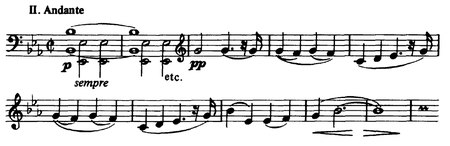
- Andante (ma non troppo lento) ( = 54) in E♭ major and ternary form, variation form
- Similarly to the second movement of Sibelius' Symphony No. 2, the slow movement starts quietly, with tragic themes. It then expands into a large and furious passage, followed by a return to the original themes, ending calmly.
- Scherzo: Allegro (. = 108) in C major and scherzo and trio form
- Like the third movement of Symphony No. 2, this fast movement is not light in tone, but is full of protests and questions. It ends with stretto and ends incompletely, proposing the final howl of the finale.

- Finale (Quasi una fantasia): Andante – Allegro molto – Andante assai – Allegro molto come prima – Andante (ma non troppo) in E minor and fantasia-like with an orchestrated introduction from the first movement
- This movement contains a number of tones that lead to a rumbling effect due to intermodulation distortion.[6] It starts with a serious and emotional strings unison with brass strikes, using the introduction from the first movement, then soon proceeds into a fantasia with nearly free form.





The first recording was made by Robert Kajanus with the London Symphony Orchestra for the HMV label in May 1930.
Notes[edit]
- ^ On 20 July 1905, the Helsinki-based music publisher Fazer & Westerlund (Helsingfors Nya Musikhandel) sold its Sibelius holdings (the publishing rights and printing plates) to the German firm of Breitkopf & Härtel.[2]
References[edit]
- ^ Dahlström 2003, p. 185.
- ^ Dahlström 2003, p. xxiv.
- ^ Dahlström 2003, pp. 184–185.
- ^ Dahlström 2003, p. 183.
- ^ MusicSalesClassical.com's "suggestion" of the tempo
- ^ "How We Reverse Engineered the Cuban "Sonic Weapon" Attack". spectrum.ieee.org. IEEE. 15 Mar 2018. Retrieved 2018-03-18.
For example, in their 1987 book The Musician's Guide to Acoustics, Murray Campbell and Clive Greated note that the last movement of Jean Sibelius's Symphony No. 1 in E minor contains tones that lead to a rumbling IMD. The human ear processes sound in a nonlinear fashion, and so it can be "tricked" into hearing tones that weren't produced by the instruments and that aren't in the sheet music; those subliminal tones are produced when the played tones combine nonlinearly in the inner ear.
Sources
- Dahlström, Fabian [in Swedish] (2003). Jean Sibelius: Thematisch-bibliographisches Verzeichnis seiner Werke [Jean Sibelius: A Thematic Bibliographic Index of His Works] (in German). Wiesbaden: Breitkopf & Härtel. ISBN 3-7651-0333-0.
External links[edit]
- Symphony No. 1 in E minor, Op. 39: Scores at the International Music Score Library Project
- "First symphony Op. 39 (1899–1900)", history and analysis, sibelius.info
- Flying Inkpot review


| National | |
|---|---|
| Other | |
