


Temperley–Lieb algebra
In statistical mechanics, the Temperley–Lieb algebra is an algebra from which are built certain transfer matrices, invented by Neville Temperley and Elliott Lieb. It is also related to integrable models, knot theory and the braid group, quantum groups and subfactors of von Neumann algebras.
Structure[edit]
Generators and relations[edit]
Let be a commutative ring and fix . The Temperley–Lieb algebra is the -algebra generated by the elements , subject to the Jones relations:



- for all
- for all
- for all
- for all such that









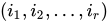
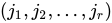
Using these relations, any product of generators can be brought to Jones' normal form:


where and are two strictly increasing sequences in . Elements of this type form a basis of the Temperley-Lieb algebra.[1]

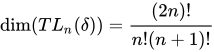
The dimensions of Temperley-Lieb algebras are Catalan numbers:[2]
The Temperley–Lieb algebra is a subalgebra of the Brauer algebra ,[3] and therefore also of the partition algebra . The Temperley–Lieb algebra is semisimple for where is a known, finite set.[4] For a given , all semisimple Temperley-Lieb algebras are isomorphic.[3]


Diagram algebra[edit]
may be represented diagrammatically as the vector space over noncrossing pairings of points on two opposite sides of a rectangle with n points on each of the two sides.

The identity element is the diagram in which each point is connected to the one directly across the rectangle from it. The generator is the diagram in which the -th and -th point on the left side are connected to each other, similarly the two points opposite to these on the right side, and all other points are connected to the point directly across the rectangle.


The generators of are:

.svg)
From left to right, the unit 1 and the generators , , , .


Multiplication on basis elements can be performed by concatenation: placing two rectangles side by side, and replacing any closed loops by a factor , for example :


 ×
×  = =
= =  .
.
The Jones relations can be seen graphically:
 =
=
 =
=

 =
=
The five basis elements of are the following:

.svg) .
.
From left to right, the unit 1, the generators , , and , .


Representations[edit]
Structure[edit]
For such that is semisimple, a complete set of simple modules is parametrized by integers with . The dimension of a simple module is written in terms of binomial coefficients as[4]



A basis of the simple module is the set of monic noncrossing pairings from points on the left to points on the right. (Monic means that each point on the right is connected to a point on the left.) There is a natural bijection between , and the set of diagrams that generate : any such diagram can be cut into two elements of for some .


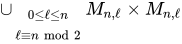
Then acts on by diagram concatenation from the left.[3] (Concatenation can produce non-monic pairings, which have to be modded out.) The module may be called a standard module or link module.[1]
If with a root of unity, may not be semisimple, and may not be irreducible:



If is reducible, then its quotient by its maximal proper submodule is irreducible.[1]
Branching rules from the Brauer algebra[edit]
Simple modules of the Brauer algebra can be decomposed into simple modules of the Temperley-Lieb algebra. The decomposition is called a branching rule, and it is a direct sum with positive integer coefficients:
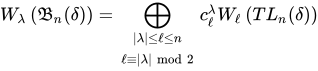
The coefficients do not depend on , and are given by[4]



where is the number of standard Young tableaux of shape , given by the hook length formula.


Affine Temperley-Lieb algebra[edit]
The affine Temperley-Lieb algebra is an infinite-dimensional algebra such that . It is obtained by adding generators such that[5]



- for all ,
- ,
- .




The indices are supposed to be periodic i.e. , and the Temperley-Lieb relations are supposed to hold for all . Then is central. A finite-dimensional quotient of the algebra , sometimes called the unoriented Jones-Temperley-Lieb algebra,[6] is obtained by assuming , and replacing non-contractible lines with the same factor as contractible lines (for example, in the case , this implies ).




The diagram algebra for is deduced from the diagram algebra for by turning rectangles into cylinders. The algebra is infinite-dimensional because lines can wind around the cylinder. If is even, there can even exist closed winding lines, which are non-contractible.
The Temperley-Lieb algebra is a quotient of the corresponding affine Temperley-Lieb algebra.[5]
The cell module of is generated by the set of monic pairings from points to points, just like the module of . However, the pairings are now on a cylinder, and the right-multiplication with is identified with for some . If , there is no right-multiplication by , and it is the addition of a non-contractible loop on the right which is identified with . Cell modules are finite-dimensional, with


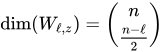
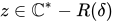
The cell module is irreducible for all , where the set is countable. For , has an irreducible quotient. The irreducible cell modules and quotients thereof form a complete set of irreducible modules of .[5] Cell modules of the unoriented Jones-Temperley-Lieb algebra must obey if , and if .


Applications[edit]
Temperley–Lieb Hamiltonian[edit]
Consider an interaction-round-a-face model e.g. a square lattice model and let be the number of sites on the lattice. Following Temperley and Lieb[7] we define the Temperley–Lieb Hamiltonian (the TL Hamiltonian) as
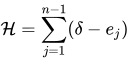
In what follows we consider the special case .

We will firstly consider the case . The TL Hamiltonian is , namely


= 2  -
-  -
-  .
.

We have two possible states,
 and
and  .
.
In acting by on these states, we find
= 2 - - = - ,
and
= 2 - - = - + .
Writing as a matrix in the basis of possible states we have,
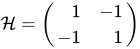
The eigenvector of with the lowest eigenvalue is known as the ground state. In this case, the lowest eigenvalue for is . The corresponding eigenvector is . As we vary the number of sites we find the following table[8]


| 2 | (1) | 3 | (1, 1) |
| 4 | (2, 1) | 5 | |
| 6 | 7 | ||
| 8 | 9 | ||






where we have used the notation -times e.g., .



An interesting observation is that the largest components of the ground state of have a combinatorial enumeration as we vary the number of sites,[9] as was first observed by Murray Batchelor, Jan de Gier and Bernard Nienhuis.[8] Using the resources of the on-line encyclopedia of integer sequences, Batchelor et al. found, for an even numbers of sites

and for an odd numbers of sites

Surprisingly, these sequences corresponded to well known combinatorial objects. For even, this (sequence A051255 in the OEIS) corresponds to cyclically symmetric transpose complement plane partitions and for odd, (sequence A005156 in the OEIS), these correspond to alternating sign matrices symmetric about the vertical axis.
XXZ spin chain[edit]
References[edit]
- ^ a b c Ridout, David; Saint-Aubin, Yvan (2012-04-20). "Standard Modules, Induction and the Temperley-Lieb Algebra". arXiv:1204.4505v4 [math-ph].
- ^ Kassel, Christian; Turaev, Vladimir (2008). "Braid Groups". Graduate Texts in Mathematics. New York, NY: Springer New York. doi:10.1007/978-0-387-68548-9. ISBN 978-0-387-33841-5. ISSN 0072-5285.
- ^ a b c Halverson, Tom; Jacobson, Theodore N. (2018-08-24). "Set-partition tableaux and representations of diagram algebras". arXiv:1808.08118v2 [math.RT].
- ^ a b c Benkart, Georgia; Moon, Dongho (2005-04-26), "Tensor product representations of Temperley-Lieb algebras and Chebyshev polynomials", Representations of Algebras and Related Topics, Providence, Rhode Island: American Mathematical Society, pp. 57–80, doi:10.1090/fic/045/05, ISBN 9780821834152
- ^ a b c Belletête, Jonathan; Saint-Aubin, Yvan (2018-02-10). "On the computation of fusion over the affine Temperley-Lieb algebra". Nuclear Physics B. 937: 333–370. arXiv:1802.03575v1. Bibcode:2018NuPhB.937..333B. doi:10.1016/j.nuclphysb.2018.10.016. S2CID 119131017.
- ^ Read, N.; Saleur, H. (2007-01-11). "Enlarged symmetry algebras of spin chains, loop models, and S-matrices". Nuclear Physics B. 777 (3): 263–315. arXiv:cond-mat/0701259. Bibcode:2007NuPhB.777..263R. doi:10.1016/j.nuclphysb.2007.03.007. S2CID 119152756.
- ^ Temperley, Neville; Lieb, Elliott (1971). "Relations between the 'percolation' and 'colouring' problem and other graph-theoretical problems associated with regular planar lattices: some exact results for the 'percolation' problem". Proceedings of the Royal Society A: Mathematical, Physical and Engineering Sciences. 322 (1549): 251–280. Bibcode:1971RSPSA.322..251T. doi:10.1098/rspa.1971.0067. JSTOR 77727. MR 0498284. S2CID 122770421.
- ^ a b Batchelor, Murray; de Gier, Jan; Nienhuis, Bernard (2001). "The quantum symmetric chain at , alternating-sign matrices and plane partitions". Journal of Physics A. 34 (19): L265–L270. arXiv:cond-mat/0101385. doi:10.1088/0305-4470/34/19/101. MR 1836155. S2CID 118048447.
- ^ de Gier, Jan (2005). "Loops, matchings and alternating-sign matrices". Discrete Mathematics. 298 (1–3): 365–388. arXiv:math/0211285. doi:10.1016/j.disc.2003.11.060. MR 2163456. S2CID 2129159.


Further reading[edit]
- Kauffman, Louis H. (1991). Knots and Physics. World Scientific. ISBN 978-981-02-0343-6.
- Kauffman, Louis H. (1987). "State Models and the Jones Polynomial". Topology. 26 (3): 395–407. doi:10.1016/0040-9383(87)90009-7. MR 0899057.
- Baxter, Rodney J. (1982). Exactly solved models in statistical mechanics. London: Academic Press Inc. ISBN 0-12-083180-5. MR 0690578.