


Total electron content

Total electron content (TEC) is an important descriptive quantity for the ionosphere of the Earth. TEC is the total number of electrons integrated between two points, along a tube of one meter squared cross section, i.e., the electron columnar number density. It is often reported in multiples of the so-called TEC unit, defined as TECU=1016el/m2≈1.66×10−8 mol⋅m−2.[1]
TEC is significant in determining the scintillation and group and phase delays of a radio wave through a medium. Ionospheric TEC is characterized by observing carrier phase delays of received radio signals transmitted from satellites located above the ionosphere, often using Global Positioning System satellites. TEC is strongly affected by solar activity.
Formulation
[edit]The TEC is path-dependent. By definition, it can be calculated by integrating along the path ds through the ionosphere with the location-dependent electron density ne(s):
- TEC =

The vertical TEC (VTEC) is determined by integration of the electron density on a perpendicular to the ground standing route, the slant TEC (STEC) is obtained by integrating over any straight path.
Propagation delay
[edit]To first order, the ionospheric radio propagation effect is proportional to TEC and inversely proportional to the radio frequency f. The ionospheric phase delay compared to propagation in vacuum reads:[2]: eq. (9.41)
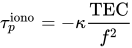
while the ionospheric group delay has the same magnitude but opposite sign:
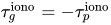
The ionospheric delay is normally expressed in units of length (meters), assuming a delay duration (in seconds) multiplied by the vacuum speed of light (in m/s). The proportionality constant κ reads:[2]: eq.(9.21), (9.20), (9.19), (9.14) [3]

where q, me, re are the electron charge, mass, and radius, respectively; c is the vacuum speed of light and ϵ0 is the vacuum permittivity. The value of the constant is approximately κ ≈ 40.308193 m3·s−2;[4][5] the units can be expressed equivalently as m·m2·Hz2 to highlight the cancellation involved in yielding delays τ in meters, given f in Hz and TEC in m−2.
Typical daytime values of TEC are expressed on the scale from 0 to 100 TEC units. However, very small variations of 0.1-0.5 TEC units can be also extracted under the assumption of relatively constant observational biases.[6] These small TEC variations are related to medium-scale traveling ionospheric disturbances (MSTIDs).[7] These ionospheric disturbances are primarily generated by gravity waves propagating upward from lower atmosphere. [8]
References
[edit]- ^ B. Hofmann-Wellenhof; H. Lichtenegger & J. Collins (2001). Global Positioning System: Theory and Practice. New York: Springer-Verlag. ISBN 978-3-211-83534-0.
- ^ a b "9" (PDF), IERS Technical Note No.36
- ^ Hagen, Jon B. (2009-06-11). Radio-Frequency Electronics: Circuits and Applications. Cambridge University Press. ISBN 978-0-521-88974-2.
- ^ "Search results". www.google.com. [better source needed]
- ^ "Search results". www.google.com. [better source needed]
- ^ van de Kamp, M.; Pokhotelov, D.; Kauristie, K. (2014-12-17). "TID characterized using joint effort of incoherent scatter radar and GPS". Annales Geophysicae. 32 (12): 1511–1532. Bibcode:2014AnGeo..32.1511V. doi:10.5194/angeo-32-1511-2014.
- ^ Tsugawa, T.; Otsuka, Y.; Coster, A. J.; Saito, A. (2007-11-22). "Medium-scale traveling ionospheric disturbances detected with dense and wide TEC maps over North America". Geophysical Research Letters. Vol. 34, no. 22. doi:10.1029/2007GL031663. Retrieved 2023-01-23.
- ^ Günzkofer, F.; Pokhotelov, D.; Stober, G.; Mann, I.; Vadas, S.L.; Becker, E.; et al. (2023-10-18). "Inferring neutral winds in the ionospheric transition region from atmospheric-gravity-wave traveling-ionospheric-disturbance (AGW-TID) observations with the EISCAT VHF radar and the Nordic Meteor Radar Cluster". Annales Geophysicae. 41 (2): 409–428. doi:10.5194/angeo-41-409-2023.