


Von Staudt–Clausen theorem
In number theory, the von Staudt–Clausen theorem is a result determining the fractional part of Bernoulli numbers, found independently by Karl von Staudt (1840) and Thomas Clausen (1840).
Specifically, if n is a positive integer and we add 1/p to the Bernoulli number B2n for every prime p such that p − 1 divides 2n, we obtain an integer, i.e.,
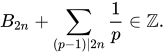
This fact immediately allows us to characterize the denominators of the non-zero Bernoulli numbers B2n as the product of all primes p such that p − 1 divides 2n; consequently the denominators are square-free and divisible by 6.
These denominators are
- 6, 30, 42, 30, 66, 2730, 6, 510, 798, 330, 138, 2730, 6, 870, 14322, 510, 6, 1919190, 6, 13530, ... (sequence A002445 in the OEIS).
The sequence of integers is
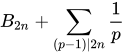
- 1, 1, 1, 1, 1, 1, 2, -6, 56, -528, 6193, -86579, 1425518, -27298230, ... (sequence A000146 in the OEIS).
Proof[edit]
A proof of the Von Staudt–Clausen theorem follows from an explicit formula for Bernoulli numbers which is:
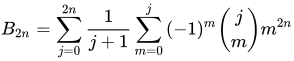
and as a corollary:
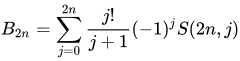
where are the Stirling numbers of the second kind.

Furthermore the following lemmas are needed:
Let p be a prime number then,
1. If p-1 divides 2n then,

2. If p-1 does not divide 2n then,

Proof of (1) and (2): One has from Fermat's little theorem,

for .
If p-1 divides 2n then one has,


for .
Thereafter one has,

from which (1) follows immediately.
If p-1 does not divide 2n then after Fermat's theorem one has,

If one lets (Greatest integer function) then after iteration one has,
![{\displaystyle \wp =[{\frac {2n}{p-1}}]}](https://wikimedia.org/api/rest_v1/media/math/render/svg/6416a18c5a398e8f5676aa37189121330f0c52f1)

for and .
Thereafter one has,


Lemma (2) now follows from the above and the fact that S(n,j)=0 for j>n.
(3). It is easy to deduce that for a>2 and b>2, ab divides (ab-1)!.
(4). Stirling numbers of second kind are integers.
Proof of the theorem: Now we are ready to prove Von-Staudt Clausen theorem,
If j+1 is composite and j>3 then from (3), j+1 divides j!.
For j=3,

If j+1 is prime then we use (1) and (2) and if j+1 is composite then we use (3) and (4) to deduce:
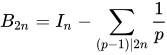
where is an integer, which is the Von-Staudt Clausen theorem.[1][2]

See also[edit]
References[edit]
- Clausen, Thomas (1840), "Theorem", Astronomische Nachrichten, 17 (22): 351–352, doi:10.1002/asna.18400172204
- Rado, R. (1934), "A New Proof of a Theorem of V. Staudt", J. London Math. Soc., 9 (2): 85–88, doi:10.1112/jlms/s1-9.2.85
- von Staudt, Ch. (1840), "Beweis eines Lehrsatzes, die Bernoullischen Zahlen betreffend", Journal für die Reine und Angewandte Mathematik, 21: 372–374, ISSN 0075-4102, ERAM 021.0672cj