


Consistency
In classical, deductive logic, a consistent theory is one that does not lead to a logical contradiction.[1] A theory is consistent if there is no formula such that both and its negation are elements of the set of consequences of . Let be a set of closed sentences (informally "axioms") and the set of closed sentences provable from under some (specified, possibly implicitly) formal deductive system. The set of axioms is consistent when there is no formula such that and . A trivial theory (i.e., one which proves every sentence in the language of the theory) is clearly inconsistent. Conversely, in an explosive formal system (e.g., classical or intuitionistic propositional or first-order logics) every inconsistent theory is trivial.[2]: 7 Consistency of a theory is a syntactic notion, whose semantic counterpart is satisfiability. A theory is satisfiable if it has a model, i.e., there exists an interpretation under which all axioms in the theory are true.[3] This is what consistent meant in traditional Aristotelian logic, although in contemporary mathematical logic the term satisfiable is used instead.


In a sound formal system, every satisfiable theory is consistent, but the converse does not hold. If there exists a deductive system for which these semantic and syntactic definitions are equivalent for any theory formulated in a particular deductive logic, the logic is called complete.[citation needed] The completeness of the propositional calculus was proved by Paul Bernays in 1918[citation needed][4] and Emil Post in 1921,[5] while the completeness of (first order) predicate calculus was proved by Kurt Gödel in 1930,[6] and consistency proofs for arithmetics restricted with respect to the induction axiom schema were proved by Ackermann (1924), von Neumann (1927) and Herbrand (1931).[7] Stronger logics, such as second-order logic, are not complete.
A consistency proof is a mathematical proof that a particular theory is consistent.[8] The early development of mathematical proof theory was driven by the desire to provide finitary consistency proofs for all of mathematics as part of Hilbert's program. Hilbert's program was strongly impacted by the incompleteness theorems, which showed that sufficiently strong proof theories cannot prove their consistency (provided that they are consistent).
Although consistency can be proved using model theory, it is often done in a purely syntactical way, without any need to reference some model of the logic. The cut-elimination (or equivalently the normalization of the underlying calculus if there is one) implies the consistency of the calculus: since there is no cut-free proof of falsity, there is no contradiction in general.
Consistency and completeness in arithmetic and set theory
[edit]In theories of arithmetic, such as Peano arithmetic, there is an intricate relationship between the consistency of the theory and its completeness. A theory is complete if, for every formula φ in its language, at least one of φ or ¬φ is a logical consequence of the theory.
Presburger arithmetic is an axiom system for the natural numbers under addition. It is both consistent and complete.
Gödel's incompleteness theorems show that any sufficiently strong recursively enumerable theory of arithmetic cannot be both complete and consistent. Gödel's theorem applies to the theories of Peano arithmetic (PA) and primitive recursive arithmetic (PRA), but not to Presburger arithmetic.
Moreover, Gödel's second incompleteness theorem shows that the consistency of sufficiently strong recursively enumerable theories of arithmetic can be tested in a particular way. Such a theory is consistent if and only if it does not prove a particular sentence, called the Gödel sentence of the theory, which is a formalized statement of the claim that the theory is indeed consistent. Thus the consistency of a sufficiently strong, recursively enumerable, consistent theory of arithmetic can never be proven in that system itself. The same result is true for recursively enumerable theories that can describe a strong enough fragment of arithmetic—including set theories such as Zermelo–Fraenkel set theory (ZF). These set theories cannot prove their own Gödel sentence—provided that they are consistent, which is generally believed.
Because consistency of ZF is not provable in ZF, the weaker notion relative consistency is interesting in set theory (and in other sufficiently expressive axiomatic systems). If T is a theory and A is an additional axiom, T + A is said to be consistent relative to T (or simply that A is consistent with T) if it can be proved that if T is consistent then T + A is consistent. If both A and ¬A are consistent with T, then A is said to be independent of T.
First-order logic
[edit]Notation
[edit]In the following context of mathematical logic, the turnstile symbol means "provable from". That is, reads: b is provable from a (in some specified formal system).


Definition
[edit]- A set of formulas in first-order logic is consistent (written ) if there is no formula such that and . Otherwise is inconsistent (written ).
- is said to be simply consistent if for no formula of , both and the negation of are theorems of .[clarification needed]
- is said to be absolutely consistent or Post consistent if at least one formula in the language of is not a theorem of .
- is said to be maximally consistent if is consistent and for every formula , implies .
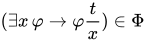
- is said to contain witnesses if for every formula of the form there exists a term such that , where denotes the substitution of each in by a ; see also First-order logic.[citation needed]






Basic results
[edit]- The following are equivalent:
- For all
- Every satisfiable set of formulas is consistent, where a set of formulas is satisfiable if and only if there exists a model such that .
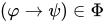
- For all and :
- if not , then ;
- if and , then ;
- if , then or .
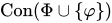
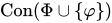
- Let be a maximally consistent set of formulas and suppose it contains witnesses. For all and :
- if , then ,
- either or ,
- if and only if or ,
- if and , then ,
- if and only if there is a term such that .[citation needed]







Henkin's theorem
[edit]Let be a set of symbols. Let be a maximally consistent set of -formulas containing witnesses.

Define an equivalence relation on the set of -terms by if , where denotes equality. Let denote the equivalence class of terms containing ; and let where is the set of terms based on the set of symbols .


Define the -structure over , also called the term-structure corresponding to , by:


- for each -ary relation symbol , define if [9]
- for each -ary function symbol , define
- for each constant symbol , define


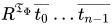





Define a variable assignment by for each variable . Let be the term interpretation associated with .



Then for each -formula :


Sketch of proof
[edit]There are several things to verify. First, that is in fact an equivalence relation. Then, it needs to be verified that (1), (2), and (3) are well defined. This falls out of the fact that is an equivalence relation and also requires a proof that (1) and (2) are independent of the choice of class representatives. Finally, can be verified by induction on formulas.

Model theory
[edit]In ZFC set theory with classical first-order logic,[10] an inconsistent theory is one such that there exists a closed sentence such that contains both and its negation . A consistent theory is one such that the following logically equivalent conditions hold



See also
[edit]

- Cognitive dissonance
- Equiconsistency
- Hilbert's problems
- Hilbert's second problem
- Jan Łukasiewicz
- Paraconsistent logic
- ω-consistency
- Gentzen's consistency proof
- Proof by contradiction
Notes
[edit]- ^ Tarski 1946 states it this way: "A deductive theory is called consistent or non-contradictory if no two asserted statements of this theory contradict each other, or in other words, if of any two contradictory sentences … at least one cannot be proved," (p. 135) where Tarski defines contradictory as follows: "With the help of the word not one forms the negation of any sentence; two sentences, of which the first is a negation of the second, are called contradictory sentences" (p. 20). This definition requires a notion of "proof". Gödel 1931 defines the notion this way: "The class of provable formulas is defined to be the smallest class of formulas that contains the axioms and is closed under the relation "immediate consequence", i.e., formula c of a and b is defined as an immediate consequence in terms of modus ponens or substitution; cf Gödel 1931, van Heijenoort 1967, p. 601. Tarski defines "proof" informally as "statements follow one another in a definite order according to certain principles … and accompanied by considerations intended to establish their validity [true conclusion] for all true premises – Reichenbach 1947, p. 68]" cf Tarski 1946, p. 3. Kleene 1952 defines the notion with respect to either an induction or as to paraphrase) a finite sequence of formulas such that each formula in the sequence is either an axiom or an "immediate consequence" of the preceding formulas; "A proof is said to be a proof of its last formula, and this formula is said to be (formally) provable or be a (formal) theorem" cf Kleene 1952, p. 83.
- ^ Carnielli, Walter; Coniglio, Marcelo Esteban (2016). Paraconsistent logic: consistency, contradiction and negation. Logic, Epistemology, and the Unity of Science. Vol. 40. Cham: Springer. doi:10.1007/978-3-319-33205-5. ISBN 978-3-319-33203-1. MR 3822731. Zbl 1355.03001.
- ^ Hodges, Wilfrid (1997). A Shorter Model Theory. New York: Cambridge University Press. p. 37.
Let be a signature, a theory in and a sentence in . We say that is a consequence of , or that entails , in symbols , if every model of is a model of . (In particular if has no models then entails .)
(Please note the definition of Mod(T) on p. 30 ...)
Warning: we don't require that if then there is a proof of from . In any case, with infinitary languages, it's not always clear what would constitute proof. Some writers use to mean that is deducible from in some particular formal proof calculus, and they write for our notion of entailment (a notation which clashes with our ). For first-order logic, the two kinds of entailment coincide by the completeness theorem for the proof calculus in question.
We say that is valid, or is a logical theorem, in symbols , if is true in every -structure. We say that is consistent if is true in some -structure. Likewise, we say that a theory is consistent if it has a model.
We say that two theories S and T in L infinity omega are equivalent if they have the same models, i.e. if Mod(S) = Mod(T). - ^ van Heijenoort 1967, p. 265 states that Bernays determined the independence of the axioms of Principia Mathematica, a result not published until 1926, but he says nothing about Bernays proving their consistency.
- ^ Post proves both consistency and completeness of the propositional calculus of PM, cf van Heijenoort's commentary and Post's 1931 Introduction to a general theory of elementary propositions in van Heijenoort 1967, pp. 264ff. Also Tarski 1946, pp. 134ff.
- ^ cf van Heijenoort's commentary and Gödel's 1930 The completeness of the axioms of the functional calculus of logic in van Heijenoort 1967, pp. 582ff.
- ^ cf van Heijenoort's commentary and Herbrand's 1930 On the consistency of arithmetic in van Heijenoort 1967, pp. 618ff.
- ^ A consistency proof often assumes the consistency of another theory. In most cases, this other theory is Zermelo–Fraenkel set theory with or without the axiom of choice (this is equivalent since these two theories have been proved equiconsistent; that is, if one is consistent, the same is true for the other).
- ^ This definition is independent of the choice of due to the substitutivity properties of and the maximal consistency of .
- ^ the common case in many applications to other areas of mathematics as well as the ordinary mode of reasoning of informal mathematics in calculus and applications to physics, chemistry, engineering
- ^ according to De Morgan's laws


References
[edit]- Gödel, Kurt (1 December 1931). "Über formal unentscheidbare Sätze der Principia Mathematica und verwandter Systeme I". Monatshefte für Mathematik und Physik. 38 (1): 173–198. doi:10.1007/BF01700692.
- Kleene, Stephen (1952). Introduction to Metamathematics. New York: North-Holland. ISBN 0-7204-2103-9. 10th impression 1991.
- Reichenbach, Hans (1947). Elements of Symbolic Logic. New York: Dover. ISBN 0-486-24004-5.
- Tarski, Alfred (1946). Introduction to Logic and to the Methodology of Deductive Sciences (Second ed.). New York: Dover. ISBN 0-486-28462-X.
- van Heijenoort, Jean (1967). From Frege to Gödel: A Source Book in Mathematical Logic. Cambridge, MA: Harvard University Press. ISBN 0-674-32449-8. (pbk.)
- "Consistency". The Cambridge Dictionary of Philosophy.
- Ebbinghaus, H. D.; Flum, J.; Thomas, W. Mathematical Logic.
- Jevons, W. S. (1870). Elementary Lessons in Logic.
External links
[edit]
- Mortensen, Chris (2017). "Inconsistent Mathematics". Stanford Encyclopedia of Philosophy.
| Functional: |  | |
|---|---|---|
| Formal: | ||
| Negation | ||
| General | |||||||||
|---|---|---|---|---|---|---|---|---|---|
| Theorems (list) and paradoxes | |||||||||
| Logics |
| ||||||||
| Set theory |
| ||||||||
| Formal systems (list), language and syntax |
| ||||||||
| Proof theory | |||||||||
| Model theory | |||||||||
| Computability theory | |||||||||
| Related | |||||||||

| Authority control databases: National |
|---|
