Tricolored brushfinch
| Tricolored brushfinch | |
|---|---|
| Tricolored brush finch | |
| Scientific classification | |
| Kingdom: | Animalia |
| Phylum: | Chordata |
| Class: | Aves |
| Order: | Passeriformes |
| Family: | Passerellidae |
| Genus: | Atlapetes |
| Species: | A. tricolor |
| Binomial name | |
| Atlapetes tricolor (Taczanowski, 1875) | |
The tricolored brushfinch or golden-crowned brushfinch[2] (Atlapetes tricolor) is a species of bird in the family Passerellidae, the New World sparrows. It is endemic to Peru.[3]
Taxonomy and systematics
[edit]The tricolored brushfinch was formally described in 1875 with the binomial Buarremon tricolor.[4] In the early twentieth century genus Buarremon was merged into Atlapetes.[5]
For a time what is now the Choco brushfinch (A. crassus), which had been described as a species, was considered a subspecies of the tricolored brushfinch. As early as 1960 an author advocated returning it to full species status.[6] By 2012 the IOC had recognized it as a species.[7] In 2014 BirdLife International's Handbook of the Birds of the World followed suit as did the Clements taxonomy in 2024. (Clements called it the golden-crowned brushfinch to avoid confusion with the two-subspecies predecessor.)[8][9] The first version of AviList in 2025 also recognized it.[10] However, as of February 2026 the independent South American Classification Committee has declined to recognize the split but has a proposal to do so under consideration.[5][11]
Description
[edit]The tricolored brushfinch is 16 to 18 cm (6.3 to 7.1 in) long and weighs about 36 g (1.3 oz). The sexes have the same plumage. Adults have a yellow to ocraceous crown and nape and a black face. Their back is dark olive to olive-citrine and their rump and uppertail coverts are olive. Their tail is blackish and their wings dusky gray with dark olive feather edges. Their throat and underparts are yellow with a strong olive wash that is darkest on the sides, flanks, vent, and undertail coverts. They have a deep reddish brown iris, a black bill, and grayish or dusky black legs and feet. Juveniles are dark brown above and lighter brown below with a dark rufous crown.[12]
Distribution and habitat
[edit]The tricolored brushfinch is found in Peru on the eastern slope of the Andes between northern La Libertad Department and west-central Cuzco Department. It inhabits the shrubby edges and openings of humid forest, secondary forest, and open cloudforest.[12][13] Sources differ on its elevational range. One says it is mostly between 1,525 and 3,050 m (5,000 and 10,000 ft)[12] and another between 1,750 and 3,050 m (5,700 and 10,000 ft)[13].
Behavior
[edit]Movement
[edit]The tricolored brushfinch is a year-round resident.[12]
Feeding
[edit]The tricolored brushfinch's diet has not been studied. It is known to forage up to about 10 m (35 ft) above ground, in contrast to many other brushfinches which forage mainly near the ground. It forages alone and in pairs, and seldom joins mixed-species feeding flocks.[12]
Breeding
[edit]Some scanty evidence suggests that the tricolored brushfinch breeds between February and July. Nothing else is known about the species' breeding biology.[12]
Vocalization
[edit]The tricolored brushfinch's song is "pleasant, 2 or 3 parts usually with 2 long, descending introductory notes followed by a more rapid series of notes". Excited pairs duet "a long chattering phrase: pi tuee-chi tu-tu-tu zzz TEW TEW TEW TEW". The species' call is "a high ti".[13]
Status
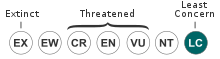
[edit]The IUCN has assessed the tricolored brushfinch as being of Least Concern. Its population size is not known and is believed to be decreasing. No immediate threats have been identified.[1] It is considered uncommon to fairly common.[13] It occurs in at least two national parks.[12]
References
[edit]- 1 2 BirdLife International (2025). "Tricolored Brushfinch Atlapetes tricolor". IUCN Red List of Threatened Species. 2025 e.T103774148A281034542. doi:10.2305/IUCN.UK.2025-2.RLTS.T103774148A281034542.en. Retrieved 24 May 2026.
- ↑ Clements, J. F., P. C. Rasmussen, T. S. Schulenberg, M. J. Iliff, J. A. Gerbracht, D. Lepage, A. Spencer, S. M. Billerman, B. L. Sullivan, M. Smith, and C. L. Wood. 2025. The eBird/Clements checklist of Birds of the World: v2025. Downloaded from https://www.birds.cornell.edu/clementschecklist/download/ retrieved November 3, 2025
- 1 2 Gill, Frank; Donsker, David; Rasmussen, Pamela, eds. (April 2026). "New World sparrows". IOC World Bird List. v 15.2. Retrieved 26 April 2026.
- ↑ Taczanowski, Władysław (1875). "Liste des Oiseaux recueillis par M. Constantin Jelskidans la partie centrale du Pérou occidental". Proceedings of the Zoological Society of London (in Latin and French). 1874: 516. Retrieved May 24, 2026. The journal issue was published in 1875 "for the year 1874".
- 1 2 Remsen, J. V., Jr., J. I. Areta, E. Bonaccorso, S. Claramunt, D. F. Lane, L, N. Naka, M. B. Robbins, F. G. Stiles, and K. J. Zimmer. Version 27 February 2026. A classification of the bird species of South America. South American Classification Committee associated with the International Ornithologists' Union. https://www.museum.lsu.edu/~Remsen/SACCBaseline.htm retrieved February 28, 2026
- ↑ Miller, A. H. (1960). "Additional data on the distribution of some Colombian birds". Novedades Colombianas 1:235–237.
- ↑ Gill, F and D Donsker (Eds). 2012. IOC World Bird List (v 3.1) https://www.worldbirdnames.org/ioc-lists/crossref/
- ↑ BirdLife International (2014) The BirdLife checklist of the birds of the world: [old] Version 7. Downloaded from http://www.birdlife.org/datazone/userfiles/file/Species/Taxonomy/BirdLife_Checklist_Version_70.zip
- ↑ Clements, J. F., P.C. Rasmussen, T. S. Schulenberg, M. J. Iliff, T. A. Fredericks, J. A. Gerbracht, D. Lepage, A. Spencer, S. M. Billerman, B. L. Sullivan, M. Smith, and C. L. Wood. 2024. The eBird/Clements checklist of birds of the world: v2024. Downloaded from https://www.birds.cornell.edu/clementschecklist/download/ retrieved 23 October 2024
- ↑ AviList Core Team. 2025. AviList: The Global Avian Checklist, v2025. https://doi.org/10.2173/avilist.v2025 retrieved June 11, 2025
- ↑ Freeman, Benjamin (2018). "Proposal (754) to South American Classification Committee: Elevate 13 taxa to species rank based on playback experiments". Proposal Roster. South American Classification Committee. Retrieved 24 May 2026.
- 1 2 3 4 5 6 7 Kirwan, G. M., A. Jaramillo, P. F. D. Boesman, J. del Hoyo, and N. Collar (2024). Golden-crowned Brushfinch (Atlapetes tricolor), version 1.0. In Birds of the World (B. K. Keeney, S. M. Billerman, and T. S. Schulenberg, Editors). Cornell Lab of Ornithology, Ithaca, NY, USA. https://doi.org/10.2173/bow.tribrf2.01 retrieved May 24, 2026
- 1 2 3 4 Schulenberg, T.S.; Stotz, D.F.; Lane, D.F.; O'Neill, J.P.; Parker, T.A. III (2010). Birds of Peru. Princeton Field Guides (revised and updated ed.). Princeton, NJ: Princeton University Press. p. 604. ISBN 978-0691130231.