


Psi (Greek)

 | This article needs additional citations for verification. (May 2013) |
 | ||||||||||||||||||||||||||||||||||||||||||||||||
| Greek alphabet | ||||||||||||||||||||||||||||||||||||||||||||||||
|---|---|---|---|---|---|---|---|---|---|---|---|---|---|---|---|---|---|---|---|---|---|---|---|---|---|---|---|---|---|---|---|---|---|---|---|---|---|---|---|---|---|---|---|---|---|---|---|---|
|
||||||||||||||||||||||||||||||||||||||||||||||||
| History | ||||||||||||||||||||||||||||||||||||||||||||||||
| Use in other languages | ||||||||||||||||||||||||||||||||||||||||||||||||
| Related topics | ||||||||||||||||||||||||||||||||||||||||||||||||


Psi /ˈ(p)saɪ, ˈ(p)siː/ (P)SY, (P)SEE[1] (uppercase Ψ, lowercase ψ or 𝛙; Greek: ψι psi [ˈpsi]) is the twenty-third and penultimate letter of the Greek alphabet and is associated with a numeric value of 700. In both Classical and Modern Greek, the letter indicates the combination /ps/ (as in English word "lapse").
For Greek loanwords in Latin and modern languages with Latin alphabets, psi is usually transliterated as "ps".
The letter's origin is uncertain. It may or may not derive from the Phoenician alphabet. It appears in the 7th century BC, expressing /ps/ in the Eastern alphabets, but /kʰ/ in the Western alphabets (the sound expressed by Χ in the Eastern alphabets). In writing, the early letter appears in an angular shape ( ).
There were early graphical variants that omitted the stem ("chickenfoot-shaped psi" as:
).
There were early graphical variants that omitted the stem ("chickenfoot-shaped psi" as:  or
or  ).
).
The Western letter (expressing /kʰ/, later /x/) was adopted into the Old Italic alphabets, and its shape is also continued into the Algiz rune of the Elder Futhark.
Psi, or its Arcadian variant  or
or  was adopted in the Latin alphabet in the form of "Antisigma" (Ↄ, ↃC, or 𐌟) during the reign of Emperor Claudius as one of the three Claudian letters.[2] However, it was abandoned after his death.
The classical Greek letter was adopted into the early Cyrillic alphabet as "Ѱ".
Use as a symbol
The letter psi is commonly used in physics to represent wave functions in quantum mechanics, such as in the Schrödinger equation and bra–ket notation: . It is also used to represent the (generalized) positional states of a qubit in a quantum computer.

Psi is also used as the symbol for the polygamma function, defined by
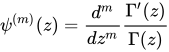
where is the gamma function.

The letters Ψ or ψ can also be a symbol for:
- Psychology, psychiatry, and sometimes parapsychology (involving paranormal or relating with the supernatural subjects, especially research into extrasensory perception).
- In mathematics, the reciprocal Fibonacci constant, the division polynomials, and the supergolden ratio.
- Water potential in movement of water between plant cells.
- In biochemistry, it denotes pseudouridine, an uncommon nucleoside.[3]
- Stream function in fluid mechanics defining the curve to which the flow velocity is always tangent.
- One of the dihedral angles in the backbones of proteins.
- The planet Neptune.
- Indiana University (as a superimposed I and U).[4]
- A sai, the name of which is pronounced the same way in English.
- Pharmacology, general pharmacy.
- In virology the ψ site is a viral packaging signal.
- The J/ψ meson, in particle physics.
- In the computability theory, represents the return value of a program .
- In circadian physiology, ψ represents the phase relationship between a zeitgeber and a biological rhythm.
- In building, to represent an adjustment to a U-value, accounting for thermal bridge effects.
- The ordinal collapsing function and notation developed by Wilfried Buchholz.[5]
- In Biblical studies, as an abbreviation for the book of Psalms.[6]


Character encodings
- Greek / Coptic Psi
| Preview | Ψ | ψ | ᴪ | Ⲯ | ⲯ | |||||
|---|---|---|---|---|---|---|---|---|---|---|
| Unicode name | GREEK CAPITAL LETTER PSI | GREEK SMALL LETTER PSI | GREEK LETTER SMALL CAPITAL PSI | COPTIC CAPITAL LETTER PSI | COPTIC SMALL LETTER PSI | |||||
| Encodings | decimal | hex | dec | hex | dec | hex | dec | hex | dec | hex |
| Unicode | 936 | U+03A8 | 968 | U+03C8 | 7466 | U+1D2A | 11438 | U+2CAE | 11439 | U+2CAF |
| UTF-8 | 206 168 | CE A8 | 207 136 | CF 88 | 225 180 170 | E1 B4 AA | 226 178 174 | E2 B2 AE | 226 178 175 | E2 B2 AF |
| Numeric character reference | Ψ |
Ψ |
ψ |
ψ |
ᴪ |
ᴪ |
Ⲯ |
Ⲯ |
ⲯ |
ⲯ |
| Named character reference | Ψ | ψ | ||||||||
| DOS Greek | 150 | 96 | 175 | AF | ||||||
| DOS Greek-2 | 212 | D4 | 246 | F6 | ||||||
| Windows 1253 | 216 | D8 | 248 | F8 | ||||||
| TeX | \Psi | \psi | ||||||||
- Cyrillic Psi
| Preview | Ѱ | ѱ | ||
|---|---|---|---|---|
| Unicode name | CYRILLIC CAPITAL LETTER PSI | CYRILLIC SMALL LETTER PSI | ||
| Encodings | decimal | hex | dec | hex |
| Unicode | 1136 | U+0470 | 1137 | U+0471 |
| UTF-8 | 209 176 | D1 B0 | 209 177 | D1 B1 |
| Numeric character reference | Ѱ |
Ѱ |
ѱ |
ѱ |
- Mathematical Psi
| Preview | 𝚿 | 𝛙 | 𝛹 | 𝜓 | 𝜳 | 𝝍 | ||||||
|---|---|---|---|---|---|---|---|---|---|---|---|---|
| Unicode name | MATHEMATICAL BOLD CAPITAL PSI |
MATHEMATICAL BOLD SMALL PSI |
MATHEMATICAL ITALIC CAPITAL PSI |
MATHEMATICAL ITALIC SMALL PSI |
MATHEMATICAL BOLD ITALIC CAPITAL PSI |
MATHEMATICAL BOLD ITALIC SMALL PSI | ||||||
| Encodings | decimal | hex | dec | hex | dec | hex | dec | hex | dec | hex | dec | hex |
| Unicode | 120511 | U+1D6BF | 120537 | U+1D6D9 | 120569 | U+1D6F9 | 120595 | U+1D713 | 120627 | U+1D733 | 120653 | U+1D74D |
| UTF-8 | 240 157 154 191 | F0 9D 9A BF | 240 157 155 153 | F0 9D 9B 99 | 240 157 155 185 | F0 9D 9B B9 | 240 157 156 147 | F0 9D 9C 93 | 240 157 156 179 | F0 9D 9C B3 | 240 157 157 141 | F0 9D 9D 8D |
| UTF-16 | 55349 57023 | D835 DEBF | 55349 57049 | D835 DED9 | 55349 57081 | D835 DEF9 | 55349 57107 | D835 DF13 | 55349 57139 | D835 DF33 | 55349 57165 | D835 DF4D |
| Numeric character reference | 𝚿 |
𝚿 |
𝛙 |
𝛙 |
𝛹 |
𝛹 |
𝜓 |
𝜓 |
𝜳 |
𝜳 |
𝝍 |
𝝍 |
| Preview | 𝝭 | 𝞇 | 𝞧 | 𝟁 | ||||
|---|---|---|---|---|---|---|---|---|
| Unicode name | MATHEMATICAL SANS-SERIF BOLD CAPITAL PSI |
MATHEMATICAL SANS-SERIF BOLD SMALL PSI |
MATHEMATICAL SANS-SERIF BOLD ITALIC CAPITAL PSI |
MATHEMATICAL SANS-SERIF BOLD ITALIC SMALL PSI | ||||
| Encodings | decimal | hex | dec | hex | dec | hex | dec | hex |
| Unicode | 120685 | U+1D76D | 120711 | U+1D787 | 120743 | U+1D7A7 | 120769 | U+1D7C1 |
| UTF-8 | 240 157 157 173 | F0 9D 9D AD | 240 157 158 135 | F0 9D 9E 87 | 240 157 158 167 | F0 9D 9E A7 | 240 157 159 129 | F0 9D 9F 81 |
| UTF-16 | 55349 57197 | D835 DF6D | 55349 57223 | D835 DF87 | 55349 57255 | D835 DFA7 | 55349 57281 | D835 DFC1 |
| Numeric character reference | 𝝭 |
𝝭 |
𝞇 |
𝞇 |
𝞧 |
𝞧 |
𝟁 |
𝟁 |
These characters are used only as mathematical symbols. Stylized Greek text should be encoded using the normal Greek letters, with markup and formatting to indicate text style.
See also

Notes and references
- ^ "psi". The Chambers Dictionary (9th ed.). Chambers. 2003. ISBN 0-550-10105-5.
- ^ Oliver, Revilo P. (1949). "The Claudian Letter Ⱶ". American Journal of Archaeology. 53 (3): 249–257. doi:10.2307/500662. JSTOR 500662. S2CID 193082268.
- ^ IUPAC-IUB Commission on Biochemical Nomenclature (1970). "Abbreviations and symbols for nucleic acids, polynucleotides, and their constituents". Biochemistry. 9 (20): 4022–4027. doi:10.1021/bi00822a023.
- ^ Although the university itself refers to its logo as a trident, not the Greek letter psi: "The IU trident—the only logo at Indiana University". Indiana University. Retrieved 2020-07-31.
At IU, the trident is the only logo we use, both institution-wide and at the unit level.
- ^ Buchholz, W. (1986). "A new System of proof-theoretic ordinal functions" (PDF). Ann. Pure Appl. Logic. 32 (3): 195–207. doi:10.1016/0168-0072(86)90052-7.
- ^ Gesenius' Hebrew Grammar
- ^ Unicode Code Charts: Greek and Coptic (Range: 0370-03FF)