From Wikipedia, the free encyclopedia
In mathematics , the Bell series is a formal power series used to study properties of arithmetical functions. Bell series were introduced and developed by Eric Temple Bell .
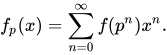
Given an arithmetic function
f
{\displaystyle f}
prime
p
{\displaystyle p}
power series
f
p
(
x
)
{\displaystyle f_{p}(x)}
f
{\displaystyle f}
p
{\displaystyle p}
f
p
(
x
)
=
∑
n
=
0
∞
f
(
p
n
)
x
n
.
{\displaystyle f_{p}(x)=\sum _{n=0}^{\infty }f(p^{n})x^{n}.}
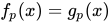
Two multiplicative functions can be shown to be identical if all of their Bell series are equal; this is sometimes called the uniqueness theorem : given multiplicative functions
f
{\displaystyle f}
g
{\displaystyle g}
f
=
g
{\displaystyle f=g}
if and only if :
f
p
(
x
)
=
g
p
(
x
)
{\displaystyle f_{p}(x)=g_{p}(x)}
p
{\displaystyle p}
Two series may be multiplied (sometimes called the multiplication theorem ): For any two arithmetic functions
f
{\displaystyle f}
g
{\displaystyle g}
h
=
f
∗
g
{\displaystyle h=f*g}
Dirichlet convolution . Then for every prime
p
{\displaystyle p}
h
p
(
x
)
=
f
p
(
x
)
g
p
(
x
)
.
{\displaystyle h_{p}(x)=f_{p}(x)g_{p}(x).\,}
In particular, this makes it trivial to find the Bell series of a Dirichlet inverse .
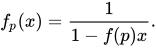
If
f
{\displaystyle f}
completely multiplicative , then formally:
f
p
(
x
)
=
1
1
−
f
(
p
)
x
.
{\displaystyle f_{p}(x)={\frac {1}{1-f(p)x}}.}
Examples [ edit ] The following is a table of the Bell series of well-known arithmetic functions.
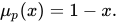
The Möbius function
μ
{\displaystyle \mu }
μ
p
(
x
)
=
1
−
x
.
{\displaystyle \mu _{p}(x)=1-x.}
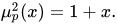
The Mobius function squared has
μ
p
2
(
x
)
=
1
+
x
.
{\displaystyle \mu _{p}^{2}(x)=1+x.}
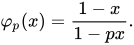
Euler's totient
φ
{\displaystyle \varphi }
φ
p
(
x
)
=
1
−
x
1
−
p
x
.
{\displaystyle \varphi _{p}(x)={\frac {1-x}{1-px}}.}
The multiplicative identity of the Dirichlet convolution
δ
{\displaystyle \delta }
δ
p
(
x
)
=
1.
{\displaystyle \delta _{p}(x)=1.}
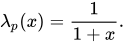
The Liouville function
λ
{\displaystyle \lambda }
λ
p
(
x
)
=
1
1
+
x
.
{\displaystyle \lambda _{p}(x)={\frac {1}{1+x}}.}
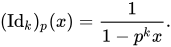
The power function Idk
(
Id
k
)
p
(
x
)
=
1
1
−
p
k
x
.
{\displaystyle ({\textrm {Id}}_{k})_{p}(x)={\frac {1}{1-p^{k}x}}.}
k
Id
k
(
n
)
=
n
k
{\displaystyle \operatorname {Id} _{k}(n)=n^{k}}
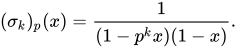
The divisor function
σ
k
{\displaystyle \sigma _{k}}
(
σ
k
)
p
(
x
)
=
1
(
1
−
p
k
x
)
(
1
−
x
)
.
{\displaystyle (\sigma _{k})_{p}(x)={\frac {1}{(1-p^{k}x)(1-x)}}.}
The constant function , with value 1, satisfies
1
p
(
x
)
=
(
1
−
x
)
−
1
{\displaystyle 1_{p}(x)=(1-x)^{-1}}
geometric series .
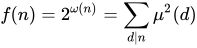
If
f
(
n
)
=
2
ω
(
n
)
=
∑
d
|
n
μ
2
(
d
)
{\displaystyle f(n)=2^{\omega (n)}=\sum _{d|n}\mu ^{2}(d)}
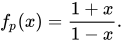
prime omega function , then
f
p
(
x
)
=
1
+
x
1
−
x
.
{\displaystyle f_{p}(x)={\frac {1+x}{1-x}}.}
Suppose that f is multiplicative and g is any arithmetic function satisfying
f
(
p
n
+
1
)
=
f
(
p
)
f
(
p
n
)
−
g
(
p
)
f
(
p
n
−
1
)
{\displaystyle f(p^{n+1})=f(p)f(p^{n})-g(p)f(p^{n-1})}
p and
n
≥
1
{\displaystyle n\geq 1}
f
p
(
x
)
=
(
1
−
f
(
p
)
x
+
g
(
p
)
x
2
)
−
1
.
{\displaystyle f_{p}(x)=\left(1-f(p)x+g(p)x^{2}\right)^{-1}.}
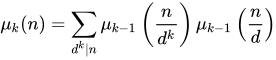
If
μ
k
(
n
)
=
∑
d
k
|
n
μ
k
−
1
(
n
d
k
)
μ
k
−
1
(
n
d
)
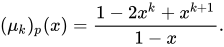
{\displaystyle \mu _{k}(n)=\sum _{d^{k}|n}\mu _{k-1}\left({\frac {n}{d^{k}}}\right)\mu _{k-1}\left({\frac {n}{d}}\right)}
Möbius function of order k , then
(
μ
k
)
p
(
x
)
=
1
−
2
x
k
+
x
k
+
1
1
−
x
.
{\displaystyle (\mu _{k})_{p}(x)={\frac {1-2x^{k}+x^{k+1}}{1-x}}.}
See also [ edit ] References [ edit ]