


Bernoulli differential equation
| Differential equations |
|---|
| Scope |
| Classification |
| Solution |
| People |
In mathematics, an ordinary differential equation is called a Bernoulli differential equation if it is of the form

where is a real number. Some authors allow any real ,[1][2] whereas others require that not be 0 or 1.[3][4] The equation was first discussed in a work of 1695 by Jacob Bernoulli, after whom it is named. The earliest solution, however, was offered by Gottfried Leibniz, who published his result in the same year and whose method is the one still used today.[5]

Bernoulli equations are special because they are nonlinear differential equations with known exact solutions. A notable special case of the Bernoulli equation is the logistic differential equation.
Transformation to a linear differential equation[edit]
When , the differential equation is linear. When , it is separable. In these cases, standard techniques for solving equations of those forms can be applied. For and , the substitution reduces any Bernoulli equation to a linear differential equation



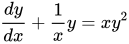
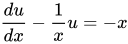
For example, in the case , making the substitution in the differential equation produces the equation , which is a linear differential equation.


Solution[edit]
Let and

![{\displaystyle {\begin{cases}z:(a,b)\rightarrow (0,\infty ),&{\text{if }}\alpha \in \mathbb {R} \smallsetminus \{1,2\},\\[4pt]z:(a,b)\rightarrow \mathbb {R} \smallsetminus \{0\},&{\text{if }}\alpha =2,\end{cases}}}](https://wikimedia.org/api/rest_v1/media/math/render/svg/8e3445c58b0b5a1610f20f8a0ed36faf16fc5896)
be a solution of the linear differential equation

Then we have that is a solution of
![{\displaystyle y(x):=[z(x)]^{1/(1-\alpha )}}](https://wikimedia.org/api/rest_v1/media/math/render/svg/766d4f218d646a3a7554205a2a1e3aa6e9e29241)
![{\displaystyle y'(x)=P(x)y(x)+Q(x)y^{\alpha }(x)\ ,\ y(x_{0})=y_{0}:=[z(x_{0})]^{1/(1-\alpha )}.}](https://wikimedia.org/api/rest_v1/media/math/render/svg/a34d0b0b8f031548097c4f5015e31a817f7ae1cf)
And for every such differential equation, for all we have as solution for .


Example[edit]
Consider the Bernoulli equation
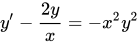
(in this case, more specifically a Riccati equation). The constant function is a solution. Division by yields


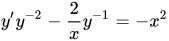
Changing variables gives the equations
![{\displaystyle {\begin{aligned}u={\frac {1}{y}}\;&,~u'={\frac {-y'}{y^{2}}}\\[5pt]-u'-{\frac {2}{x}}u&=-x^{2}\\[5pt]u'+{\frac {2}{x}}u&=x^{2}\end{aligned}}}](https://wikimedia.org/api/rest_v1/media/math/render/svg/98f9c86e3784079b43bca4756eaeadf12974b462)
which can be solved using the integrating factor

Multiplying by ,


The left side can be represented as the derivative of by reversing the product rule. Applying the chain rule and integrating both sides with respect to results in the equations


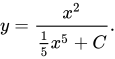
![{\displaystyle {\begin{aligned}\int \left(ux^{2}\right)'dx&=\int x^{4}\,dx\\[5pt]ux^{2}&={\frac {1}{5}}x^{5}+C\\[5pt]{\frac {1}{y}}x^{2}&={\frac {1}{5}}x^{5}+C\end{aligned}}}](https://wikimedia.org/api/rest_v1/media/math/render/svg/b4cb793962b9fa7d23ee641e01c72277ae644914)
The solution for is

Notes[edit]
- ^ Zill, Dennis G. (2013). A First Course in Differential Equations with Modeling Applications (10th ed.). Boston, Massachusetts: Cengage Learning. p. 73. ISBN 9780357088364.
- ^ Stewart, James (2015). Calculus: Early Transcendentals (8th ed.). Boston, Massachusetts: Cengage Learning. p. 625. ISBN 9781305482463.
- ^ Rozov, N. Kh. (2001) [1994], "Bernoulli equation", Encyclopedia of Mathematics, EMS Press
- ^ Teschl, Gerald (2012). "1.4. Finding explicit solutions" (PDF). Ordinary Differential Equations and Dynamical Systems. Graduate Studies in Mathematics. Providence, Rhode Island: American Mathematical Society. p. 15. eISSN 2376-9203. ISBN 978-0-8218-8328-0. ISSN 1065-7339. Zbl 1263.34002.
- ^ Parker, Adam E. (2013). "Who Solved the Bernoulli Differential Equation and How Did They Do It?" (PDF). The College Mathematics Journal. 44 (2): 89–97. ISSN 2159-8118 – via Mathematical Association of America.
References[edit]
- Bernoulli, Jacob (1695), "Explicationes, Annotationes & Additiones ad ea, quae in Actis sup. de Curva Elastica, Isochrona Paracentrica, & Velaria, hinc inde memorata, & paratim controversa legundur; ubi de Linea mediarum directionum, alliisque novis", Acta Eruditorum. Cited in Hairer, Nørsett & Wanner (1993).
- Hairer, Ernst; Nørsett, Syvert Paul; Wanner, Gerhard (1993), Solving ordinary differential equations I: Nonstiff problems, Berlin, New York: Springer-Verlag, ISBN 978-3-540-56670-0.