


Riccati equation
In mathematics, a Riccati equation in the narrowest sense is any first-order ordinary differential equation that is quadratic in the unknown function. In other words, it is an equation of the form

where and . If the equation reduces to a Bernoulli equation, while if the equation becomes a first order linear ordinary differential equation.


The equation is named after Jacopo Riccati (1676–1754).[1]
More generally, the term Riccati equation is used to refer to matrix equations with an analogous quadratic term, which occur in both continuous-time and discrete-time linear-quadratic-Gaussian control. The steady-state (non-dynamic) version of these is referred to as the algebraic Riccati equation.
Conversion to a second order linear equation[edit]
The non-linear Riccati equation can always be converted to a second order linear ordinary differential equation (ODE):[2] If

then, wherever is non-zero and differentiable, satisfies a Riccati equation of the form


where and , because

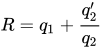

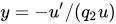
Substituting , it follows that satisfies the linear 2nd order ODE



since

so that

and hence

A solution of this equation will lead to a solution of the original Riccati equation.
Application to the Schwarzian equation[edit]
An important application of the Riccati equation is to the 3rd order Schwarzian differential equation

which occurs in the theory of conformal mapping and univalent functions. In this case the ODEs are in the complex domain and differentiation is with respect to a complex variable. (The Schwarzian derivative has the remarkable property that it is invariant under Möbius transformations, i.e. whenever is non-zero.) The function satisfies the Riccati equation




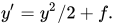
By the above where is a solution of the linear ODE


Since , integration gives for some constant . On the other hand any other independent solution of the linear ODE has constant non-zero Wronskian which can be taken to be after scaling. Thus




so that the Schwarzian equation has solution

Obtaining solutions by quadrature[edit]
The correspondence between Riccati equations and second-order linear ODEs has other consequences. For example, if one solution of a 2nd order ODE is known, then it is known that another solution can be obtained by quadrature, i.e., a simple integration. The same holds true for the Riccati equation. In fact, if one particular solution can be found, the general solution is obtained as


Substituting

in the Riccati equation yields

and since

it follows that

or

which is a Bernoulli equation. The substitution that is needed to solve this Bernoulli equation is

Substituting

directly into the Riccati equation yields the linear equation

A set of solutions to the Riccati equation is then given by
where z is the general solution to the aforementioned linear equation.
See also[edit]
References[edit]
- ^ Riccati, Jacopo (1724) "Animadversiones in aequationes differentiales secundi gradus" (Observations regarding differential equations of the second order), Actorum Eruditorum, quae Lipsiae publicantur, Supplementa, 8 : 66-73. Translation of the original Latin into English by Ian Bruce.
- ^ Ince, E. L. (1956) [1926], Ordinary Differential Equations, New York: Dover Publications, pp. 23–25
Further reading[edit]
- Hille, Einar (1997) [1976], Ordinary Differential Equations in the Complex Domain, New York: Dover Publications, ISBN 0-486-69620-0
- Nehari, Zeev (1975) [1952], Conformal Mapping, New York: Dover Publications, ISBN 0-486-61137-X
- Polyanin, Andrei D.; Zaitsev, Valentin F. (2003), Handbook of Exact Solutions for Ordinary Differential Equations (2nd ed.), Boca Raton, Fla.: Chapman & Hall/CRC, ISBN 1-58488-297-2
- Zelikin, Mikhail I. (2000), Homogeneous Spaces and the Riccati Equation in the Calculus of Variations, Berlin: Springer-Verlag
- Reid, William T. (1972), Riccati Differential Equations, London: Academic Press
External links[edit]
- "Riccati equation", Encyclopedia of Mathematics, EMS Press, 2001 [1994]
- Riccati Equation at EqWorld: The World of Mathematical Equations.
- Riccati Differential Equation at Mathworld
- MATLAB function for solving continuous-time algebraic Riccati equation.
- SciPy has functions for solving the continuous algebraic Riccati equation and the discrete algebraic Riccati equation.