


Bijin-ga
 | This article includes a list of general references, but it lacks sufficient corresponding inline citations. (December 2014) |
_Three_Beauties_of_the_Present_Time,_MFAB_21.6382.jpg)
Bijin-ga (美人画, "beautiful person picture") is a generic term for pictures of beautiful women (bijin) in Japanese art, especially in woodblock printing of the ukiyo-e genre.
Definition
[edit]Kōjien defines bijin-ga as a picture that simply "emphasizes the beauty of women",[1] and the Shincho Encyclopedia of World Art defines it as depiction of "the beauty of a woman's appearance".[2] On the other hand, Gendai Nihon Bijin-ga Zenshū Meisaku-sen I defines bijin-ga as pictures that explore "the inner beauty of women".[3] For this reason, the essence of bijin-ga cannot always be expressed only through the depiction of a bijin, a woman aligning with the beauty image. In fact, in ukiyo-e bijin-ga, it was not considered important that the picture resemble the facial features of the model, and the depiction of women in ukiyo-e bijin-ga is stylized rather than an attempt to create a realistic image;[4] For example, throughout the Edo period (1603–1867), married women had a custom of shaving their eyebrows (hikimayu), but in bijin-ga, there was a rule to draw the eyebrows for married women.
History
[edit]Ukiyo-e itself is a genre of woodblock prints and paintings that was produced in Japan from the 17th century to the 19th century. The prints were very popular amongst the Japanese merchants and the middle class of the time.
From the Edo period to the Meiji period (1868–1912), the technical evolution of ukiyo-e processes increased, with the accuracy of carving and printing and the vividness of colors used developing through the introduction of new printing processes and synthetic dyes. This technical development can also be seen in ukiyo-e bijin-ga, and many painters of bijin-ga contributed to the evolution of ukiyo-e techniques and styles, with the aim of maximizing the realistic expression of a real beauty living in the artists' time period.[5]
Nearly all ukiyo-e artists produced bijin-ga, as it was one of the central themes of the genre. However, a few, including Utamaro, Suzuki Harunobu, Itō Shinsui, Toyohara Chikanobu, Uemura Shōen and Torii Kiyonaga, have been described as the greatest innovators and masters of the form.[citation needed]
Gallery
[edit]- Bijin-ga
-
 Bijin-ga by Keisai Eisen (1790–1848)
 -
 Woman Visiting the Shrine in the Night by Suzuki Harunobu (1725–1770)
 -
 Shin Bijin, Shin Bijin series, No. 12 by Yōshū Chikanobu (1838–1912)
 -
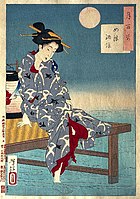 100 Aspects of the Moon by Yoshitoshi (1839–1892)
 -
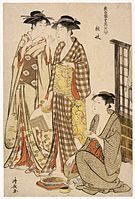 Two Women Standing from the series "Tosai Yuri Bijin Awase", by Torii Kiyonaga (1752–1815)
 -
 Woman with cherry flowers by Tsukioka Yoshitoshi
 -
 A Girl About to Despatch a Letter, by Torii Kiyomine (1786–1868)
 -
 The Courtesan Someyama of the Matsubaya house, from the series Contest of Beauties in the Gay Quarters, by Eishosai Choki (active from about 1786 to 1808)
 -
 Murasaki Shikibu, from the series "Mirror of Women, Ancient and Modern" (古今姫鏡) by Tsukioka Yoshitoshi (1839–1892)


-
 Woman in the night, by Suzuki Harunobu, c. 1765–1770
 -
 Bathhouse women, by Torii Kiyonaga (1752–1815)


See also
[edit]References
[edit]- ^ 新村出 (1967). 広辞苑. Iwanami Shoten. 美人画. OCLC 33931612.
- ^ Shinchō sekai bijutsu jiten = Shincho encyclopedia of world art. Shinchōsha, 新潮社. Tōkyō: Shinchōsha. 1985. 美人画. ISBN 4-10-730206-7. OCLC 15418683.
{{cite book}}: CS1 maint: others (link) - ^ 座右宝刊行会 (1979). 現代日本美人画全集. 集英社. 美人.
- ^ Kobayashi, Tadashi; 小林忠 (2002). Edo ukiyoe o yomu. Tōkyō: Chikuma Shobō. pp. 187–93. ISBN 4-480-05943-1. OCLC 50825592.
- ^ Horie, Mari (2017). 錦絵美人画の発展―春信・歌麿から芳年・周延までを軸として―(『美人画名品選―春信・歌麿から芳年・周延まで―』. 展図録所収、足立区立郷土博物館. pp. 2–5.
Further reading
[edit]- Forbes, Andrew; Henley, David (2012). Suzuki Harunobu: 100 Beauties. Chiang Mai: Cognoscenti Books. ASIN B00AC2NB8Y.
- Hamanaka, Shinji (2000). Female Image: 20th Century Prints of Japanese Beauties. Hotei Publishing. ISBN 90-74822-20-7.
External links
[edit]- Bijinga artworks gallery-sakura.com. Archived 2009-06-07 at the Wayback Machine.
| General |  | |
|---|---|---|
| Themes |
| |
| Region specific themes | ||
| Techniques | ||
| Schools | ||
| Related traditions | ||
| Authority control databases: National |
|---|

 | This article related to art or architecture in Japan is a stub. You can help Wikipedia by expanding it. |
_-_Google_Art_Project.jpg) | This printmaking-related article is a stub. You can help Wikipedia by expanding it. |