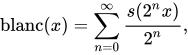
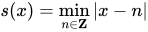
In mathematics, the blancmange curve is a self-affinefractal curve constructible by midpoint subdivision. It is also known as the Takagi curve, after Teiji Takagi who described it in 1901, or as the Takagi–Landsberg curve, a generalization of the curve named after Takagi and Georg Landsberg. The name blancmange comes from its resemblance to a Blancmange pudding. It is a special case of the more general de Rham curve.
The blancmange curve can be visually built up out of triangle wave functions if the infinite sum is approximated by finite sums of the first few terms. In the illustrations below, progressively finer triangle functions (shown in red) are added to the curve at each stage.
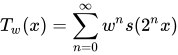
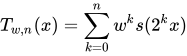
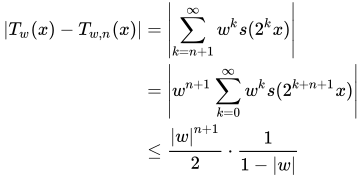
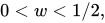
if The Takagi curve of parameter is defined on the unit interval (or ) if . The Takagi function of parameter is continuous. The functions defined by the partial sums
Since the absolute value is a subadditive function so is the function , and its dilations ; since positive linear combinations and point-wise limits of subadditive functions are subadditive, the Takagi function is subadditive for any value of the parameter .
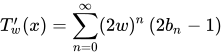
For values of the parameter the Takagi function is differentiable in the classical sense at any which is not a dyadic rational. By derivation under the sign of series, for any non dyadic rational one finds
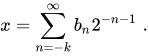
where is the sequence of binary digits in the base 2 expansion of :
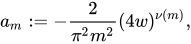
Equivalently, the bits in the binary expansion can be understood as a sequence of square waves, the Haar wavelets, scaled to width This follows, since the derivative of the triangle wave is just the square wave:
and so
For the parameter the function is Lipschitz of constant In particular for the special value one finds, for any non dyadic rational , according with the mentioned
For the blancmange function it is of bounded variation on no non-empty open set; it is not even locally Lipschitz, but it is quasi-Lipschitz, indeed, it admits the function as a modulus of continuity .
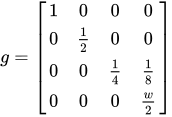
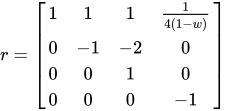
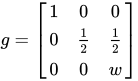
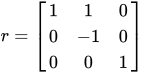
The recursive definition allows the monoid of self-symmetries of the curve to be given. This monoid is given by two generators, g and r, which act on the curve (restricted to the unit interval) as
and
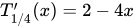
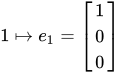
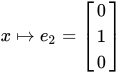
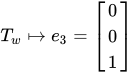
A general element of the monoid then has the form for some integers This acts on the curve as a linear function: for some constants a, b and c. Because the action is linear, it can be described in terms of a vector space, with the vector space basis:
In this representation, the action of g and r are given by
and
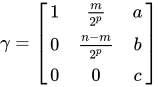
That is, the action of a general element maps the blancmange curve on the unit interval [0,1] to a sub-interval for some integers m, n, p. The mapping is given exactly by where the values of a, b and c can be obtained directly by multiplying out the above matrices. That is:
Note that is immediate.
The monoid generated by g and r is sometimes called the dyadic monoid; it is a sub-monoid of the modular group. When discussing the modular group, the more common notation for g and r is T and S, but that notation conflicts with the symbols used here.
The above three-dimensional representation is just one of many representations it can have; it shows that the blancmange curve is one possible realization of the action. That is, there are representations for any dimension, not just 3; some of these give the de Rham curves.
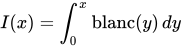
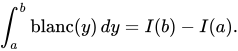
Given that the integral of from 0 to 1 is 1/2, the identity allows the integral over any interval to be computed by the following relation. The computation is recursive with computing time on the order of log of the accuracy required. Defining
A more general expression can be obtained by defining
which, combined with the series representation, gives
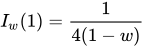
Note that
This integral is also self-similar on the unit interval, under an action of the dyadic monoid described in the section Self similarity. Here, the representation is 4-dimensional, having the basis . The action of g on the unit interval is the commuting diagram
From this, one can then immediately read off the generators of the four-dimensional representation:
and
Repeated integrals transform under a 5,6,... dimensional representation.
Takagi, Teiji (1901), "A Simple Example of the Continuous Function without Derivative", Proc. Phys.-Math. Soc. Jpn., 1: 176–177, doi:10.11429/subutsuhokoku1901.1.F176
Benoit Mandelbrot, "Fractal Landscapes without creases and with rivers", appearing in The Science of Fractal Images, ed. Heinz-Otto Peitgen, Dietmar Saupe; Springer-Verlag (1988) pp 243–260.
























 parameter w = 2/3
 parameter w = 1/2
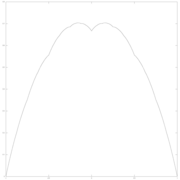 parameter w = 1/3
 parameter w = 1/4
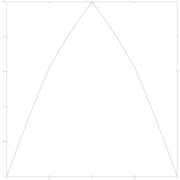 parameter w = 1/8









![{\displaystyle x\in [0,1]}](https://wikimedia.org/api/rest_v1/media/math/render/svg/64a15936df283add394ab909aa7a5e24e7fb6bb2)











=T_{w}\left(g\cdot x\right)=T_{w}\left({\frac {x}{2}}\right)={\frac {x}{2}}+wT_{w}(x)}](https://wikimedia.org/api/rest_v1/media/math/render/svg/80f034a1c5a31e0450f85eeddfb63b70991e300f)
=T_{w}(r\cdot x)=T_{w}(1-x)=T_{w}(x).}](https://wikimedia.org/api/rest_v1/media/math/render/svg/288657b954a7fa30be7fc8ce85bfb6e11c5da16b)




![{\displaystyle [m/2^{p},n/2^{p}]}](https://wikimedia.org/api/rest_v1/media/math/render/svg/b2acb3583829325eec7ea50efa165a45b3385898)
=a+bx+cT_{w}(x)}](https://wikimedia.org/api/rest_v1/media/math/render/svg/932dcafe233d050f126f04a32d13dee690b55c6d)







=I_{w}\left(g\cdot x\right)=I_{w}\left({\frac {x}{2}}\right)={\frac {x^{2}}{8}}+{\frac {w}{2}}I_{w}(x).}](https://wikimedia.org/api/rest_v1/media/math/render/svg/c9b4166fbddbfd1c3d3c2b076e835b0a8d2b5159)