


Butterfly plan

A Butterfly plan, also known as a Double Suntrap plan, is a type of architectural plan in which two or more wings of a house are constructed at an angle to the core, usually at approximately 45 degrees to the wall of the core building.[1] It was used primarily in late Victorian architecture and during the early Arts and Crafts movement.
History[edit]
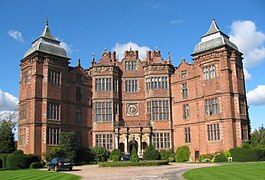
Westwood House, Worcestershire, was a 17-century precursor.[2] After the original, rectangular house was begun c. 1612, four diagonal wings were added at some time later in the same century.[3]
Victorian interest in the plan originated in the 1891 remodelling of Chesters, Northumberland, by Norman Shaw.[2] To the original, square house of 1771 he added five wings; three of these were diagonal, creating suntrap flanks for the south and west fronts.[4]
The principle of the butterfly plan was also re-adapted within an overall rectangular overall form, as for instance in Kallio Library in Helsinki, Finland, by architect Karl Hård af Segerstad, completed in 1902.
Notable Arts and Crafts examples:
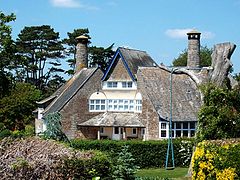
- The Barn, Exmouth, Devon, by Edward Schroeder Prior (1897)[5]
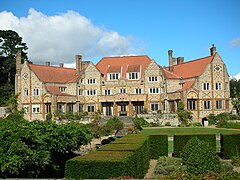
- Happisburgh Manor, Happisburgh, Norfolk, by Detmar Blow to a concept by Ernest Gimson (1900)[6]
- Papillon Hall, Lubenham, Leicestershire,. David Papillon (1581-1659) a French Huguenot and Military architect built it in 1620.[7] [8] In about 1903 it was redesigned by Edwin Lutyens and demolished in 1950 [9][7]
- Home Place, Kelling, Norfolk, by Edward Schroeder Prior (1903–4)[10]
- Kelling Hall, Kelling, Norfolk, by Edward Maufe (1913)[11]
- Yaffle Hill, Broadstone, Dorset, by Edward Maufe (1930)[12]
Gallery[edit]
-
-
-
-

-
 Kallio Library, Helsinki


References[edit]
- ^ "English Heritage Online thesaurus butterfly plan". Archived from the original on 2011-07-18. Retrieved 2010-04-21.
- ^ a b Beckett, Matthew (24 October 2012). "The Butterfly House". New architecture blog. Country Life. Retrieved 24 October 2015.
- ^ Brooks, Alan; Pevsner, Nikolaus (2007). The Buildings of England: Worcestershire. New Haven: Yale University Press. pp. 653–56. ISBN 978-0-300-11298-6.
- ^ Historic England. "Chesters (1155585)". National Heritage List for England. Retrieved 24 October 2015.
- ^ Historic England. "The Barn (1164569)". National Heritage List for England. Retrieved 25 October 2015.
- ^ Drury, Michael (2000), Wandering Architects: In Pursuit of the Arts and Crafts Ideal, Shaun Tyas. ISBN 190028913X
- ^ a b "Papillon Hall | England's Lost Country Houses". www.lostheritage.org.uk. Retrieved 2020-03-30.
- ^ "Lubenham | British History Online". www.british-history.ac.uk. Retrieved 2020-03-30.
- ^ Cantor, Leonard (1998), Historic Country Houses in Leicestershire and Rutland. Kairos Press. ISBN 1871344182
- ^ Historic England. "Thornfield residential home for the elderly (1049826)". National Heritage List for England. Retrieved 25 October 2015.
- ^ Historic England. "Kelling Hall (1151974)". National Heritage List for England. Retrieved 25 October 2015.
- ^ Historic England. "Yaffle House and attached screen wall (1275360)". National Heritage List for England. Retrieved 25 October 2015.