A cardioidThe caustic appearing on the surface of this cup of coffee is a cardioid.
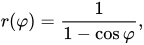
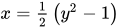
In geometry, a cardioid (from Greekκαρδιά (kardiá) 'heart') is a plane curve traced by a point on the perimeter of a circle that is rolling around a fixed circle of the same radius. It can also be defined as an epicycloid having a single cusp. It is also a type of sinusoidal spiral, and an inverse curve of the parabola with the focus as the center of inversion.[1] A cardioid can also be defined as the set of points of reflections of a fixed point on a circle through all tangents to the circle.[2]
Cardioid generated by a rolling circle on a circle with the same radius
The name was coined by Giovanni Salvemini in 1741[3] but the cardioid had been the subject of study decades beforehand.[4] Although named for its heart-like form, it is shaped more like the outline of the cross-section of a round apple without the stalk.
A cardioid microphone exhibits an acoustic pickup pattern that, when graphed in two dimensions, resembles a cardioid (any 2d plane containing the 3d straight line of the microphone body). In three dimensions, the cardioid is shaped like an apple centred around the microphone which is the "stalk" of the apple.
Generation of a cardioid and the coordinate system used
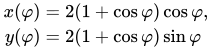
Let be the common radius of the two generating circles with midpoints , the rolling angle and the origin the starting point (see picture). One gets the
A proof can be established using complex numbers and their common description as the complex plane. The rolling movement of the black circle on the blue one can be split into two rotations. In the complex plane a rotation around point (the origin) by an angle can be performed by multiplying a point (complex number) by . Hence
the rotation around point is,
the rotation around point is: .
A point of the cardioid is generated by rotating the origin around point and subsequently rotating around by the same angle :
From here one gets the parametric representation above:
Remark: Not every inverse curve of a parabola is a cardioid. For example, if a parabola is inverted across a circle whose center lies at the vertex of the parabola, then the result is a cissoid of Diocles.
In the previous section if one inverts additionally the tangents of the parabola one gets a pencil of circles through the center of inversion (origin). A detailed consideration shows: The midpoints of the circles lie on the perimeter of the fixed generator circle. (The generator circle is the inverse curve of the parabola's directrix.)
This property gives rise to the following simple method to draw a cardioid:
Choose a circle and a point on its perimeter,
draw circles containing with centers on , and
draw the envelope of these circles.
Proof with envelope condition
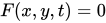
The envelope of the pencil of implicitly given curves
with parameter consists of such points which are solutions of the non-linear system
Let be the circle with midpoint and radius . Then has parametric representation . The pencil of circles with centers on containing point can be represented implicitly by
which is equivalent to
The second envelope condition is
One easily checks that the points of the cardioid with the parametric representation
fulfill the non-linear system above. The parameter is identical to the angle parameter of the cardioid.
Despite the two angles have different meanings (s. picture) one gets for the same line. Hence any secant line of the circle, defined above, is a tangent of the cardioid, too:
The cardioid is the envelope of the chords of a circle.
Remark:
The proof can be performed with help of the envelope conditions (see previous section) of an implicit pencil of curves:
is the pencil of secant lines of a circle (s. above) and
For fixed parameter t both the equations represent lines. Their intersection point is
which is a point of the cardioid with polar equation
Cardioid as caustic: light source , light ray , reflected ray Cardioid as caustic of a circle with light source (right) on the perimeter
The considerations made in the previous section give a proof that the caustic of a circle with light source on the perimeter of the circle is a cardioid.
If in the plane there is a light source at a point on the perimeter of a circle which is reflecting any ray, then the reflected rays within the circle are tangents of a cardioid.
Proof
As in the previous section the circle may have midpoint and radius . Its parametric representation is
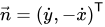
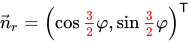
The tangent at circle point has normal vector . Hence the reflected ray has the normal vector (see graph) and contains point . The reflected ray is part of the line with equation (see previous section)
which is tangent of the cardioid with polar equation
from the previous section.
Remark: For such considerations usually multiple reflections at the circle are neglected.
In a Cartesian coordinate system circle may have midpoint and radius . The tangent at circle point has the equation
The foot of the perpendicular from point on the tangent is point with the still unknown distance to the origin . Inserting the point into the equation of the tangent yields
which is the polar equation of a cardioid.
Remark: If point is not on the perimeter of the circle , one gets a limaçon of Pascal.
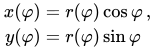
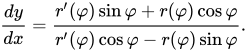
For a curve given in polar coordinates by a function the following connection to Cartesian coordinates hold:
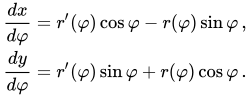
and for the derivatives
Dividing the second equation by the first yields the Cartesian slope of the tangent line to the curve at the point :
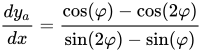
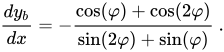
For the cardioids with the equations and respectively one gets:
and
(The slope of any curve depends on only, and not on the parameters or !)
Hence
That means: Any curve of the first pencil intersects any curve of the second pencil orthogonally.
4 cardioids in polar representation and their position in the coordinate system
Choosing other positions of the cardioid within the coordinate system results in different equations. The picture shows the 4 most common positions of a cardioid and their polar equations.
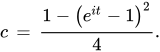
In complex analysis, the image of any circle through the origin under the map is a cardioid. One application of this result is that the boundary of the central period-1 component of the Mandelbrot set is a cardioid given by the equation
The Mandelbrot set contains an infinite number of slightly distorted copies of itself and the central bulb of any of these smaller copies is an approximate cardioid.
Certain caustics can take the shape of cardioids. The catacaustic of a circle with respect to a point on the circumference is a cardioid. Also, the catacaustic of a cone with respect to rays parallel to a generating line is a surface whose cross section is a cardioid. This can be seen, as in the photograph to the right, in a conical cup partially filled with liquid when a light is shining from a distance and at an angle equal to the angle of the cone.[5] The shape of the curve at the bottom of a cylindrical cup is half of a nephroid, which looks quite similar.








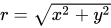











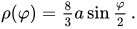




![{\displaystyle \rho (\varphi )={\frac {\left[r(\varphi )^{2}+{\dot {r}}(\varphi )^{2}\right]^{3/2}}{r(\varphi )^{2}+2{\dot {r}}(\varphi )^{2}-r(\varphi ){\ddot {r}}(\varphi )}}\ .}](https://wikimedia.org/api/rest_v1/media/math/render/svg/1e7cf0dc8bbc7c290a5046d1002a3ad215646126)

![{\displaystyle \rho (\varphi )=\cdots ={\frac {\left[16a^{2}\sin ^{2}{\frac {\varphi }{2}}\right]^{\frac {3}{2}}}{24a^{2}\sin ^{2}{\frac {\varphi }{2}}}}={\frac {8}{3}}a\sin {\frac {\varphi }{2}}\ .}](https://wikimedia.org/api/rest_v1/media/math/render/svg/93226b1c859be822160a3403fd366ef703eb1db4)