


Cassini and Catalan identities
Cassini's identity (sometimes called Simson's identity) and Catalan's identity are mathematical identities for the Fibonacci numbers. Cassini's identity, a special case of Catalan's identity, states that for the nth Fibonacci number,

Note here is taken to be 0, and is taken to be 1.


Catalan's identity generalizes this:

Vajda's identity generalizes this:

History[edit]
Cassini's formula was discovered in 1680 by Giovanni Domenico Cassini, then director of the Paris Observatory, and independently proven by Robert Simson (1753).[1] However Johannes Kepler presumably knew the identity already in 1608.[2]
Catalan's identity is named after Eugène Catalan (1814–1894). It can be found in one of his private research notes, entitled "Sur la série de Lamé" and dated October 1879. However, the identity did not appear in print until December 1886 as part of his collected works (Catalan 1886). This explains why some give 1879 and others 1886 as the date for Catalan's identity (Tuenter 2022, p. 314).
The Hungarian-British mathematician Steven Vajda (1901–95) published a book on Fibonacci numbers (Fibonacci and Lucas Numbers, and the Golden Section: Theory and Applications, 1989) which contains the identity carrying his name.[3][4] However, the identity had been published earlier in 1960 by Dustan Everman as problem 1396 in The American Mathematical Monthly,[1] and in 1901 by Alberto Tagiuri in Periodico di Matematica.[5]
Proof of Cassini identity[edit]
Proof by matrix theory[edit]
A quick proof of Cassini's identity may be given (Knuth 1997, p. 81) by recognising the left side of the equation as a determinant of a 2×2 matrix of Fibonacci numbers. The result is almost immediate when the matrix is seen to be the nth power of a matrix with determinant −1:
![{\displaystyle F_{n-1}F_{n+1}-F_{n}^{2}=\det \left[{\begin{matrix}F_{n+1}&F_{n}\\F_{n}&F_{n-1}\end{matrix}}\right]=\det \left[{\begin{matrix}1&1\\1&0\end{matrix}}\right]^{n}=\left(\det \left[{\begin{matrix}1&1\\1&0\end{matrix}}\right]\right)^{n}=(-1)^{n}.}](https://wikimedia.org/api/rest_v1/media/math/render/svg/d33c58ed530977ce60f18c7a87e3aa18c0c35bd4)
Proof by induction[edit]
Consider the induction statement:

The base case is true.

Assume the statement is true for . Then:






so the statement is true for all integers .

Proof of Catalan identity[edit]
We use Binet's formula, that , where and .
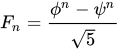

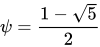
Hence, and .


So,




Using ,

and again as ,


The Lucas number is defined as , so



Because




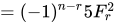
Cancelling the 's gives the result.

Notes[edit]
- ^ a b Thomas Koshy: Fibonacci and Lucas Numbers with Applications. Wiley, 2001, ISBN 9781118031315, pp. 74-75, 83, 88
- ^ Miodrag Petkovic: Famous Puzzles of Great Mathematicians. AMS, 2009, ISBN 9780821848142, S. 30-31
- ^ Douglas B. West: Combinatorial Mathematics. Cambridge University Press, 2020, p. 61
- ^ Steven Vadja: Fibonacci and Lucas Numbers, and the Golden Section: Theory and Applications. Dover, 2008, ISBN 978-0486462769, p. 28 (original publication 1989 at Ellis Horwood)
- ^ Alberto Tagiuri: Equation (3) in Di alcune successioni ricorrenti a termini interi e positivi, Periodico di Matematica 16 (1901), pp. 1–12.
References[edit]
- Catalan, Eugène-Charles (December 1886). "CLXXXIX. — Sur la série de Lamé". Mémoires de la Société Royale des Sciences de Liège, Deuxième Série. 13: 319–321.
- Knuth, Donald Ervin (1997), The Art of Computer Programming, Volume 1: Fundamental Algorithms, The Art of Computer Programming, vol. 1 (3rd ed.), Reading, Mass: Addison-Wesley, ISBN 0-201-89683-4
- Simson, R. (1753). "An Explication of an Obscure Passage in Albert Girard's Commentary upon Simon Stevin's Works". Philosophical Transactions of the Royal Society of London. 48: 368–376. doi:10.1098/rstl.1753.0056.
- Tuenter, Hans J. H. (November 2022). "Fibonacci Summation Identities arising from Catalan's Identity". The Fibonacci Quarterly. 60 (4): 312–319. MR 4539699. Zbl 1512.11025.
- Werman, M.; Zeilberger, D. (1986). "A bijective proof of Cassini's Fibonacci identity". Discrete Mathematics. 58 (1): 109. doi:10.1016/0012-365X(86)90194-9. MR 0820846.