


Cola acuminata
 | This article needs additional citations for verification. (December 2019) |
| Cola acuminata | |
|---|---|
.jpg)
| |
Scientific classification 
| |
| Kingdom: | Plantae |
| Clade: | Tracheophytes |
| Clade: | Angiosperms |
| Clade: | Eudicots |
| Clade: | Rosids |
| Order: | Malvales |
| Family: | Malvaceae |
| Genus: | Cola |
| Species: | C. acuminata
|
| Binomial name | |
| Cola acuminata | |
| Synonyms | |
|
Sterculia acuminata | |
Cola acuminata is a species in the genus Cola, of the family Malvaceae, native to tropical Africa. It is generally known for its fruit, the kola nut, originally used to impart the cola flavor in manufactured beverages, such as Coca-Cola.[1][2]
Description
[edit]The kola tree mainly inhabits lowlands, and is medium-sized with low branches, grey or dark green bark, dark green leaves, and white flowers pollinated by insects.[1] It usually grows to a height of about 13–20 metres (43–66 ft), is hardy to zones 10-12 (USDA), and is vulnerable to frost.[1] The tree prefers moist, sandy, loam or clay soils that are well-drained with neutral acidity.[1] It requires sun exposure and can tolerate drought.[1]
Fruits
[edit]The fruits are rough, mottled and up to 8 inches (20 cm) long and contain large, flat and bright red coloured seeds, commonly known as kola nuts.[2] The seed contains 1.25 - 2.4% caffeine, and can be chewed or ground into a powder added to beverages to increase alertness, diminish fatigue, and increase stamina.[1] These seeds are unique in having as many as six cotyledons, the greatest number of any dicot. 99.99% of dicots have two cotyledons. [3]
Uses
[edit]Its fruits are harvested from the forests of West Africa.[2] The fruits contain about 2% catechin-caffeine, theobromine and kolatin. They are roasted, pounded or chewed, and can be added to drinks, such as tea or milk, or cereal such as porridge.[2] When the whole nuts are chewed, they have a bitter flavour, but leave a sweet aftertaste that enhances flavour and sweetness of other foods in the meal.[1]
In Africa, kola nuts may be used in traditional medicine or as a food colorant, while the wood may be used as fuel, or for making furniture, houses or boats.[1]
Gallery
[edit]-
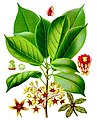 Cola acuminata in flower : coloured plate from Köhler's Medizinal-Pflanzen
 -
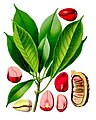 Cola acuminata in fruit, also from Köhler's Medizinal-Pflanzen
 -
 Botanical line drawing of anatomy of C. acuminata, showing warty exterior of pod, from Du Niger au golfe de Guiné..., by Louis Gustave Binger
 -
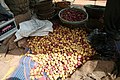 Kola nuts spread out for sale in the central market in Ouagadougou, Burkina Faso
 -
 Dried kola nuts and chewing sticks harvested from C. acuminata


References
[edit]- ^ a b c d e f g h "Cola acuminata - (P.Beauv.) Schott & Endl". Plants For A Future. 2012. Retrieved 23 December 2019.
- ^ a b c d Veronique Greenwood (23 September 2016). "The little-known nut that gave Coca-Cola its name". BBC News - Future. Retrieved 23 December 2019.
These days, the Coca-Cola recipe is a closely guarded secret. But it's said to no longer contain kola nut extract, relying instead on artificial imitations to achieve the flavour
- ^ Keay andOnochie , Nigerian trees , Lagos: Govt printing .page 229)
| Authority control databases: National |
|---|

 | This Sterculioideae article is a stub. You can help Wikipedia by expanding it. |