


Common grackle
| Common grackle Temporal range:
| |
|---|---|

| |
Scientific classification 
| |
| Domain: | Eukaryota |
| Kingdom: | Animalia |
| Phylum: | Chordata |
| Class: | Aves |
| Order: | Passeriformes |
| Family: | Icteridae |
| Genus: | Quiscalus |
| Species: | Q. quiscula
|
| Binomial name | |
| Quiscalus quiscula | |

| |
| Approximate range in North America Breeding range Year-round range Wintering range
| |
| Synonyms | |
|
Gracula quiscula Linnaeus, 1758 | |


.jpg)

The common grackle (Quiscalus quiscula) is a species of large icterid bird found in large numbers through much of North America. First described in 1758 by Carl Linnaeus, the common grackle has three subspecies. Adult common grackles have a long and dark bill, pale yellow eyes, and a long tail. Adults often have an iridescent appearance on their head, especially males. Common grackles can be found widely across North America east of the Rocky Mountains.
Taxonomy
[edit]The common grackle was first described in 1758 by Carl Linnaeus in the tenth edition of Systema Naturae, as Gracula quiscula. It was assigned to the genus Quiscalus by French ornithologist Louis Pierre Vieillot in his 1816 Dictionnaire d'histoire naturelle.[3]
Three subspecies are recognized:[4][5]
- the Florida grackle (Q. q. quiscula) (Linnaeus 1758), the nominate subspecies
- the purple grackle (Q. q. stonei) (Chapman, 1935)[6]
- the bronzed grackle (Q. q. versicolor) (Vieillot, 1816)
Description
[edit]
Adult common grackles measure from 28 to 34 cm (11 to 13 in) in length, span 36–46 cm (14–18 in) across the wings, and weigh 74–142 g (2.6–5.0 oz).[7] Common grackles are less sexually dimorphic than larger grackle species, but the differences between the sexes can still be noticeable. The male, which averages 122 g (4.3 oz), is larger than the female, at an average of 94 g (3.3 oz).[8] Adults have a long, dark bill, pale yellowish eyes, and a long tail; their feathers appear black with purple, green, or blue iridescence on the head, and primarily bronze sheen in the body plumage. Adult females, beyond being smaller, are usually less iridescent; their tails in particular are shorter, and unlike the males, do not keel (display a longitudinal ridge) in flight and are brown with no purple or blue gloss. Juveniles are brown with dark brown eyes.
When grackles are in a group, they are referred to as a "plague".[9]
Distribution and habitat
[edit]

The breeding habitat is open and semiopen areas across North America east of the Rocky Mountains. The nest is a well-concealed cup in dense trees (particularly pine) or shrubs, usually near water; sometimes, the common grackle nests in cavities or in man-made structures. It often nests in colonies, some being quite large. Bird houses are also a suitable nesting site. Four to seven eggs are in a clutch.
This bird is a permanent resident in much of its range. Northern birds migrate in flocks to the Southeastern United States. The distribution of the common grackle is largely explained by annual mean temperature, and the species has expanded its range by greater than three-fold since the last glacial maximum, approximately 22,000 years ago.[10]
Ecology and behavior
[edit]Foraging and diet
[edit]_-_DPLA_-_6344e4b51fa8dcc7120d63d690bb4a5f.jpg)
The common grackle forages on the ground, in shallow water, or in shrubs; it may steal food from other birds. It is omnivorous, eating insects, minnows, frogs, eggs, berries, seeds, grain, and even small birds and rodents. Grackles at outdoor eating areas often wait eagerly until someone drops some food. They rush forward and try to grab it, often snatching food out of the beak of another bird. Grackles prefer to eat from the ground at bird feeders, making scattered seed an excellent choice of food for them. Grackles can be regularly seen foraging for insects, especially after a lawn trimming.
Grackles have a unique adaptation in the keel within their bill which allows them to crack and cut hard nuts or kernels. The keel projects downward from the horny palate and is sharper and more abrupt anterior. It extends below the level of the tomium and is used in a sawing motion to score open acorns or dried kernels. Larger adductor muscles within their jaw compared to those of other icterids make this adaptation even more useful for opening hard seeds and acorns.[11]
Along with some other species of grackles, the common grackle is known to practice "anting", rubbing insects on its feathers possibly to apply liquids such as formic acid secreted by the insects.
Vocals
[edit]The grackle's song is particularly harsh, especially when these birds, in a flock, are calling. Songs vary from year-round chewink chewink to a more complex breeding season ooo whew, whew, whew, whew, whew call that gets faster and faster and ends with a loud crewhewwhew! It also occasionally sounds like a power line buzzing. The grackle can also mimic the sounds of other birds or even humans, though not as precisely as the mockingbird, which is known to share its habitat in the Southeastern United States.
Breeding
[edit]In the breeding season, males tip their heads back and fluff up feathers to display and keep other males away. This same behavior is used as a defensive posture to attempt to intimidate predators. Male common grackles are less aggressive toward one another, and more cooperative and social, than the larger boat-tailed grackle species.
Relationship with humans
[edit]The range of this bird expanded west as forests were cleared. In some areas, it is now considered a pest by farmers because of its large numbers and fondness for grain. Despite a currently robust population, a recent study by the National Audubon Society of data from the Christmas Bird Count indicated that populations had declined by 61% to a population of 73 million from historic highs of over 190 million birds.[12] As a result, it is now classified by the IUCN as Near Threatened.
Unlike many birds, the common grackle benefits from the expansion of human populations due to its resourceful and opportunistic nature. Common grackles are considered to be a serious threat to crops by some, and are notoriously difficult to control; this usually requires the use of hawks or similar large birds of prey.[13]
Proposed magnetoreceptivity
[edit]Though the exact mechanism is poorly understood, several studies have examined the ability of the common grackle to interpret the Earth's magnetic field—or in this case, the variability of it. The common grackle (like most of its Quiscalus relatives) has been found to be attuned to a dynamic magnetic field to a scientifically significant degree.[14]
Gallery
[edit]-
 Juvenile and adult together
 -
 Iridescent back and head
 -
 Iridescence in direct sunlight
 -

-
 Chick
Chick -
 An albino grackle in Peterborough, Ontario
 -
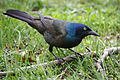 Male feeding in grass
 -
 In Ontario, Canada
 -
 Common grackle on a wood piling, Connecticut River


.jpg)

References
[edit]- ^ BirdLife International (2018). "Quiscalus quiscula". IUCN Red List of Threatened Species. 2018: e.T22724320A131484290. doi:10.2305/IUCN.UK.2018-2.RLTS.T22724320A131484290.en. Retrieved 11 November 2021.
- ^ "NatureServe Explorer 2.0". explorer.natureserve.org. Retrieved 13 September 2022.
- ^ Oberholser, Harry (October 1919). "Races of Quiscalus quiscula". The Auk. 36 (4): 549–555. doi:10.2307/4073352. JSTOR 4073352.
- ^ "Quiscalus quiscula". Integrated Taxonomic Information System. Retrieved 28 May 2017.
- ^ Gill, Frank; Donsker, David, eds. (2017). "New World warblers & oropendolas, Bananaquit". World Bird List Version 7.2. International Ornithologists' Union. Retrieved 28 May 2017.
- ^ Chapman, Frank (January 1935). "Further Remarks on the Relationships of the Grackles of the Subgenus Quiscalus". The Auk. 52 (1): 21–29. doi:10.2307/4077103. JSTOR 4077103.
- ^ "Common Grackle". Cornell Lab of Ornithology.
- ^ "Quiscalus quiscula, common grackle". Animal Diversity Web.
- ^ Murphy-Hiscock, Arin (January 2012). Birds - A Spiritual Field Guide: Explore the Symbology and Significance of These Divine Winged Messengers. Adams Media. p. 86. ISBN 978-1-4405-2688-6.
- ^ Capainolo, Peter; Perktaş, Utku; Fellowes, Mark D.E. (July 1, 2020). "Late Quaternary Range Dynamics in the Common Grackle Quiscalus quiscula" (PDF). Ardea. 108 (1): 95. doi:10.5253/arde.v108i1.a8. ISSN 0373-2266.
- ^ Beecher, William (1951). "Adaptations for Food-Getting in the American Blackbirds" (PDF). The Auk. 68 (4): 420–422. doi:10.2307/4080840. JSTOR 4080840.
- ^ Strassburg, Matthew David (November 2011). The evaluation of Christmas Bird Counts as an indicator of population trends and habitat selection in blackbirds and starlings (PDF) (MSc). North Dakota State University. Retrieved January 19, 2019.
- ^ "Murder Most Fowl". Time. Archived from the original on January 27, 2007.
- ^ Schnell, Gary D.; Dubois, Robert L.; Hutchison, Victor H. (1992). "Natural and Induced Remanent Magnetism in Birds" (PDF). The Auk. 109 (1): 43–56. doi:10.2307/4088265. JSTOR 4088265 – via Department of Geology and Geophysics, University of Oklahoma.
External links
[edit]
- "Common grackle media". Internet Bird Collection.
- Common grackle - Cornell Lab of Ornithology
- Audubon's Common Birds in Decline Report
- Florida bird sounds including the common grackle - Florida Museum of Natural History
- Common grackle photo gallery at VIREO (Drexel University)
| Authority control databases: National |
|---|
