


Iridescence

Iridescence (also known as goniochromism) is the phenomenon of certain surfaces that appear gradually to change colour as the angle of view or the angle of illumination changes. Iridescence is caused by wave interference of light in microstructures or thin films. Examples of iridescence include soap bubbles, feathers, butterfly wings and seashell nacre, and minerals such as opal. Pearlescence is a related effect where some or most of the reflected light is white. The term pearlescent is used to describe certain paint finishes, usually in the automotive industry, which actually produce iridescent effects.
Etymology[edit]
The word iridescence is derived in part from the Greek word ἶρις îris (gen. ἴριδος íridos), meaning rainbow, and is combined with the Latin suffix -escent, meaning "having a tendency toward".[1] Iris in turn derives from the goddess Iris of Greek mythology, who is the personification of the rainbow and acted as a messenger of the gods. Goniochromism is derived from the Greek words gonia, meaning "angle", and chroma, meaning "colour".
Mechanisms[edit]

Iridescence is an optical phenomenon of surfaces in which hue changes with the angle of observation and the angle of illumination.[2][3] It is often caused by multiple reflections from two or more semi-transparent surfaces in which phase shift and interference of the reflections modulates the incidental light, by amplifying or attenuating some frequencies more than others.[2][4] The thickness of the layers of the material determines the interference pattern. Iridescence can for example be due to thin-film interference, the functional analogue of selective wavelength attenuation as seen with the Fabry–Pérot interferometer, and can be seen in oil films on water and soap bubbles. Iridescence is also found in plants, animals and many other items. The range of colours of natural iridescent objects can be narrow, for example shifting between two or three colours as the viewing angle changes,[5][6]

Iridescence can also be created by diffraction. This is found in items like CDs, DVDs, some types of prisms, or cloud iridescence.[7] In the case of diffraction, the entire rainbow of colours will typically be observed as the viewing angle changes. In biology, this type of iridescence results from the formation of diffraction gratings on the surface, such as the long rows of cells in striated muscle, or the specialized abdominal scales of peacock spider Maratus robinsoni and M. chrysomelas.[8] Some types of flower petals can also generate a diffraction grating, but the iridescence is not visible to humans and flower-visiting insects as the diffraction signal is masked by the colouration due to plant pigments.[9][10][11]
In biological (and biomimetic) uses, colours produced other than with pigments or dyes are called structural colouration. Microstructures, often multilayered, are used to produce bright but sometimes non-iridescent colours: quite elaborate arrangements are needed to avoid reflecting different colours in different directions.[12] Structural colouration has been understood in general terms since Robert Hooke's 1665 book Micrographia, where Hooke correctly noted that since the iridescence of a peacock's feather was lost when it was plunged into water, but reappeared when it was returned to the air, pigments could not be responsible.[13][14] It was later found that iridescence in the peacock is due to a complex photonic crystal.[15]
Pearlescence[edit]

Pearlescence is an effect related to iridescence and has a similar cause. Structures within a surface cause light to be reflected back, but in the case of pearlescence some or most of the light is white, giving the object a pearl-like luster.[16] Artificial pigments and paints showing an iridescent effect are often described as pearlescent, for example when used for car paints.[17]
Examples[edit]
Life[edit]
Invertebrates[edit]
Eledone moschata has a bluish iridescence running along its body and tentacles.[18]
-
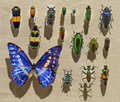 Cornell drawer displaying iridescent insects
 -
 The iridescent exoskeleton of a golden stag beetle
 -
 Structurally coloured wings of Morpho didius
 -
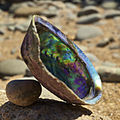 The inside surface of Haliotis iris, the paua shell


Vertebrates[edit]
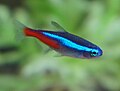
The feathers of birds such as kingfishers,[19] birds-of-paradise,[20] hummingbirds, parrots, starlings,[21] grackles, ducks, and peacocks[15] are iridescent. The lateral line on the neon tetra is also iridescent.[5] A single iridescent species of gecko, Cnemaspis kolhapurensis, was identified in India in 2009.[22] The tapetum lucidum, present in the eyes of many vertebrates, is also iridescent.[23] Iridescence is known to be present among prehistoric non-avian and avian dinosaurs such as dromaeosaurids, enantiornithes, and lithornithids.[24]
-
 Both the body and the train of the peacock are iridescent
 -
-
 The rainbow boa
 -


Plants[edit]
Many groups of plants have developed iridescence as an adaptation to use more light in dark environments such as the lower levels of tropical forests. The leaves of Southeast Asia's Begonia pavonina, or peacock begonia, appear iridescent azure to human observers due to each leaf's thinly layered photosynthetic structures called iridoplasts that absorb and bend light much like a film of oil over water. Iridescences based on multiple layers of cells are also found in the lycophyte Selaginella and several species of ferns.[25][26]
-
 Iridescent Begonia leaf
 -
 Selaginella wildenowii leaves
 -
 Pollia condensata fruits
 -
 Ophrys speculum flowers

_(8681119528).jpg)


Non-biological[edit]
Minerals[edit]
-
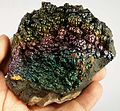
 A bismuth crystal with a thin iridescent layer of bismuth oxide, with a whitish-silver bismuth cube for comparison
 -
-
 Polished labradorite


Meteorological[edit]
-
 Polar stratospheric clouds displaying a Nacreous iridescence
 -


Human-made[edit]
-
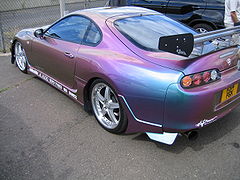 Pearlescent paint job on a Toyota Supra car
 -
 Playing surface of a compact disc
 -
 Iridescent glitter nail polish
 -
 Smartphone with iridescent back panel
 -
 An engine oil spill


.jpg)


Nanocellulose is sometimes iridescent,[27] as are thin films of petrol and some other hydrocarbons and alcohols when floating on water.[28]
See also[edit]
- Anisotropy
- Bioluminescence, irrespective of angle
- Dichroic filter
- Dichroism
- Iridocyte
- Labradorescence (Adularescence)
- Metallic colour
- Opalescence
- Structural colour
- Thin-film optics
- Nacre
- Opal
References[edit]
- ^ "Online Etymology Dictionary". etymonline.com. Archived from the original on 2014-04-07.
- ^ a b Srinivasarao, Mohan (July 1999). "Nano-Optics in the Biological World: Beetles, Butterflies, Birds, and Moths". Chemical Reviews. 99 (7): 1935–1962. doi:10.1021/cr970080y. PMID 11849015.
- ^ Kinoshita, S; Yoshioka, S; Miyazaki, J (1 July 2008). "Physics of structural colors". Reports on Progress in Physics. 71 (7): 076401. Bibcode:2008RPPh...71g6401K. doi:10.1088/0034-4885/71/7/076401. S2CID 53068819.
- ^ Meadows, Melissa G; Butler, Michael W; Morehouse, Nathan I; Taylor, Lisa A; Toomey, Matthew B; McGraw, Kevin J; Rutowski, Ronald L (23 February 2009). "Iridescence: views from many angles". Journal of the Royal Society Interface. 6 (suppl_2): S107-13. doi:10.1098/rsif.2009.0013.focus. PMC 2706472. PMID 19336343.
- ^ a b Yoshioka, S.; Matsuhana, B.; Tanaka, S.; Inouye, Y.; Oshima, N.; Kinoshita, S. (16 June 2010). "Mechanism of variable structural colour in the neon tetra: quantitative evaluation of the Venetian blind model". Journal of the Royal Society Interface. 8 (54): 56–66. doi:10.1098/rsif.2010.0253. PMC 3024824. PMID 20554565.
- ^ Rutowski, R.L; Macedonia, J.M; Morehouse, N; Taylor-Taft, L (2 September 2005). "Pterin pigments amplify iridescent ultraviolet signal in males of the orange sulphur butterfly". Proceedings of the Royal Society B: Biological Sciences. 272 (1578): 2329–2335. doi:10.1098/rspb.2005.3216. PMC 1560183. PMID 16191648.
- ^ Ackerman, Steven A.; Knox, John A. (2013). Meteorology: Understanding the Atmosphere. Jones & Bartlett Learning. pp. 173–175. ISBN 978-1-284-03080-8.
- ^ Hsiung, Bor-Kai; Siddique, Radwanul Hasan; Stavenga, Doekele G.; Otto, Jürgen C.; Allen, Michael C.; Liu, Ying; Lu, Yong-Feng; Deheyn, Dimitri D.; Shawkey, Matthew D.; Blackledge, Todd A. (22 December 2017). "Rainbow peacock spiders inspire miniature super-iridescent optics". Nature Communications. 8 (1): 2278. Bibcode:2017NatCo...8.2278H. doi:10.1038/s41467-017-02451-x. PMC 5741626. PMID 29273708.
- ^ Lee, David (2007). Nature's Palette: The Science of Plant Color. University of Chicago Press. ISBN 978-0-226-47052-8.[page needed]
- ^ van der Kooi, Casper J.; Wilts, Bodo D.; Leertouwer, Hein L.; Staal, Marten; Elzenga, J. Theo M.; Stavenga, Doekele G. (July 2014). "Iridescent flowers? Contribution of surface structures to optical signaling" (PDF). New Phytologist. 203 (2): 667–673. doi:10.1111/nph.12808. PMID 24713039.
- ^ van der Kooi, Casper J.; Dyer, Adrian G.; Stavenga, Doekele G. (January 2015). "Is floral iridescence a biologically relevant cue in plant-pollinator signaling?". New Phytologist. 205 (1): 18–20. doi:10.1111/nph.13066. PMID 25243861.
- ^ Hsiung, Bor-Kai; Siddique, Radwanul Hasan; Jiang, Lijia; Liu, Ying; Lu, Yongfeng; Shawkey, Matthew D.; Blackledge, Todd A. (January 2017). "Tarantula-Inspired Noniridescent Photonics with Long-Range Order". Advanced Optical Materials. 5 (2): 1600599. doi:10.1002/adom.201600599. S2CID 100181186.
- ^ Hooke, Robert. Micrographia. Chapter 36 ('Observ. XXXVI. Of Peacoks, Ducks, and Other Feathers of Changeable Colours.')
- ^ Ball, Philip (17 April 2012). "Nature's Color Tricks". Scientific American. 306 (5): 74–79. Bibcode:2012SciAm.306e..74B. doi:10.1038/scientificamerican0512-74 (inactive 2024-02-07). PMID 22550931.
{{cite journal}}: CS1 maint: DOI inactive as of February 2024 (link) - ^ a b Zi, Jian; Yu, Xindi; Li, Yizhou; Hu, Xinhua; Xu, Chun; Wang, Xingjun; Liu, Xiaohan; Fu, Rongtang (28 October 2003). "Coloration strategies in peacock feathers". Proceedings of the National Academy of Sciences of the United States of America. 100 (22): 12576–12578. Bibcode:2003PNAS..10012576Z. doi:10.1073/pnas.2133313100. PMC 240659. PMID 14557541.
- ^ Ruth Johnston-Feller (2001). Color Science in the Examination of Museum Objects: Nondestructive Procedures. Getty Publications. pp. 169–. ISBN 978-0-89236-586-9.
- ^ Paint and Coating Testing Manual. ASTM International. pp. 229–. GGKEY:7W7C2G88G2J.
- ^ Mazza, Giuseppe (2008-08-07). "Eledone moschata". Monaco Nature Encyclopedia. Retrieved 2023-02-07.
- ^ Stavenga, D. G.; Tinbergen, J.; Leertouwer, H. L.; Wilts, B. D. (9 November 2011). "Kingfisher feathers – colouration by pigments, spongy nanostructures and thin films". Journal of Experimental Biology. 214 (23): 3960–3967. doi:10.1242/jeb.062620. PMID 22071186.
- ^ Stavenga, Doekele G.; Leertouwer, Hein L.; Marshall, N. Justin; Osorio, Daniel (15 December 2010). "Dramatic colour changes in a bird of paradise caused by uniquely structured breast feather barbules". Proceedings of the Royal Society B: Biological Sciences. 278 (1715): 2098–2104. doi:10.1098/rspb.2010.2293. PMC 3107630. PMID 21159676.
- ^ Cuthill, I. C.; Bennett, A. T. D.; Partridge, J. C.; Maier, E. J. (February 1999). "Plumage Reflectance and the Objective Assessment of Avian Sexual Dichromatism". The American Naturalist. 153 (2): 183–200. doi:10.1086/303160. JSTOR 303160. PMID 29578758. S2CID 4386607.
- ^ "New lizard species found in India". BBC Online. 24 July 2009. Retrieved 20 February 2014.
- ^ Engelking, Larry (2002). Review of Veterinary Physiology. Teton NewMedia. p. 90. ISBN 978-1-893441-69-9.
- ^ Eliason, Chad M.; Clarke, Julia A. (13 May 2020). "Cassowary gloss and a novel form of structural color in birds". Science Advances. 6 (20): eaba0187. Bibcode:2020SciA....6..187E. doi:10.1126/sciadv.aba0187. PMC 7220335. PMID 32426504.
- ^ Glover, Beverley J.; Whitney, Heather M. (April 2010). "Structural colour and iridescence in plants: the poorly studied relations of pigment colour". Annals of Botany. 105 (4): 505–511. doi:10.1093/aob/mcq007. PMC 2850791. PMID 20142263.
- ^ Graham, Rita M.; Lee, David W.; Norstog, Knut (1993). "Physical and Ultrastructural Basis of Blue Leaf Iridescence in Two Neotropical Ferns". American Journal of Botany. 80 (2): 198–203. doi:10.2307/2445040. JSTOR 2445040.
- ^ Picard, G.; Simon, D.; Kadiri, Y.; LeBreux, J. D.; Ghozayel, F. (3 October 2012). "Cellulose Nanocrystal Iridescence: A New Model". Langmuir. 28 (41): 14799–14807. doi:10.1021/la302982s. PMID 22988816.
- ^ Zitzewitz, Paul W (2011). The Handy Physics Answer Book. Visible Ink Press. p. 215. ISBN 978-1-57859-357-6.
External links[edit]

- A 2.2 MB GIF animation of a morpho butterfly showing iridescence
- "Article on butterfly iridescence" Archived 2015-11-07 at the Wayback Machine
