


Direct sum
 | This article needs additional citations for verification. (December 2013) |
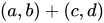
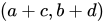
The direct sum is an operation between structures in abstract algebra, a branch of mathematics. It is defined differently, but analogously, for different kinds of structures. As an example, the direct sum of two abelian groups and is another abelian group consisting of the ordered pairs where and . To add ordered pairs, we define the sum to be ; in other words addition is defined coordinate-wise. For example, the direct sum , where is real coordinate space, is the Cartesian plane, . A similar process can be used to form the direct sum of two vector spaces or two modules.




We can also form direct sums with any finite number of summands, for example , provided and are the same kinds of algebraic structures (e.g., all abelian groups, or all vector spaces). This relies on the fact that the direct sum is associative up to isomorphism. That is, for any algebraic structures , , and of the same kind. The direct sum is also commutative up to isomorphism, i.e. for any algebraic structures and of the same kind.




The direct sum of finitely many abelian groups, vector spaces, or modules is canonically isomorphic to the corresponding direct product. This is false, however, for some algebraic objects, like nonabelian groups.
In the case where infinitely many objects are combined, the direct sum and direct product are not isomorphic, even for abelian groups, vector spaces, or modules. As an example, consider the direct sum and direct product of (countably) infinitely many copies of the integers. An element in the direct product is an infinite sequence, such as (1,2,3,...) but in the direct sum, there is a requirement that all but finitely many coordinates be zero, so the sequence (1,2,3,...) would be an element of the direct product but not of the direct sum, while (1,2,0,0,0,...) would be an element of both. Often, if a + sign is used, all but finitely many coordinates must be zero, while if some form of multiplication is used, all but finitely many coordinates must be 1. In more technical language, if the summands are , the direct sum


Examples[edit]
The xy-plane, a two-dimensional vector space, can be thought of as the direct sum of two one-dimensional vector spaces, namely the x and y axes. In this direct sum, the x and y axes intersect only at the origin (the zero vector). Addition is defined coordinate-wise, that is , which is the same as vector addition.

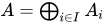
Given two structures and , their direct sum is written as . Given an indexed family of structures , indexed with , the direct sum may be written . Each Ai is called a direct summand of A. If the index set is finite, the direct sum is the same as the direct product. In the case of groups, if the group operation is written as the phrase "direct sum" is used, while if the group operation is written the phrase "direct product" is used. When the index set is infinite, the direct sum is not the same as the direct product since the direct sum has the extra requirement that all but finitely many coordinates must be zero.




Internal and external direct sums[edit]
A distinction is made between internal and external direct sums, though the two are isomorphic. If the summands are defined first, and then the direct sum is defined in terms of the summands, we have an external direct sum. For example, if we define the real numbers and then define the direct sum is said to be external.
If, on the other hand, we first define some algebraic structure and then write as a direct sum of two substructures and , then the direct sum is said to be internal. In this case, each element of is expressible uniquely as an algebraic combination of an element of and an element of . For an example of an internal direct sum, consider (the integers modulo six), whose elements are . This is expressible as an internal direct sum .




Types of direct sum[edit]
Direct sum of abelian groups[edit]
The direct sum of abelian groups is a prototypical example of a direct sum. Given two such groups and their direct sum is the same as their direct product. That is, the underlying set is the Cartesian product and the group operation is defined component-wise:



For an arbitrary family of groups indexed by their direct sum[2]




Direct sum of modules[edit]
The direct sum of modules is a construction which combines several modules into a new module.
The most familiar examples of this construction occur when considering vector spaces, which are modules over a field. The construction may also be extended to Banach spaces and Hilbert spaces.
Direct sum in categories[edit]
An additive category is an abstraction of the properties of the category of modules.[4][5] In such a category, finite products and coproducts agree and the direct sum is either of them, cf. biproduct.
General case:[2] In category theory the direct sum is often, but not always, the coproduct in the category of the mathematical objects in question. For example, in the category of abelian groups, direct sum is a coproduct. This is also true in the category of modules.
Direct sums versus coproducts in category of groups[edit]
However, the direct sum (defined identically to the direct sum of abelian groups) is not a coproduct of the groups and in the category of groups. So for this category, a categorical direct sum is often simply called a coproduct to avoid any possible confusion.


Direct sum of group representations[edit]
The direct sum of group representations generalizes the direct sum of the underlying modules, adding a group action to it. Specifically, given a group and two representations and of (or, more generally, two -modules), the direct sum of the representations is with the action of given component-wise, that is,



Given two representations and the vector space of the direct sum is and the homomorphism is given by where is the natural map obtained by coordinate-wise action as above.




Furthermore, if are finite dimensional, then, given a basis of , and are matrix-valued. In this case, is given as


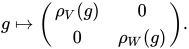
Moreover, if we treat and as modules over the group ring , where is the field, then the direct sum of the representations and is equal to their direct sum as modules.


Direct sum of rings[edit]
Some authors will speak of the direct sum of two rings when they mean the direct product , but this should be avoided[6] since does not receive natural ring homomorphisms from and : in particular, the map sending to is not a ring homomorphism since it fails to send 1 to (assuming that in ). Thus is not a coproduct in the category of rings, and should not be written as a direct sum. (The coproduct in the category of commutative rings is the tensor product of rings.[7] In the category of rings, the coproduct is given by a construction similar to the free product of groups.)


Use of direct sum terminology and notation is especially problematic when dealing with infinite families of rings: If is an infinite collection of nontrivial rings, then the direct sum of the underlying additive groups can be equipped with termwise multiplication, but this produces a rng, that is, a ring without a multiplicative identity.

Direct sum of matrices[edit]
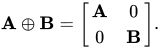
For any arbitrary matrices and , the direct sum is defined as the block diagonal matrix of and if both are square matrices (and to an analogous block matrix, if not).


Direct sum of topological vector spaces[edit]
A topological vector space (TVS) such as a Banach space, is said to be a topological direct sum of two vector subspaces and if the addition map


![{\displaystyle {\begin{alignedat}{4}\ \;&&M\times N&&\;\to \;&X\\[0.3ex]&&(m,n)&&\;\mapsto \;&m+n\\\end{alignedat}}}](https://wikimedia.org/api/rest_v1/media/math/render/svg/fa950ef47718bddc42f008679a9270e8afc1492b)


If is a vector subspace of a real or complex vector space then there always exists another vector subspace of called an algebraic complement of in such that is the algebraic direct sum of and (which happens if and only if the addition map is a vector space isomorphism). In contrast to algebraic direct sums, the existence of such a complement is no longer guaranteed for topological direct sums.

A vector subspace of is said to be a (topologically) complemented subspace of if there exists some vector subspace of such that is the topological direct sum of and A vector subspace is called uncomplemented if it is not a complemented subspace. For example, every vector subspace of a Hausdorff TVS that is not a closed subset is necessarily uncomplemented. Every closed vector subspace of a Hilbert space is complemented. But every Banach space that is not a Hilbert space necessarily possess some uncomplemented closed vector subspace.
Homomorphisms[edit]
The direct sum comes equipped with a projection homomorphism for each j in I and a coprojection for each j in I.[8] Given another algebraic structure (with the same additional structure) and homomorphisms for every j in I, there is a unique homomorphism , called the sum of the gj, such that for all j. Thus the direct sum is the coproduct in the appropriate category.





See also[edit]
- Direct sum of groups
- Direct sum of permutations
- Direct sum of topological groups
- Restricted product
- Whitney sum
- Feferman-Vaught theorem
Notes[edit]
- ^ Thomas W. Hungerford, Algebra, p.60, Springer, 1974, ISBN 0387905189
- ^ a b Direct Sum at the nLab
- ^ Joseph J. Rotman, The Theory of Groups: an Introduction, p. 177, Allyn and Bacon, 1965
- ^ ""p.45"" (PDF). Archived from the original (PDF) on 2013-05-22. Retrieved 2014-01-14.
- ^ "Appendix" (PDF). Archived from the original (PDF) on 2006-09-17. Retrieved 2014-01-14.
- ^ Math StackExchange on direct sum of rings vs. direct product of rings.
- ^ Lang 2002, section I.11
- ^ Heunen, Chris (2009). Categorical Quantum Models and Logics. Pallas Proefschriften. Amsterdam University Press. p. 26. ISBN 978-9085550242.
References[edit]
- Lang, Serge (2002), Algebra, Graduate Texts in Mathematics, vol. 211 (Revised third ed.), New York: Springer-Verlag, ISBN 978-0-387-95385-4, MR 1878556, Zbl 0984.00001