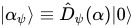
The name of this operator is derived from its ability to displace a localized state in phase space by a magnitude . It may also act on the vacuum state by displacing it into a coherent state. Specifically,
where is a coherent state, which is an eigenstate of the annihilation (lowering) operator.
The displacement operator is a unitary operator, and therefore obeys
,
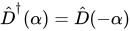
where is the identity operator. Since , the hermitian conjugate of the displacement operator can also be interpreted as a displacement of opposite magnitude (). The effect of applying this operator in a similarity transformation of the ladder operators results in their displacement.
The product of two displacement operators is another displacement operator whose total displacement, up to a phase factor, is the sum of the two individual displacements. This can be seen by utilizing the Baker–Campbell–Hausdorff formula.
which shows us that:
When acting on an eigenket, the phase factor appears in each term of the resulting state, which makes it physically irrelevant.[1]
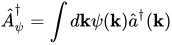
The displacement operator can also be generalized to multimode displacement. A multimode creation operator can be defined as
,
where is the wave vector and its magnitude is related to the frequency according to . Using this definition, we can write the multimode displacement operator as