


Small-bias sample space
 | This article includes a list of general references, but it lacks sufficient corresponding inline citations. (June 2020) |
In theoretical computer science, a small-bias sample space (also known as -biased sample space, -biased generator, or small-bias probability space) is a probability distribution that fools parity functions. In other words, no parity function can distinguish between a small-bias sample space and the uniform distribution with high probability, and hence, small-bias sample spaces naturally give rise to pseudorandom generators for parity functions.

The main useful property of small-bias sample spaces is that they need far fewer truly random bits than the uniform distribution to fool parities. Efficient constructions of small-bias sample spaces have found many applications in computer science, some of which are derandomization, error-correcting codes, and probabilistically checkable proofs. The connection with error-correcting codes is in fact very strong since -biased sample spaces are equivalent to -balanced error-correcting codes.
Definition[edit]
Bias[edit]
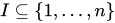
Let be a probability distribution over . The bias of with respect to a set of indices is defined as[1]



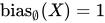
where the sum is taken over , the finite field with two elements. In other words, the sum equals if the number of ones in the sample at the positions defined by is even, and otherwise, the sum equals . For , the empty sum is defined to be zero, and hence .


ϵ-biased sample space[edit]
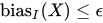
A probability distribution over is called an -biased sample space if holds for all non-empty subsets .

ϵ-biased set[edit]
An -biased sample space that is generated by picking a uniform element from a multiset is called -biased set. The size of an -biased set is the size of the multiset that generates the sample space.


ϵ-biased generator[edit]
An -biased generator is a function that maps strings of length to strings of length such that the multiset is an -biased set. The seed length of the generator is the number and is related to the size of the -biased set via the equation .





Connection with epsilon-balanced error-correcting codes[edit]
There is a close connection between -biased sets and -balanced linear error-correcting codes. A linear code of message length and block length is -balanced if the Hamming weight of every nonzero codeword is between and . Since is a linear code, its generator matrix is an -matrix over with .



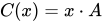
Then it holds that a multiset is -biased if and only if the linear code , whose columns are exactly elements of , is -balanced.[2]


Constructions of small epsilon-biased sets[edit]
Usually the goal is to find -biased sets that have a small size relative to the parameters and . This is because a smaller size means that the amount of randomness needed to pick a random element from the set is smaller, and so the set can be used to fool parities using few random bits.
Theoretical bounds[edit]
The probabilistic method gives a non-explicit construction that achieves size .[2] The construction is non-explicit in the sense that finding the -biased set requires a lot of true randomness, which does not help towards the goal of reducing the overall randomness. However, this non-explicit construction is useful because it shows that these efficient codes exist. On the other hand, the best known lower bound for the size of -biased sets is , that is, in order for a set to be -biased, it must be at least that big.[2]


Explicit constructions[edit]
There are many explicit, i.e., deterministic constructions of -biased sets with various parameter settings:
- Naor & Naor (1990) achieve . The construction makes use of Justesen codes (which is a concatenation of Reed–Solomon codes with the Wozencraft ensemble) as well as expander walk sampling.
- Alon et al. (1992) achieve . One of their constructions is the concatenation of Reed–Solomon codes with the Hadamard code; this concatenation turns out to be an -balanced code, which gives rise to an -biased sample space via the connection mentioned above.
- Concatenating Algebraic geometric codes with the Hadamard code gives an -balanced code with .[2]
- Ben-Aroya & Ta-Shma (2009) achieves .
- Ta-Shma (2017) achieves which is almost optimal because of the lower bound.

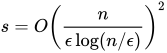
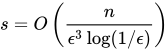
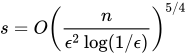
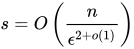
These bounds are mutually incomparable. In particular, none of these constructions yields the smallest -biased sets for all settings of and .
Application: almost k-wise independence[edit]
An important application of small-bias sets lies in the construction of almost k-wise independent sample spaces.
k-wise independent spaces[edit]
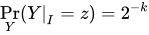
A random variable over is a k-wise independent space if, for all index sets of size , the marginal distribution is exactly equal to the uniform distribution over . That is, for all such and all strings , the distribution satisfies .


Constructions and bounds[edit]
k-wise independent spaces are fairly well understood.
- A simple construction by Joffe (1974) achieves size .
- Alon, Babai & Itai (1986) construct a k-wise independent space whose size is .
- Chor et al. (1985) prove that no k-wise independent space can be significantly smaller than .


Joffe's construction[edit]
Joffe (1974) constructs a -wise independent space over the finite field with some prime number of elements, i.e., is a distribution over . The initial marginals of the distribution are drawn independently and uniformly at random:


- .

For each with , the marginal distribution of is then defined as



where the calculation is done in . Joffe (1974) proves that the distribution constructed in this way is -wise independent as a distribution over . The distribution is uniform on its support, and hence, the support of forms a -wise independent set. It contains all strings in that have been extended to strings of length using the deterministic rule above.


Almost k-wise independent spaces[edit]
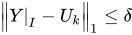
A random variable over is a -almost k-wise independent space if, for all index sets of size , the restricted distribution and the uniform distribution on are -close in 1-norm, i.e., .


Constructions[edit]
Naor & Naor (1990) give a general framework for combining small k-wise independent spaces with small -biased spaces to obtain -almost k-wise independent spaces of even smaller size. In particular, let be a linear mapping that generates a k-wise independent space and let be a generator of an -biased set over . That is, when given a uniformly random input, the output of is a k-wise independent space, and the output of is -biased. Then with is a generator of an -almost -wise independent space, where .[3]






As mentioned above, Alon, Babai & Itai (1986) construct a generator with , and Naor & Naor (1990) construct a generator with . Hence, the concatenation of and has seed length . In order for to yield a -almost k-wise independent space, we need to set , which leads to a seed length of and a sample space of total size .







Notes[edit]
- ^ cf., e.g., Goldreich (2001)
- ^ a b c d cf., e.g., p. 2 of Ben-Aroya & Ta-Shma (2009)
- ^ Section 4 in Naor & Naor (1990)
References[edit]
- Alon, Noga; Babai, László; Itai, Alon (1986), "A fast and simple randomized parallel algorithm for the maximal independent set problem" (PDF), Journal of Algorithms, 7 (4): 567–583, doi:10.1016/0196-6774(86)90019-2
- Alon, Noga; Goldreich, Oded; Håstad, Johan; Peralta, René (1992), "Simple Constructions of Almost k-wise Independent Random Variables" (PDF), Random Structures & Algorithms, 3 (3): 289–304, CiteSeerX 10.1.1.106.6442, doi:10.1002/rsa.3240030308
- Ben-Aroya, Avraham; Ta-Shma, Amnon (2009). "Constructing Small-Bias Sets from Algebraic-Geometric Codes". 2009 50th Annual IEEE Symposium on Foundations of Computer Science (PDF). pp. 191–197. CiteSeerX 10.1.1.149.9273. doi:10.1109/FOCS.2009.44. ISBN 978-1-4244-5116-6.
- Chor, Benny; Goldreich, Oded; Håstad, Johan; Freidmann, Joel; Rudich, Steven; Smolensky, Roman (1985). "The bit extraction problem or t-resilient functions". 26th Annual Symposium on Foundations of Computer Science (SFCS 1985). pp. 396–407. CiteSeerX 10.1.1.39.6768. doi:10.1109/SFCS.1985.55. ISBN 978-0-8186-0644-1. S2CID 6968065.
- Goldreich, Oded (2001), Lecture 7: Small bias sample spaces
- Joffe, Anatole (1974), "On a Set of Almost Deterministic k-Independent Random Variables", Annals of Probability, 2 (1): 161–162, doi:10.1214/aop/1176996762
- Naor, Joseph; Naor, Moni (1990), "Small-bias probability spaces: Efficient constructions and applications", Proceedings of the twenty-second annual ACM symposium on Theory of computing - STOC '90, pp. 213–223, CiteSeerX 10.1.1.421.2784, doi:10.1145/100216.100244, ISBN 978-0897913614, S2CID 14031194
- Ta-Shma, Amnon (2017), "Explicit, almost optimal, epsilon-balanced codes", Proceedings of the 49th Annual ACM SIGACT Symposium on Theory of Computing, pp. 238–251, doi:10.1145/3055399.3055408, ISBN 9781450345286, S2CID 5648543