


European greenfinch
| European greenfinch | |
|---|---|
.jpg)
| |
| Male | |
.jpg)
| |
| Female | |
Scientific classification 
| |
| Domain: | Eukaryota |
| Kingdom: | Animalia |
| Phylum: | Chordata |
| Class: | Aves |
| Order: | Passeriformes |
| Family: | Fringillidae |
| Subfamily: | Carduelinae |
| Genus: | Chloris |
| Species: | C. chloris
|
| Binomial name | |
| Chloris chloris | |

| |
| Range of the European greenfinch (Chloris chloris) Breeding Resident Non-breeding Extant & Introduced (resident) Possible extinct & Introduced
| |
| Synonyms | |
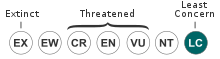
The European greenfinch or simply the greenfinch (Chloris chloris) is a small passerine bird in the finch family Fringillidae.
This bird is widespread throughout Europe, North Africa and Southwest Asia. It is mainly resident, but some northernmost populations migrate further south. The greenfinch has also been introduced into Australia, New Zealand, Uruguay, and Argentina.
Taxonomy[edit]
The greenfinch was described by Carl Linnaeus in his landmark 1758 10th edition of Systema Naturae under the binomial name Loxia chloris.[4][5] The specific epithet is from khloris, the Ancient Greek name for this bird, from khloros, "green".[6]
The finch family, Fringillidae, is divided into two subfamilies, the Carduelinae, containing around 28 genera with 141 species and the Fringillinae containing a single genus, Fringilla, with four species. The finch family are all seed-eaters with stout conical bills. They have similar skull morphologies, nine large primaries, 12 tail feathers and no crop. In all species the female bird builds the nest, incubates the eggs and broods the young. Fringilline finches raise their young almost entirely on arthropods, while the cardueline finches raise their young on regurgitated seeds.[7]
A molecular phylogenetic study published in 2012 found that the greenfinches are not closely related to other members of the genus Carduelis.[8] They have therefore been placed in the resurrected genus Chloris that had originally been introduced by the French naturalist Georges Cuvier in 1800, with the European greenfinch as the type species.[9][10][11]
Subspecies[edit]
There are 10 recognised subspecies.[10]
| Image | Name and describing authority | Range |
|---|---|---|
_(3)_(9108229195).jpg) |
C. c. harrisoni Clancey, 1940 | Great Britain (except northern Scotland) and Ireland |
| C. c. chloris (Linnaeus, 1758) | Northern Scotland, northern and central France and Norway to western Siberia | |
| C. c. muehlei Parrot, 1905 | Serbia and Montenegro to Moldova, Bulgaria, and Greece | |
_Extremadura.jpg) |
C. c. aurantiiventris (Cabanis, 1851) | Southern Spain through southern Europe to western Greece |
| C. c. madaraszi Tschusi, 1911 | Corsica and Sardinia | |
| C. c. vanmarli Voous, 1952 | Northwestern Spain, Portugal and northwestern Morocco | |
_male.jpg) |
C. c. voousi (Roselaar, 1993) | Central Morocco and northern Algeria |
| C. c. chlorotica (Bonaparte, 1850) | South-central Turkey to northeastern Egypt | |
| C. c. bilkevitchi Zarudny, 1911 | Southern Ukraine, the Caucasus and northeastern Turkey to northern Iran and southwestern Turkmenistan | |
| C. c. turkestanica Zarudny, 1907 | Southern Kazakhstan to Kyrgyzstan and central Tajikistan |
Description[edit]
_-_Ystad-2020.jpg)
The European greenfinch is 15 cm (5.9 in) long with a wingspan of 24.5 to 27.5 cm (9.6 to 10.8 in). It is similar in size and shape to a house sparrow, but is mainly green, with yellow in the wings and tail. The female and young birds are duller and have brown tones on the back. The bill is thick and conical.[12] The song contains a lot of trilling twitters interspersed with wheezes, and the male has a "butterfly" display flight. Male greenfinch birds exhibit higher degrees of fluctuating asymmetry. The development of males' bones is more subject to disruption than that of females.
Behaviour and ecology[edit]
Breeding[edit]

.jpg)
The breeding season lasts from the second half of March until June; fledging takes place in early July. Woodland edges, farmland hedges and gardens with relatively thick vegetation are favoured for breeding.[13] The nest is placed in trees or bushes.[14][15] The nest is built by the female who is accompanied by the male. The clutch consists of 4–6 eggs which are laid at daily intervals usually beginning one or two days after the completion of the nest. The eggs are greyish-white, bluish-white or beige with reddish or brownish spots or blotches concentrated at the broader end. On average the eggs measure 20.0 mm × 14.6 mm (0.79 in × 0.57 in) and weigh 2.17 g (0.077 oz). They are incubated by the female for 13–14 days.[16] The male feeds her at the nest during this period. Chicks are covered with thick, long, greyish-white down at hatching. They are fed on insect larvae by both adults during the first days, and later, by a frequently regurgitated yellowish paste made of seeds. They leave the nest about 13 days later, but they are not able to fly. Usually, they fledge 16–18 days after hatching. This species produces two or three broods per year.[14][15]
In Australasia, the European greenfinch's breeding season is from October to March.[17]
Food and feeding[edit]
The European greenfinch feeds on a great variety of seeds, berries, fruit, buds, flowers and some arthropods. It forages in trees and bushes, and also on the ground.[18]
Predators and parasites[edit]
The protozoal parasite Trichomonas gallinae was known to infect pigeons and raptors, but, beginning in Great Britain in 2005, carcasses of dead European greenfinches and common chaffinches were found to be infected with the parasite.[19] The disease spread and in 2008, infected carcasses were found in Norway, Sweden and Finland and a year later in Germany. The spread of the disease is believed to have been mediated by common chaffinches, as large numbers of the birds breed in northern Europe and winter in Great Britain.[20] In Great Britain, the number of infected carcasses recovered each year declined after a peak in 2006. There was a reduction in the number of European greenfinches from around 4.3 million to around 2.8 million, but no significant decline in the overall number of common chaffinches.[21] A similar pattern occurred in Finland where, after the arrival of the disease in 2008, there was a reduction in the number of European greenfinches but only a small change in the number of common chaffinches.[22]
In literature[edit]
The English poet William Wordsworth wrote a poem about this species entitled The Green Linnet in 1803.[23][24]
References[edit]
- ^ BirdLife International (2018). "Chloris chloris". IUCN Red List of Threatened Species. 2018: e.T22720330A132000123. doi:10.2305/IUCN.UK.2018-2.RLTS.T22720330A132000123.en. Retrieved 12 November 2021.
- ^ For Ligurinus chloris see for instance Bonhote, J. Lewis (1907). Birds of Britain. illustrated by H.E. Dresser. London: Adam and Charles Black. pp. 114/5. OCLC 1451688.. John Gould uses the scientific name Ligurinus chloris for the greenfinch in his The Birds of Great Britain (vol. 3, 1873, plate 38).
- ^ In The Birds of Europe (vol. 3, 1837, plate 57) John Gould describes the "green grossbeak" (Coccothraustes chloris).
- ^ Paynter 1968, pp. 235–236.
- ^ Linnaeus 1758, p. 174.
- ^ Jobling 2010, p. 102.
- ^ Collar, Newton & Clement 2010, pp. 440–441.
- ^ Zuccon, Dario; Prŷs-Jones, Robert; Rasmussen, Pamela C.; Ericson, Per G.P. (2012). "The phylogenetic relationships and generic limits of finches (Fringillidae)" (PDF). Molecular Phylogenetics and Evolution. 62 (2): 581–596. doi:10.1016/j.ympev.2011.10.002. PMID 22023825.
- ^ Cuvier, Georges (1800). Leçons d'anatomie comparée. Vol. 1. Paris: Baudouin. Table 2. The year on the title page is An VIII.
- ^ a b Gill, Frank; Donsker, David; Rasmussen, Pamela, eds. (January 2023). "Finches, euphonias". IOC World Bird List Version 13.1. International Ornithologists' Union. Retrieved 10 June 2023.
- ^ Sangster, G.; et al. (October 2011). "Taxonomic recommendations for British birds: seventh report". Ibis. 153 (4): 883–892. doi:10.1111/j.1474-919X.2011.01155.x.
- ^ Snow, D.W.; Perrins, C.M., eds. (1998). "Greenfinch (Carduelis chloris)". The Birds of the Western Palearctic: Concise Edition. Volume 2: Passerines. Oxford: Oxford University Press. pp. 1557–1560. ISBN 978-0-19-850188-6.
- ^ Bensouilah, T.; Brahmia, H.; Zeraoula, A.; Bouslama, Z.; Houhamdi, M. (2015). "Variation in nest placement by the European Greenfinch Chloris chloris in relation to the age of orange trees". Zoology and Ecology. 26 (1): 9–14. doi:10.1080/21658005.2015.1126156.
- ^ a b Bensouilah, Taqiyeddine; Brahmia, Hafid; Zeraoula, Ali; Bouslama, Zihad; Houhamdi, Moussa (2014). "Breeding biology of the European Greenfinch Chloris chloris in the loquat orchards of Algeria (North Africa)". Zoology and Ecology. 24 (3): 199–207. doi:10.1080/21658005.2014.934514.
- ^ a b Kosiński, Ziemowit (2001). "The breeding ecology of the greenfinch Carduelis chloris in urban conditions (study in Krotoszyn, W Poland)". Acta Ornithologica. 36 (2): 111–121. doi:10.3161/068.036.0203.
- ^ Cramp 1994, pp. 542–543.
- ^ Robertson, Hugh A.; Heather, B.D.; Onley, Derek J. (2005). The Hand Guide to the Birds of New Zealand. Auckland, New Zealand: Penguin Books. p. 160. ISBN 978-0-14-028835-3.
- ^ Cramp 1994, pp. 553–555.
- ^ Robinson, R A; et al. (2010). "Emerging infectious disease leads to rapid population declines of common British birds". PLOS ONE. 5 (8): e12215. Bibcode:2010PLoSO...512215R. doi:10.1371/journal.pone.0012215. PMC 2923595. PMID 20805869.
- ^ Lawson, B.; et al. (2011). "Evidence of spread of emerging infectious disease, finch trichomonosis, by migrating birds". Ecohealth. 8 (2): 143–153. doi:10.1007/s10393-011-0696-8. PMID 21935745. S2CID 13343152.
- ^ Lawson, B; et al. (2012). "The emergence and spread of finch trichomonosis in the British Isles". Philosophical Transactions of the Royal Society B. 367 (1604): 2852–2863. doi:10.1098/rstb.2012.0130. JSTOR 41740010. PMC 3427565. PMID 22966140.
- ^ Lehikoinen, A.; Lehikoinen, E.; Valkama, J.; Väisänen, R.A.; Isomursu, M. (April 2013). "Impacts of trichomonosis epidemics on Greenfinch Chloris chloris and Chaffinch Fringilla coelebs populations in Finland". Ibis. 155 (2): 357–366. doi:10.1111/ibi.12028.
- ^ Wordsworth, William "The Poetical Works of William Wordsworth". Copyright 1847, 1858 Edward Moxon, Dover Street, London. pp. 118-119.
- ^ Poetry Foundation The Green Linnet
Sources[edit]
- Cramp, Stanley; et al., eds. (1994). "Carduelis chloris Greenfich". Handbook of the Birds of Europe the Middle East and North Africa. The Birds of the Western Palearctic. Vol. VIII: Crows to Finches. Oxford: Oxford University Press. pp. 548–569. ISBN 978-0-19-854679-5.
- Collar, N.J.; Newton, I.; Clement, P. (2010). "Family Fringillidae (Finches)". In del Hoyo, J.; Elliott, A.; Christie, D.A. (eds.). Handbook of the Birds of the World. Vol. 15: Weavers to New World Warblers. Barcelona, Spain: Lynx Edicions. pp. 440–617. ISBN 978-84-96553-68-2.
- Jobling, James A (2010). The Helm Dictionary of Scientific Bird Names. London: Christopher Helm. ISBN 978-1-4081-2501-4.
- Linnaeus, C. (1758). Systema naturae per regna tria naturae, secundum classes, ordines, genera, species, cum characteribus, differentiis, synonymis, locis. Tomus I. Editio decima, reformata (in Latin). Holmiae:Laurentii Salvii.
- Paynter, Raymond A. Jnr, ed. (1968). Check-list of Birds of the World Volume 14. Cambridge, Massachusetts: Museum of Comparative Zoology.
External links[edit]
