


False killer whale

| False killer whale Temporal range: Middle Pleistocene–Recent[1]
| |
|---|---|
.jpg)
| |

| |
| Size compared to an average human | |
Scientific classification 
| |
| Domain: | Eukaryota |
| Kingdom: | Animalia |
| Phylum: | Chordata |
| Class: | Mammalia |
| Order: | Artiodactyla |
| Infraorder: | Cetacea |
| Family: | Delphinidae |
| Genus: | Pseudorca |
| Species: | P. crassidens
|
| Binomial name | |
| Pseudorca crassidens (Owen, 1846)
| |

| |
| Range of the false killer whale | |
| Synonyms[4] | |
|
List of synonyms
| |
The false killer whale (Pseudorca crassidens) is a species of oceanic dolphin that is the only extant representative of the genus Pseudorca. It is found in oceans worldwide but mainly in tropical regions. It was first described in 1846 as a species of porpoise based on a skull, which was revised when the first carcasses were observed in 1861. The name "false killer whale" comes from having a skull similar to the orca (Orcinus orca), or killer whale.
The false killer whale reaches a maximum length of 6 m (20 ft), though size can vary around the world. It is highly sociable, known to form pods of up to 50 members, and can also form pods with other dolphin species, such as the common bottlenose dolphin (Tursiops truncatus). It can form close bonds with other species, as well as have sexual interactions with them. But the false killer whale has also been known to eat other dolphins, though it typically eats squid and fish. It is a deep-diver; maximum known depth is 927.5 m (3,043 ft); maximum speed is ~ 29 km/h (18 mph).
Several aquariums around the world keep one or more false killer whales, though its aggression toward other dolphins makes it less desirable. It is threatened by fishing operations, as it can entangle in fishing gear. It is drive hunted in some Japanese villages. The false killer whale has a tendency to mass-strand given its highly social nature; the largest stranding consisted of over 800 beached at Mar del Plata, Argentina, in 1946. Most of what is known of this species comes from examining stranded individuals.
Taxonomy[edit]

The false killer whale was first described by British paleontologist and biologist Richard Owen in his 1846 book, A history of British fossil mammals and birds, based on a fossil skull discovered in 1843. This specimen was unearthed from the Lincolnshire Fens near Stamford in England, a subfossil deposited in a marine environment that existed around 126,000 years ago.[1][5] The skull was reported as present in a number of museum collections, but noted as lost by William Henry Flower in 1884.[6] Owen compared the skull to those of the long-finned pilot whale (Globicephala melas), beluga whale (Delphinapterus leucas), and Risso's dolphin (Grampus griseus)–in fact, he gave it the nickname "thick toothed grampus" in light of this and assigned the animal to the genus Phocaena (a genus of porpoises) which Risso's dolphin was also assigned to in 1846. The species name crassidens means "thick toothed".[5]
In 1846, zoologist John Edward Gray put the false killer whale in the genus Orcinus, which had been known as the killer whale (Orcinus orca). Until 1861, when the first carcasses washed up on the shores of Kiel Bay, Denmark, the species was presumed extinct. Based on these and a pod that beached itself three months later in November, zoologist Johannes Theodor Reinhardt moved the species in 1862 to the newly erected genus Pseudorca, which established it as being neither a porpoise nor a killer whale.[7][8] The name "false killer whale" comes from the apparent similarity between its skull and that of the killer whale.[9]
The false killer whale is in the family Delphinidae (oceanic dolphins). It is in the subfamily Globicephalinae; its closest living relatives are Risso's dolphin, the melon-headed whale (Peponocephala electra), the pygmy killer whale (Feresa attenuata), pilot whales (Globicephala spp.), and possibly snubfin dolphins (Orcaella spp.).[10] Paules Edward Pieris Deraniyagala proposed a subspecies, P. c. meridionalis, in 1945, though without enough justification; and William Henry Flower suggested in 1884 and later abandoned a distinction between northern and southern false killer whales; there are currently no recognized subspecies.[11] But individuals in populations around the world can have different skull structure and vary in average length; Japanese false killers are 10–20% larger than South African ones.[9][12] It can hybridize with the bottlenose dolphin (Tursiops truncatus) to produce fertile offspring called "wholphins".[9][13]
Description[edit]
_(http-www.bluekaymahahual.com)_-_panoramio.jpg)
The false killer whale is black or dark gray; slightly lighter on the underside. It has a slender body with an elongated, tapered head and 44 teeth. The dorsal fin is sickle-shaped; and flippers are narrow, short, and pointed, with a distinctive bulge on the leading edge of the flipper (the side closest to the head). False killer whales are large marine predators. They are the fourth-largest extant species of oceanic dolphin, exceeded in size only by the orca, and the two species of pilot whales. Females reach a maximum size of 5 m (16 ft) in length and 1,200 kg (2,600 lb) in weight, and males 6 m (20 ft) long and 2,300 kg (5,100 lb). Males are about 10–15 % larger than females.[14][15] Newborns can be 1.5–2.1 m (5–7 ft) long.[9][16] Body temperature ranges from 36–37.2 °C (96.8–99.0 °F), increasing during activity.[8] The teeth are conical, and there are 14–21 in the upper jaw and 16–24 in the lower.[17]
A false killer reaches physical maturity at 8 to 14 years; maximum age in captivity is 57 years for males and 62 for females. Sexual maturity happens at 8 to 11 years. In one population, calving was at 7 year intervals; calving can occur year-round, though it usually occurs in late winter. Gestation takes ~15 months;[9] lactation, 9 months to 2 years.[18] The false killer is one of three toothed whales, the other two being the pilot whales, identified as having a sizable lifespan after menopause, which occurs at age 45 to 55.[19]
As a toothed whale, a false killer can echolocate using its melon organ in the forehead to create sound, which it uses to navigate and find prey.[20][21][22] The melon is larger in males than in females.[9]
Behaviour[edit]

The false killer whale has been known to interact non-aggressively with some dolphins: the common bottlenose dolphin, the Pacific white-sided dolphin (Lagenorhynchus obliquidens), the rough-toothed dolphin (Steno bredanensis), the pilot whales, the melon-headed whale, the pantropical spotted dolphin (Stenella attenuata), the pygmy killer whale, and Risso's dolphin.[23][8][9][24][25] They have been shown to engage in depredation at fisheries with killer whales (Orcinus orca), though their diets differ with the killer whales and false killer whales preferring swordfish (4) and smaller fish respectively.[26]
A false killer may respond to distress calls and protect other species from predators, aid in childbirth by helping to remove the afterbirth, and has been known to interact sexually with bottlenose dolphins (see Wholphin) and pilot whales,[8] including homosexually.[27] It has been known to form mixed-species pods with those dolphins, probably due to shared feeding grounds. In Japan, these only occur in winter, suggesting it is tied to seasonal food shortages.[9][8][17]
A pod near Chile had a 15 km/h (9.3 mph) cruising speed, and false killer whales in captivity were recorded to have a maximum speed of 26.9–28.8 km/h (16.7–17.9 mph), similar to a bottlenose dolphin. Diving behavior is not well recorded, but one individual near Japan dove for 12 minutes to a depth of 230 m (750 ft).[9][28] In Japan, one individual had a documented dive of 600 m (2,000 ft), and one in Hawaii 927.5 m (3,043 ft), comparable to pilot whales and other similarly-sized dolphins. Its maximum dive time is likely 18.5 minutes.[17]
The false killer travels in large pods, evidenced by mass strandings; usually 10 to 20 members, though these smaller groups can be part of larger groups; it is highly social and can travel in groups of more than 500 whales.[29] These large groups may break up into smaller family groups of 4 to 6 members while feeding. Members stay with the pod long-term, some recorded as 15 years, and, indicated by mass strandings, share strong bonds with other members. It is thought it has a matrifocal family structure, with mothers heading the pod instead of the father, like in sperm whales and pilot whales. Different populations around the world have different vocalizations, similar to other dolphins. The false killer whale is probably polygynous, with males mating with multiple females.[9][17][30][31]
Ecology[edit]
.jpg)
The false killer whale is an apex predator, inhabiting tropical and subtropical waters.[32][33] Generally, the false killer whale targets a wide array of squid and fish of various sizes during daylight hours.[9][34] They typically target large species of fish, such as mahi-mahi, wahoo and tuna. They are also known to prey on marine mammals, such as some species of dolphins and whales.[35][36][37] In captivity, it eats 3.4 to 4.3% of its body weight per day.[17] A video taken in 2016 near Sydney shows a group hunting a juvenile shark.[38] It sometimes discards the tail, gills, and stomach of captured fish, and pod members have been known to share food.[9]
In the Eastern Pacific, the false killer whale has been known to target smaller dolphins during tuna purse-seine fishing operations; there are attacks on sperm whales (Physeter macrocephalus), and one instance against a humpback whale (Megaptera novaeangliae) calf. Killer whales are known to prey on the false killer, and it also possibly faces a threat from large sharks, though there are no documented instances.[9][8][17][39]
The false killer is known to host parasites: trematode Nasitrema in the sinuses, nematode Stenurus in the sinuses and lungs, an unidentified crassicaudine nematode in the sinuses, stomach nematodes Anisakis simplex and Anisakis typica, acanthocephalan worm Bolbosoma capitatum in the intestines, whale lice Syncyamus pseudorcae and Isocyamus delphinii, and the whale barnacle Xenobalanus globicipitis. Some strandings had whales with large Bolbosoma infestations, such as the 1976 and 1986 strandings in Florida.[8]
Population and distribution[edit]
The false killer whale appears to have a widespread presence in tropical and semitropical oceans.[40] The species has been found in temperate waters, but these occurrences were possibly stray individuals, or associated with warm water events. It generally does not go beyond 50°N or below 50°S.[16][23] It usually inhabits open ocean and deep-water areas, though it may frequent coastal areas near oceanic islands.[41] Distinct populations inhabit the seas near the Hawaiian Islands[42][43] and in the eastern North Pacific.[44]
The false killer whale is thought to be common around the world, though no total estimate has been made.[45] The population in the Eastern Pacific is probably in the low tens-of-thousands,[46] and ~16,000 near China and Japan.[47] The population around Hawaii has been declining.[41]
Human interaction[edit]

The false killer whale is known to be much more adaptable in captivity than other dolphins, being easily trained and highly sociable with other species, and as such it has been kept in several public aquariums around the world, such as in Japan, the United States, the Netherlands, Hong Kong, and Australia.[48] Individuals were mainly captured off California and Hawaii, and then in Japan and Taiwan after 1980.[9][8][17][27] It has also been successfully bred in captivity.[9] Chester, an orphaned calf that had been stranded near Tofino in 2014 and rescued by Vancouver Aquarium, probably died from a bacterial erysipelas infection in 2017 at the age of approximately three and a half.[49][50]
The false killer has been known to approach and offer fish it has caught to humans diving or boating. It also takes fish off hooks, which sometimes leads to entanglement or swallowing the hook. Entanglement can cause drowning, loss of circulation to an appendage, or impede the animal's ability to hunt, and swallowing the hook can puncture the digestive tract or can become a blockage. In Hawaii, this is likely leading to the decline in local populations, reducing them by 75% from 1989 to 2009. The false killer is more susceptible to organochloride buildup than other dolphins, being higher up on the food chain, and stranded individuals around the world show higher levels than other dolphins. It has been known to ride the wakes of large boats, which could put it at risk of hitting the propeller.[41][17]
In a few Japanese villages, the false killer is killed in drive hunts using sound to herd individuals together and cause a mass stranding or corral them into nets before being killed.[51]
Beachings[edit]

The false killer whale regularly beaches itself, for reasons largely unknown, on coasts around the world, with the largest stranding consisting of 835 individuals on 9 October 1946 at Mar del Plata in Argentina.[9][41] Unlike other dolphins, but similar to other globicephalines, the false killer usually mass strands in pods, leading to such high mortality rates. These can also occur in temperate waters outside its normal range, such as with the mass strandings in Britain in 1927, 1935, and 1936.[31]
.JPG)
The 30 July 1986 mass stranding of 114 false killers in Flinders Bay, Western Australia was widely watched as volunteers and the newly created Department of Conservation and Land Management (CALM) saved 96 whales, and founded an informal network for whale strandings.[52][53] The 2 June 2005 Geographe Bay stranding of 120 whales in Western Australia, the fourth in the bay, was caused by a storm preventing the animals from seeing the shoreline; this also caused a rescue effort of 1,500 volunteers by CALM.[54][55]
Since 2005, there have been seven mass strandings of false killer whales in New Zealand involving more than one individual, the largest on 8 April 1943 on the Māhia Peninsula with 300 stranded, and 31 March 1978 in Manukau Harbour with 253 stranded.[17]
Whale strandings are rare in southern Africa, but mass strandings in this area are typically associated with the false killer, with mass strandings averaging at 58 individuals. Hot-spots for mass stranding exist along the coast of the Western Cape in South Africa; the most recent in 30 May 2009 near the village of Kommetjie with 55 individuals.[56]
On 14 January 2017, a pod of ~100 beached themselves in Everglades National Park, Florida, US; the remoteness of the area was detrimental to rescue efforts, causing the deaths of 81 whales. The other two strandings in Florida were in 1986 with three beached whales from a pod of 40 in Cedar Key, and 1980 with 28 stranded in Key West.[57]
Conservation[edit]
The false killer whale is covered by the Agreement on the Conservation of Small Cetaceans of the Baltic, North East Atlantic, Irish and North Seas (ASCOBANS), and the Agreement on the Conservation of Cetaceans in the Black Sea, Mediterranean Sea and Contiguous Atlantic Area (ACCOBAMS). The species is further included in the Memorandum of Understanding Concerning the Conservation of the Manatee and Small Cetaceans of Western Africa and Macaronesia (Western African Aquatic Mammals MoU) and the Memorandum of Understanding for the Conservation of Cetaceans and Their Habitats in the Pacific Islands Region (Pacific Cetaceans MoU).[58]
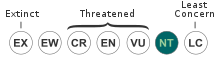
No accurate global estimates for the false killer whale exist, so the species is listed as Near Threatened by the IUCN Redlist.[2] In November 2012, the United States' National Oceanic and Atmospheric Administration recognized the Hawaiian population of false killers, comprising ~150 whales, as endangered.[59]
See also[edit]


References[edit]
- ^ a b "Pseudorca crassidens". Fossilworks. Gateway to the Paleobiology Database. Retrieved 11 August 2018.
- ^ a b Baird, R.W. (2018). "Pseudorca crassidens". IUCN Red List of Threatened Species. 2018: e.T18596A145357488. doi:10.2305/IUCN.UK.2018-2.RLTS.T18596A145357488.en. Retrieved 13 November 2021.
- ^ "Appendices | CITES". cites.org. Retrieved 14 January 2022.
- ^ Perrin WF (ed.). "Pseudorca crassidens". World Cetacea Database. World Register of Marine Species. Retrieved 4 August 2018.
- ^ a b Owen, R. (1846). A history of British fossil mammals and birds. J. Van Voorst. pp. 516–520.
- ^ Hershkovitz, P. 1966. Catalog of living whales. Bulletin of the United States National Museum 246: viii 1–259 [81]
- ^ Reinhardt, J. (1866). "Pseudorca crassidens". In Eschricht, D. F.; Lilljeborg, W.; Reindhardt, J. (eds.). Recent memoirs on the Cetacea. pp. 190–218.
- ^ a b c d e f g h Odell, D. K.; McClune, K. M. (1981). "False killer whale Pseudorca crassidens (Owen, 1946)". In Ridgeway, S. H.; Harrison, R.; Harrison, R. J. (eds.). Handbook of marine mammals: the second book of dolphins and the porpoises. Elsevier. ISBN 978-0-12-588506-5.
- ^ a b c d e f g h i j k l m n o p Baird, R. W. (2009). "False Killer Whale: Pseudorca crassidens". In Perrin, W. F.; Würsig, B.; Thewissen, J. G. M. (eds.). Encyclopedia of marine mammals. Academic Press. pp. 405–406. ISBN 978-0-08-091993-5.
- ^ Cunha, H. A.; Moraes, L. C.; Medeiros, B. V.; Lailson-Brito, Jr, J.; da Silva, V. M. F.; Solé-Cava, A. M.; Schrago, C. G. (2011). "Phylogenetic Status and Timescale for the Diversification of Steno and Sotalia Dolphins". PLOS ONE. 6 (12): e28297. Bibcode:2011PLoSO...628297C. doi:10.1371/journal.pone.0028297. PMC 3233566. PMID 22163290.
- ^ Stacey, P. J.; Leatherwood, S.; Baird, R. W. (1994). "Pseudorca crassidens" (PDF). Mammalian Species (456): 1–6. doi:10.2307/3504208. JSTOR 3504208. S2CID 253993005.
- ^ Ferreira, I. M.; Kasuya, T.; Marsh, H.; Best, P. B. (2013). "False killer whales (Pseudorca crassidens) from Japan and South Africa: Differences in growth and reproduction". Marine Mammal Science. 30 (1): 64–84. doi:10.1111/mms.12021. hdl:2263/50452.
- ^ Carroll, S. B. (13 September 2010). "Hybrids may thrive where parents fear to tread". New York Times.
- ^ Foley, Charles; Foley, Lara; Lobora, Alex; Luca, Daniela De; Msuha, Maurus; Davenport, Tim R. B.; Durant, Sarah M. (8 June 2014). A Field Guide to the Larger Mammals of Tanzania. Princeton University Press. p. 252. ISBN 978-1-4008-5280-2.
- ^ "False killer whale". Whale & Dolphin Conservation UK.
- ^ a b "False killer whale (Pseudorca crassidens)". Marine Species Identification Portal. Archived from the original on 30 June 2018. Retrieved 26 January 2013.
- ^ a b c d e f g h i Zaeschmar, J. R. (2014). "False killer whales (Pseudorca crassidens) in New Zealand waters". Massey University. Archived from the original (PDF) on 3 August 2018. Retrieved 2 August 2018.
- ^ Riccialdelli, L.; Goodall, R. N. P. (2015). "Intra-specific trophic variation in false killer whales (Pseudorca crassidens) from the southwestern South Atlantic Ocean through stable isotopes analysis". Mammalian Biology. 80 (4): 298–302. doi:10.1016/j.mambio.2015.01.003. hdl:11336/5439.
- ^ Photopoulou, T.; Ferreira, I. M.; Best, P. B.; Kasuya, T.; Marsh, H. (2017). "Evidence for a postreproductive phase in female false killer whales Pseudorca crassidens". Frontiers in Zoology. 14 (30): 30. arXiv:1606.04519. doi:10.1186/s12983-017-0208-y. PMC 5479012. PMID 28649267.
- ^ Au, W. W. L.; Pawloski, J. L.; Nachtigall, P. E. (1995). "Echolocation signals and transmission beam pattern of a false killer whale (Pseudorca crassidens)". Journal of the Acoustical Society of America. 98 (51): 51–59. Bibcode:1995ASAJ...98...51A. doi:10.1121/1.413643. PMID 7608405.
- ^ Marlee, Breese (2012). "Echolocation beam focusing in the false killer whale (Pseudorca crassidens)". Frontiers in Behavioral Neuroscience. 6. doi:10.3389/conf.fnbeh.2012.27.00161. ISSN 1662-5153.
- ^ Kloepper, Laura; Nachtigall, Paul; Donahe, Megan; Breese, Marlee (15 April 2012). "Active echolocation beam focusing in the false killer whale, Pseudorca crassidens". Journal of Experimental Biology. 215 (8): 1306–1312. doi:10.1242/jeb.066605. PMID 22442368. S2CID 207170104.
- ^ a b c Halpin, Luke R.; Towers, Jared R.; Ford, John K. B. (20 April 2018). "First record of common bottlenose dolphin (Tursiops truncatus) in Canadian Pacific waters". Marine Biodiversity Records. 11 (1): 3. Bibcode:2018MBdR...11....3H. doi:10.1186/s41200-018-0138-1.
- ^ Brown, David H.; Caldwell, David K.; Caldwell, Melba C. (4 April 1966). "Observations on the behavior of wild and captive false killer whales, with notes on associated behavior of other genera of captive delphinids". Contributions in Science. 95: 1–32. doi:10.5962/p.241085. ISSN 0459-8113. S2CID 91933110.
- ^ Zaeschmar, Jochen R.; Dwyer, Sarah L.; Stockin, Karen A. (9 July 2012). "Rare observations of false killer whales (Pseudorca crassidens) cooperatively feeding with common bottlenose dolphins (Tursiops truncatus) in the Hauraki Gulf, New Zealand". Marine Mammal Science. 29 (3): 555–562. doi:10.1111/j.1748-7692.2012.00582.x. ISSN 0824-0469. S2CID 83714092.
- ^ Passadore, Cecilia; Domingo, Andrés; Secchi, Eduardo R. (16 January 2015). "Depredation by killer whale (Orcinus orca) and false killer whale (Pseudorca crassidens) on the catch of the Uruguayan pelagic longline fishery in Southwestern Atlantic Ocean". ICES Journal of Marine Science. 72 (5): 1653–1666. doi:10.1093/icesjms/fsu251. ISSN 1095-9289.
- ^ a b Brown, D. H.; Caldwell, D. H.; Caldwell, M. B. (1966). "Observations on the wild and captive false killer whales, with notes on associated behavior of other genera of captive delphinids" (PDF). Los Angeles County Museum (95). Archived from the original (PDF) on 22 March 2016.
- ^ Minamikawa, S.; Watanabe, H.; Iwasaki, T. (2011). "Diving behavior of a false killer whale, Pseudorca crassidens, in the Kuroshio–Oyashio transition region and the Kuroshio front region of the western North Pacific". Marine Mammal Science. 29 (1): 177–185. doi:10.1111/j.1748-7692.2011.00532.x.
- ^ Caldwell, David K.; Caldwell, Melba C.; Walker, Cecil M. (August 1970). "Mass and Individual Strandings of False Killer Whales, Pseudorca crassidens, in Florida". Journal of Mammalogy. 51 (3): 634. doi:10.2307/1378415. ISSN 0022-2372. JSTOR 1378415.
- ^ Chivers, S. J.; Baird, R. W.; McSweeney, D. J.; Webster, D. L.; Hedrick, N. M.; Salinas, J. C. (2007). "Genetic variation and evidence for population structure in eastern North Pacific false killer whales (Pseudorca crassidens)" (PDF). Canadian Journal of Zoology. 85 (7): 783–794. doi:10.1139/Z07-059.
- ^ a b Sergeant, D. E. (1982). "Mass strandings of toothed whales (Odontoceti) as a population phenomenon" (PDF). The Scientific Reports of the Whales Research Institute. 34: 18.
- ^ Riccialdelli, Luciana; Goodall, Natalie (1 August 2015). "Intra-specific trophic variation in false killer whales (Pseudorca crassidens) from the southwestern South Atlantic Ocean through stable isotopes analysis". Mammalian Biology. 80 (4): 298–302. doi:10.1016/j.mambio.2015.01.003. hdl:11336/5439. ISSN 1616-5047.
- ^ Haro, Daniela; Riccialdelli, Luciana; Blank, Olivia; Matus, Ricardo; Sabat, Pablo (July 2019). "Estimating the isotopic niche of males and females of false killer whales (Pseudorca crassidens) from Magellan Strait, Chile". Marine Mammal Science. 35 (3): 1070–1082. Bibcode:2019MMamS..35.1070H. doi:10.1111/MMS.12564. ISSN 0824-0469. S2CID 92280892.
- ^ Alonso, M. K.; Pedraza, S. N.; Schiavini, A. C. M.; Goodman, R. N. P.; Crespo, E. A. (1999). "Stomach contents of false killer whales (Pseudorca crassidens) stranded on the coasts of the Strait of Magellan". Marine Mammal Science. 15 (3): 712–724. doi:10.1111/j.1748-7692.1999.tb00838.x.
- ^ "WDC". us.whales.org. Retrieved 7 October 2018.
- ^ "False killer whale". iwc.int.
- ^ Stuart, Chris (1 July 2017). Stuarts' Field Guide to the Larger Mammals of Africa. Penguin Random House South Africa. ISBN 978-1-77584-276-7.
- ^ Hubbard, N. (10 May 2016). "Drone films false killer whales hunting down a shark". Earth Touch News Network. Retrieved 2 August 2018.
- ^ Palacios, D. M.; Mate, B. R. (1996). "Attack by false killer whales (Pseudorca crassidens) on sperm whales (Physeter macrocephalus) in the Galápagos Islands". Marine Mammal Science. 12 (4): 582–587. Bibcode:1996MMamS..12..582P. doi:10.1111/j.1748-7692.1996.tb00070.x.
- ^ ACEVEDO-GUTIÉRREZ, ALEJANDRO; BRENNAN, BERNARD; RODRIGUEZ, PATRICIA; THOMAS, MOLLY (April 1997). "Resightings and Behavior of False Killer Whales ( Pseudorca Crasszdens ) in Costa Rica". Marine Mammal Science. 13 (2): 307–314. Bibcode:1997MMamS..13..307A. doi:10.1111/j.1748-7692.1997.tb00634.x. ISSN 0824-0469.
- ^ a b c d Baird, R. W. (23 December 2009). "A review of false killer whales in Hawaiian waters: biology, status, and risk factors" (PDF). Cascadia Research Collective. Retrieved 2 August 2018.
- ^ Baird, RW; Schorr, GS; Webster, DL; McSweeney, DJ; Hanson, MB; Andrews, RD (9 February 2010). "Movements and habitat use of satellite-tagged false killer whales around the main Hawaiian Islands". Endangered Species Research. 10: 107–121. doi:10.3354/esr00258. ISSN 1863-5407. S2CID 54074273.
- ^ Baird, Robin W.; Gorgone, Antoinette M.; McSweeney, Daniel J.; Webster, Daniel L.; Salden, Dan R.; Deakos, Mark H.; Ligon, Allan D.; Schorr, Gregory S.; Barlow, Jay; Mahaffy, Sabre D. (July 2008). "False killer whales (Pseudorca crassidens) around the main Hawaiian Islands: Long-term site fidelity, inter-island movements, and association patterns". Marine Mammal Science. 24 (3): 591–612. Bibcode:2008MMamS..24..591B. doi:10.1111/j.1748-7692.2008.00200.x. ISSN 0824-0469. S2CID 12769431.
- ^ Chivers, Susan J.; Baird, Robin W.; McSweeney, Daniel J.; Webster, Daniel L.; Hedrick, Nicole M.; Salinas, Juan Carlos (July 2007). "Genetic variation and evidence for population structure in eastern North Pacific false killer whales (Pseudorca crassidens)". Canadian Journal of Zoology. 85 (7): 783–794. doi:10.1139/z07-059. ISSN 0008-4301.
- ^ Stacey, P. J.; Baird, R. W. (1991). "Status of the false killer whale, Pseudorca crassidens, in Canada". Canadian Field-Naturalist. 105 (2): 189–197. doi:10.5962/p.357997.
- ^ Reeves, R. R.; Smith, B. D.; Crespo, E. A.; di Sciara, G. N. (2003). "Dolphins, Whales, and Porpoises: 2002-2010 Conservation Action Plan for the World's Cetaceans" (PDF). IUCN. Archived from the original (PDF) on 4 August 2018. Retrieved 3 August 2018.
- ^ "Pseudorca crassidens –False killer whale". Australia Government Department of the Environment and Energy. Retrieved 3 August 2018.
- ^ Brown, David H.; Caldwell, David K.; Caldwell, Melba C. (4 April 1966). "Observations on the behavior of wild and captive false killer whales, with notes on associated behavior of other genera of captive delphinids". Contributions in Science. 95: 1–32. doi:10.5962/p.241085. ISSN 0459-8113. S2CID 91933110.
- ^ Eagland, N. (24 November 2017). "Only one cetacean remains in Vancouver Aquarium's tanks after a false killer whale died Friday morning". Vancouver Sun. Retrieved 2 August 2018.
- ^ "False killer whale 'Chester' may have died from bacterial infection: preliminary necropsy report". Global News. 30 November 2017. Retrieved 2 August 2017.
- ^ Brownell Jr., R. L.; Nowacek, D. P.; Ralls, K. (2008). "Hunting cetaceans with sound: a worldwide review" (PDF). Journal of Cetacean Research and Management. 10 (1): 81–88. doi:10.47536/jcrm.v10i1.663. S2CID 44966372.
- ^ "Whale rescue in 1986 changed not just the people who were there". ABC. South West WA. 7 June 2011. Retrieved 8 July 2012.
- ^ "World watched as WA town saved the whales". The West Australian. 19 July 2011. Retrieved 8 July 2012.
- ^ "No further sightings of stranded whales". Department of Conservation and Land Management. 6 March 2005. Archived from the original on 7 September 2006. Retrieved 2 August 2018.
- ^ Chambers, S. L.; James, R. N. (2005). "Sonar termination as a cause of mass cetacean strandings in Geographe Bay, south-western Australia" (PDF). Proceedings of the Australian Acoustical Society: 391–398. Archived from the original (PDF) on 4 October 2006. Retrieved 3 August 2018.
- ^ Kirkman, S.; Meyer, M. A.; Thornton, M. (2010). "False killer whale Pseudorca crassidens mass stranding at Long Beach on South Africa's Cape Peninsula, 2009". African Journal of Marine Science. 32 (1): 167–170. Bibcode:2010AfJMS..32..167K. doi:10.2989/1814232X.2010.481168. S2CID 84702502.
- ^ Staletovich, J. (16 January 2017). "Mysterious stranding kills 81 false killer whales off Southwest Florida". Miami Herald. Retrieved 2 August 2018.
- ^ "Accobams News". Archived from the original on 16 October 2021. Retrieved 20 October 2021.
- ^ Kearn, Rebekah (27 November 2012). "Hawaiian False Killer Whale Endangered". Courthouse News. Retrieved 27 November 2012.
External links[edit]

- Whale and Dolphin Conservation Society
- NOAA Fisheries Office of Protected Resources, False Killer Whale (Pseudorca crassidens)
- Agreement on the Conservation of Small Cetaceans of the Baltic, North East Atlantic, Irish and North Seas
- Agreement on the Conservation of Cetaceans in the Black Sea, Mediterranean Sea and Contiguous Atlantic Area
- Memorandum of Understanding Concerning the Conservation of the Manatee and Small Cetaceans of Western Africa and Macaronesia
- Memorandum of Understanding for the Conservation of Cetaceans and Their Habitats in the Pacific Islands Region
- Voices in the Sea - Sounds of the False Killer Whale Archived 9 July 2014 at the Wayback Machine