


François Boucher
François Boucher | |
|---|---|
 Portrait of François Boucher by Gustaf Lundberg (1741) | |
| Born | 29 September 1703 Paris, France |
| Died | 30 May 1770 (aged 66) Paris, France |
| Known for | Painting |
| Movement | Rococo |
| Signature | |
 | |
François Boucher (UK: /ˈbuːʃeɪ/ BOO-shay, US: /buːˈʃeɪ/ boo-SHAY; French: [fʁɑ̃swa buʃe]; 29 September 1703 – 30 May 1770) was a French painter, draughtsman and etcher, who worked in the Rococo style. Boucher is known for his idyllic and voluptuous paintings on classical themes, decorative allegories, and pastoral scenes. He was perhaps the most celebrated painter and decorative artist of the 18th century.
Life[edit]
A native of Paris, Boucher was the son of a lesser known painter Nicolas Boucher, who gave him his first artistic training. At the age of seventeen, a painting by Boucher was admired by the painter François Lemoyne. Lemoyne later appointed Boucher as his apprentice, but after only three months, he went to work for the engraver Jean-François Cars.[1]

In 1720, he won the elite Grand Prix de Rome for painting, but did not take up the consequential opportunity to study in Italy until five years later, due to financial problems at the Académie royale de peinture et de sculpture.[1] On his return from studying in Italy he was admitted to the refounded Académie de peinture et de sculpture on 24 November 1731.[2] His morceau de réception (reception piece) was his Rinaldo and Armida of 1734.[2]
Boucher married Marie-Jeanne Buzeau in 1733. The couple had three children together. Boucher became a faculty member in 1734 and his career accelerated from this point as he was promoted Professor then Rector of the academy, becoming inspector at the Royal Gobelins Manufactory and finally Premier Peintre du Roi (First Painter of the King) in 1765.
_-_Alte_Pinakothek_-_Munich_-_Germany_2017_(crop).jpg)
Boucher died on 30 May 1770 in his native Paris. His name, along with that of his patron Madame de Pompadour, had become synonymous with the French Rococo style, leading the Goncourt brothers to write: "Boucher is one of those men who represent the taste of a century, who express, personify and embody it."
Boucher is famous for saying that nature is "trop verte et mal éclairée" (too green and badly lit).[4]
Boucher was associated with the gemstone engraver Jacques Guay, whom he taught to draw. He also mentored the Moravian-Austrian painter Martin Ferdinand Quadal as well as the neoclassical painter Jacques-Louis David in 1767.[5] Later, Boucher made a series of drawings of works by Guay which Madame de Pompadour then engraved and distributed as a handsomely bound volume to favored courtiers.[6]
Painting[edit]

Boucher took inspiration from artists such as Peter Paul Rubens and Antoine Watteau.[7] Boucher's early works celebrate the idyllic and tranquil portrayal of nature and landscape with great elan.[8] However, his art typically forgoes traditional rural innocence to portray scenes with a definitive style of eroticism as his mythological scenes are passionate and intimately amorous rather than traditionally epic. Boucher's paintings of a flirtatious shepherd and shepherdess in a woodland setting, featured in The Enjoyable Lesson (The Flute Players) of 1748 and An Autumn Pastoral (The Grape Eaters) of 1749, were based upon characters in a 1745 play by Boucher's close friend Charles-Simon Favart. Boucher's characters in those paintings later inspired a pair of figurines created by the Sèvres Porcelain Manufactory, c. 1757–66.[9] Marquise de Pompadour (mistress of King Louis XV), whose name became synonymous with Rococo art, was a great admirer of his work.[10] Marquise de Pompadour is often referred to as the "godmother of Rococo"[10] and Boucher's portraits were central to her self-presentation and cultivation of her image. For instance, Boucher's 'Sketch for a Portrait of Madame de Pompadour', displayed in the Starhemburg room at Waddesdon Manor, acts as a surviving example of the oil preparation prior to the, now lost, portrait. In one hand she holds her hat, in the other she picks up a pearl bracelet with a portrait of the king – symbolising the relationship upon which her status depends.
Boucher's paintings such as The Breakfast (1739), a familial scene, show how he was as a master of the genre scene, where he regularly used his own wife and children as models. These intimate family scenes are contrasting to the licentious style seen in his Odalisque portraits.
The dark-haired version of the Odalisque portraits prompted claims by the art critic Denis Diderot that Boucher was "prostituting his own wife", and the Blonde Odalisque was a portrait that illustrated the extramarital relationships of the King. Boucher gained lasting notoriety through such private commissions for wealthy collectors and, after Diderot expressed his disapproval, his reputation came under increasing critical attack during the last years of his career.
Theatrical and tapestry designs[edit]
.jpg)
Along with his painting, Boucher also designed theater costumes and sets, and the ardent intrigues of the comic operas of Charles Simon Favart closely paralleled his own style of painting. Tapestry design was also a concern. For the Beauvais tapestry workshops he first designed a series of Fêtes italiennes ("Italian festivals") in 1736, which proved to be very successful and often rewoven over the years, and then, commissioned in 1737, a suite of the story of Cupid and Psyche.[11] During two decades' involvement with the Beauvais tapestry workshops Boucher produced designs for six series of hangings in all, like the tapestry showing Psyche and the Basketmaker from 1741 to 1742.
Boucher was also called upon for designs for court festivities organized by that section of the King's household called the Menus-Plaisirs du Roi and for the opera and for royal châteaux Versailles, Fontainebleau and Choisy. His designs for all of the aforementioned augmented his earlier reputation, resulting in many engravings from his work and even reproduction of his designs on porcelain and biscuit-ware at the Vincennes and Sèvres factories. The death of Oudry in 1755 put an end to its contribution to Beauvais but his collaboration with the Gobelins lasted until 1765, when he stepped down from his position as an inspector.
Drawings and prints[edit]


Boucher was a very prolific and varied draftsman. His drawings served not only as preparatory studies for his paintings and as designs for printmakers but also as finished works of art for which there was a great demand by collectors. Boucher followed standard studio practices of the time, by first working out the overall composition of his major canvases, and then making chalk studies for individual figures, or groups of figures. He also relied on oil and gouache sketches in the preparation of major commissions.
Gradually he made more and more sketches as independent works for the market. The Adoration of the Shepherds (Metropolitan Museum of Art), a free and painterly sketch in gouache, was long considered a preparatory sketch for Madame de Pompadour's private altarpiece La lumière du monde (ca. 1750, Musée des Beaux-Arts, Lyon). Recent scholarship suggests, however, that it was made at least 10 years later as an autonomous work. In the last decade of his career the artist began to favor brown chalk, a fabricated medium.[12]
Boucher was also a gifted engraver and etcher. Boucher etched some 180 original copperplates. He made many etchings after Watteau. He thus helped propagate a taste for reproductions of drawings. When his own drawings began to sell, 266 of them were etched in stipple substitutes by Gilles Demarteau. These were printed in red ink so they resembled red chalk drawings which could be framed as little pictures. They could then be hung in the small blank spaces of the elaborately decorated paneling of luxury dwellings.
Boucher's most original inventions were decorative, and he contributed to the fashionable style of chinoiserie, after having etched 12 'Figures Chinoises' (Chinese figures) by Watteau.[13]
Gallery[edit]
-
 Self-portrait in the Studio, 1720, Louvre
 -
 Putti with Birds, c. 1730–1733, Honolulu Museum of Art
 -
 Rinaldo and Armida, 1734 (Reception piece)
 -
-
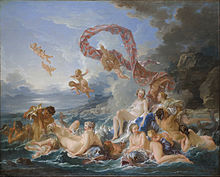
 Leda and the Swan, 1741
 -
 Diana Leaving the Bath, 1742
 -
 La Toilette de Venus, after 1743, Hermitage Museum
 -
 In this sketch, Boucher allows the viewer to glimpse Madame de Pompadour before she goes out, c 1750, Waddesdon Manor
 -
 Venus Consoling Love, 1751
 -
 The Toilette of Venus (1751) typifies the pleasing elegance of Boucher's mature style.
 -
 The Bridge, 1751, Louvre
 -

-
 Saint Peter Attempting to Walk on Water, 1766, Cathédrale Saint-Louis, Versailles
 -
 Dreaming Shepherdess
 -
 Autumn Pastoral
 -

-
 Aurora Heralding the Arrival of the Morning Sun, c. 1765, National Gallery of Art


_et_son_atelier,_La_Toilette_de_V%C3%A9nus_(apr%C3%A8s_1743).jpg)
,_c._1750_at_Waddesdon_Manor.jpg)


Works by François Boucher[edit]

This is an incomplete list of works by François Boucher.
- Death of Meleager (c. 1727), Los Angeles County Museum of Art[14]
- Project for a Cartouche (c. 1727), Los Angeles County Museum of Art[15]
- Imaginary Landscape with the Palatine Hill from Campo Vaccino (1734), Metropolitan Museum of Art[16]
- Monument to Mignard (c. 1735), Los Angeles County Museum of Art[17]
- Venus and Mercury Instructing Cupid (1738), Los Angeles County Museum of Art[18]
- Cupid Wounding Psyche (1741), Los Angeles County Museum of Art[19]
- Les Confidences Pastorales (c. 1745), Los Angeles County Museum of Art[20]
- Arion on the Dolphin (1748), Princeton University Art Museum[21]
- Pompadour at Her Toilette (1750), Harvard Art Museums[22]
- Sketch for a Portrait of Madame de Pompadour (c.1750), Waddesdon Manor[23]
- The Bird Has Flown (1765), Snite Museum of Art, University of Notre Dame, IN[24]
- The Interrupted Sleep (1750), Metropolitan Museum of Art[25]
- The Love Letter (1750), National Gallery of Art[26]

- The Toilette of Venus (1751), Metropolitan Museum of Art[27]
- Shepherd Boy Playing Bagpipes (c. 1754), Museum of Fine Arts, Boston[28]
- Landscape with a Watermill (1755), National Gallery, London [29]
- Venus in the Workshop of Vulcan (1757), Yale University Art Gallery[30]
- Fishing (1757), Grand Trianon
- Lovers in a Park (1758), Timken Museum,[31]
- Pan and Syrinx (1759), National Gallery,[32]
- Study of a standing nude young woman seen from behind, raising drapery (1762), Miguel Urrutia Art Museum, Bogotá[33]
- Angelica and Medoro (1763), Metropolitan Museum of Art[34]
- Jupiter, in the Guise of Diana, and Callisto (1763), Metropolitan Museum of Art[35]
- The Judgment of Paris (circa 1763), Musée des Beaux-Arts de Mulhouse
- Virgin and Child with the Young Saint John the Baptist and Angels (1765), Metropolitan Museum of Art[36]
- Halt at the Spring (1765), Museum of Fine Arts, Boston[37]
- Return from Market (1767), Museum of Fine Arts, Boston[38]
- Shepherd's Idyll (1768), Metropolitan Museum of Art[39]
- Washerwomen (1768), Metropolitan Museum of Art[40]
- Aurora Heralding the Arrival of the Morning Sun (1765), National Gallery of Art[41]
See also[edit]
References[edit]
- ^ a b Alastair Laing. "Boucher, François." Grove Art Online. Oxford Art Online. Oxford University Press. Web. 16 June 2016
- ^ a b Levey, Michael. (1993) Painting and sculpture in France 1700–1789. New Haven: Yale University Press, p. 164. ISBN 0300064942
- ^ Wallace, Arminta. "Marie-Louise O'Murphy, the Versailles king's Irish mistress". The Irish Times. Retrieved 2023-09-09.
- ^ Houssaye, Arsène (1843). "Boucher et la peinture sous Louis XV". Revue des deux mondes. New series. 3: 70–98. p. 86 (citing a letter to Nicolas Lancret).
- ^ "Martin Ferdinand Quadal – Biography, Interesting Facts, Famous Artworks". Arthive. Retrieved 2019-04-03.
- ^ Leturcq, Jean François (1873). Notice sur Jacques Guay, graveur sur pierres fines du roi Louis xv. Documents émanant de Guay, et notes sur les œuvres de gravure en taille-douce et en pierres fines de la marquise de Pompadour. Baur. pp. 10–12. Retrieved 2014-08-24.
- ^ Hoskin, Dawn (September 30, 2014). "Born on this Day: Francois Boucher". Victoria and Albert Museum.
- ^ Voss, Hermann; Barea, Ilse (March 1953). "Francois Boucher's Early Development". The Burlington Magazine. 95 (600). Burlington Magazine Publications Ltd.: 82. JSTOR 871018.
- ^ Zarucchi, Jeanne Morgan (2016). "The Shepherdess' Progress: From Favart to Boucher to Sèvres". Konsthistorisk Tidskrift (Journal of Art History, Stockholm). 85 (2): 141–158. doi:10.1080/00233609.2016.1142474. S2CID 192925316.
- ^ a b Hyde, Melissa (September 2000). "The "Makeup" of the Marquise: Boucher's Portrait of Pompadour at her Toilette". Art Bulletin. 82 (3): 455. doi:10.2307/3051397. ISSN 0004-3079. JSTOR 3051397.
- ^ Kathryn B. Hiesinger, "The Sources of François Boucher's 'Psyche' Tapestries" Philadelphia Museum of Art Bulletin 72 No. 314 (November 1976), pp. 7–23.
- ^ Perrin Stein. François Boucher (1703–1770) at the Metropolitan Museum of Art, October 2003.
- ^ Alpheus Hyatt Mayor, Prints & People: A Social History of Printed Pictures, Metropolitan Museum of Art (New York, N.Y.), 1 January 1971, p. 589
- ^ "Death of Meleager | LACMA Collections". Collections.lacma.org. Retrieved 2014-04-05.
- ^ "Project for a Cartouche: An Allegory of Minerva, Fame, History and Faith Overcoming Ignorance and Time | LACMA Collections". Collections.lacma.org. Retrieved 2014-04-05.
- ^ "The Metropolitan Museum of Art – Imaginary Landscape with the Palatine Hill from Campo Vaccino". Metmuseum.org. Retrieved 2014-04-05.
- ^ "Monument to Mignard | LACMA Collections". Collections.lacma.org. Retrieved 2014-04-05.
- ^ "Venus and Mercury Instructing Cupid | LACMA Collections". Collections.lacma.org. Retrieved 2014-04-05.
- ^ "Cupid Wounding Psyche | LACMA Collections". Collections.lacma.org. Retrieved 2014-04-05.
- ^ "Les Confidences Pastorales | LACMA Collections". Collections.lacma.org. Retrieved 2014-04-05.
- ^ "Arion on the Dolphin (y1980-2)". Princeton University Art Museum. Princeton University.
- ^ "Jeanne-Antoinette Poisson, Marquise de Pompadour". Harvard Art Museums. Retrieved 2014-04-05.
- ^ "Search Results". collection.waddesdon.org.uk. Retrieved 2017-04-24.
- ^ "The Bird Has Flown". University of Notre Dame. Retrieved 2016-03-29.
- ^ "The Metropolitan Museum of Art – The Interrupted Sleep". Metmuseum.org. Retrieved 2014-04-05.
- ^ "The National Gallery of Art – The Love Letter". Nga.gov. Retrieved 2021-03-04.
- ^ "The Metropolitan Museum of Art – The Toilette of Venus". Metmuseum.org. Retrieved 2014-04-05.
- ^ "Shepherd Boy Playing Bagpipes -François Boucher, French, 1703–1770 | Museum of Fine Arts, Boston". Mfa.org. Retrieved 2014-04-05.
- ^ "François Boucher | Landscape with a Watermill | NG6374 | The National Gallery, London". Nationalgallery.org.uk. Retrieved 2014-04-05.
- ^ "Venus in the Workshop of Vulcan". Artgallery.yale.edu. Archived from the original on 2014-04-07. Retrieved 2014-04-05.
- ^ "Lovers in a Park; Timken Museum, San Diego". timkenmuseum.org. Retrieved 2019-06-03.
- ^ "François Boucher | Pan and Syrinx | NG1090 | The National Gallery, London". Nationalgallery.org.uk. Retrieved 2014-04-05.
- ^ "Estudio de mujer joven de pie, vista de espaldas, levantando una tela". banrepcultural.org. Retrieved 2022-10-24.
- ^ "The Metropolitan Museum of Art – Angelica and Medoro". Metmuseum.org. Retrieved 2014-04-05.
- ^ "The Metropolitan Museum of Art – Jupiter, in the Guise of Diana, and Callisto". Metmuseum.org. Retrieved 2014-04-05.
- ^ Virgin and Child with the Young Saint John the Baptist and Angels
- ^ "Halt at the Spring -François Boucher, French, 1703–1770 | Museum of Fine Arts, Boston". Mfa.org. Retrieved 2014-04-05.
- ^ "Return from Market -François Boucher, French, 1703–1770 | Museum of Fine Arts, Boston". Mfa.org. Retrieved 2014-04-05.
- ^ "The Metropolitan Museum of Art – Shepherd's Idyll". Metmuseum.org. Retrieved 2014-04-05.
- ^ "The Metropolitan Museum of Art – Washerwomen". Metmuseum.org. Retrieved 2014-04-05.
- ^ "Aurora Heralding the Arrival of the Morning Sun". www.nga.gov. 7 June 1765. Retrieved 2019-11-16.
Further reading[edit]
- General studies
Adapted from a following source: Freitag, Wolfgang M. (1997) [1985]. Art Books: A Basic Bibliography of Monographs on Artists (2nd ed.). New York, London: Garland. pp. 42–43, entries nos. 1200–1213. ISBN 0-8240-3326-4. LCCN 96028425.
- Ananoff, Alexandre (1976). Wildenstein, Daniel (ed.). Boucher (catalogue raisonné) (in French). Lausanne, Paris: La Bibliothéque des Arts. Vols. 1 and 2 available via the Internet Archive.
- Bailey, Colin B. (1992). The Loves of the Gods: Mythological Painting from Watteau to David (exhibition catalogue). New York; Fort Worth, TX: Rizzoli, Kimbell Art Museum. ISBN 0-8478-1521-8. OCLC 1245529108 – via the Internet Archive.
- Brunel, Georges (1986). Boucher (in French). Paris: Flammarion. ISBN 2-08-012066-2. LCCN 86-11145 – via the Internet Archive.
- Hyde, Melissa Lee (2006). Making Up the Rococo: François Boucher and His Critics. Los Angeles, CA: Getty Research Institute. ISBN 0-89236-743-1. OCLC 1150262302 – via the Internet Archive.
- Kahn, Gustave (1904). Boucher: biographie critique (in French). Paris: H. Laurens. OCLC 1041628220 – via the Internet Archive.
- Laing, Alastair; et al. (1986). François Boucher, 1703–1770 (exhibition catalogue). New York: Metropolitan Museum of Art. ISBN 2-7118-2073-4. OCLC 1035142859 – via the Internet Archive.
- Mantz, Paul (1880). François Boucher, Lemoyne et Natoire (in French). Paris: A. Quantin – via the Internet Archive.
- Nolhac, Pierre de (1907). François Boucher: premier peintre du roi, 1703-1770 (in French). Paris: Goupil – via the Internet Archive.
- Priebe, Jessica (2022). François Boucher and the Art of Collecting in Eighteenth-Century France. Abingdon, Oxon; New York: Routledge. ISBN 9781472435835. OCLC 1252736555.
- Wakefield, David (2005). Boucher. London: Chaucer Press. ISBN 1-904449-352.
- Reference works
- Blumer, Marie-Louise (1954). "Boucher (François)". In Prevost, Michel; Roman d'Amat, Jean-Charles (eds.). Dictionnaire de biographie française (in French). Vol. 6. Paris: Letouzet et Ané. cols. 1202–1205. OCLC 922284772.
- Geffroy, Gustave (1910). "Boucher, François". In Thieme, Ulrich; Becker, Felix (eds.). Allgemeines Lexikon der bildenden Künstler (in German). Vol. 4. Leipzig: W. Engelmann. pp. 428–432. OCLC 1039507204 – via the Internet Archive.
- Laing, Alastair (1996a). "Boucher, François". In Turner, Jane (ed.). The Dictionary of Art. Vol. 4. New York: Grove's Dictionaries. pp. 511–519. ISBN 1-884446-00-0. OCLC 1033646743 – via the Internet Archive.
- Laing, Alastair (1996b). "Boucher, François". In Kasten, Eberhard; et al. (eds.). Allgemeines Künstlerlexikon (in German). Vol. 13. München, Leipzig: Saur. pp. 289–293. ISBN 3-598-22753-1.
External links[edit]

- Chronological list of Paintings by François Boucher at Wikidata
- 70 artworks by or after François Boucher at the Art UK site
- François Boucher.org
- Boucher's Madame de Pompadour Archived 2014-10-24 at the Wayback Machine (video)
- Boucher's Venus Consoling Love (video)
- Mobilier national collection
| International | |
|---|---|
| National | |
| Artists | |
| People | |
| Other | |


