


Frederic Leighton
The Lord Leighton | |
|---|---|
 Frederic Leighton, Self-portrait, 1880 | |
| Born | Frederic Leighton 3 December 1830 Scarborough, North Riding of Yorkshire, England |
| Died | 25 January 1896 (aged 65) Kensington, London, England |
| Education | |
| Known for | Painting and sculpture |
| Notable work | Flaming June |
| Movement | Academicism, Pre-Raphaelite and British Aestheticism |
| Awards | |
| Signature | |
 | |
Frederic Leighton, 1st Baron Leighton, PRA (3 December 1830 – 25 January 1896), known as Sir Frederic Leighton between 1878 and 1896, was a British Victorian painter, draughtsman, and sculptor. His works depicted historical, biblical, and classical subject matter in an academic style. His paintings were enormously popular and expensive, during his lifetime, but fell out of critical favour for many decades in the early 20th century.[citation needed]
Leighton was the bearer of the shortest-lived peerage in history; after only one day, his hereditary peerage became extinct upon his death.[1]
Biography[edit]
.jpg)

Leighton was born in Scarborough to Augusta Susan and Dr. Frederic Septimus Leighton (1799–1892), a medical doctor. Leighton's grandfather, Sir James Boniface Leighton (1769–1843), had been the primary physician to two Russian tsars—Alexander I and Nicholas I—and their families, and amassed a fortune while in their service.[2] Leighton’s career was always cushioned by this family wealth, with his father paying him an allowance throughout his life.[3] He had two sisters, one of them being Alexandra who was Robert Browning's biographer.[4] He was educated at University College School, London. He then received his artistic training on the European continent, first from Eduard von Steinle and then from Giovanni Costa. At age 17, in the summer of 1847, he met the philosopher Arthur Schopenhauer in Frankfurt and drew his portrait, in graphite and gouache on paper—the only known full-length study of Schopenhauer done from life.[5] When he was 24 he was in Florence; he studied at the Accademia di Belle Arti, and painted the procession of the Cimabue Madonna through the Borgo Allegri. From 1855 to 1859 he lived in Paris, where he met Ingres, Delacroix, Corot, and Millet.
Travel was an important part of Leighton’s life from childhood. By his late teens, he was living with his family in Frankfurt, Germany and had already visited many of Europe’s major cities, including Florence and Rome; places which he would return to on a great many occasions over the next decades. By his late twenties, extended periods had been spent living in Rome and then Paris and Leighton had made his first trip outside Europe, travelling to north Africa in 1857. Once settled in London, he continued to make extensive trips on an annual basis until shortly before his death. The countries that Leighton visited on at least one occasion include Austria, Algeria, Egypt, France, Germany, Greece, Ireland, Italy, Lebanon, Morocco, The Netherlands, Scotland, Spain, Switzerland, Syria, and Turkey.
In 1860, he moved to London, where he associated with the Pre-Raphaelites. He designed Elizabeth Barrett Browning's tomb for Robert Browning in the English Cemetery, Florence in 1861. In 1864 he became an associate of the Royal Academy and in 1878 he became its President (1878–96). His 1877 sculpture, Athlete Wrestling with a Python, was considered at its time to inaugurate a renaissance in contemporary British sculpture, referred to as the New Sculpture. American art critic Earl Shinn claimed at the time that "Except Leighton, there is scarce any one capable of putting up a correct frescoed figure in the archway of the Kensington Museum."[6] His paintings represented Britain at the great 1900 Paris Exhibition.
He was the first President of the Committee commissioning the Survey of London which documented the capital's principal buildings and public art.[7]
Leighton was knighted at Windsor in 1878,[8] and was created a baronet, of Holland Park Road in the Parish of St Mary Abbots, Kensington, in the County of Middlesex, eight years later.[9] He was the first painter to be given a peerage, in the 1896 New Year Honours. The patent creating him Baron Leighton, of Stretton in the County of Shropshire, was issued on 24 January 1896;[10] Leighton died the next day of angina pectoris.


Leighton remained a bachelor; rumours of him having an illegitimate child with one of his models, in addition to the supposition that Leighton may have been homosexual, continue to be debated.[11] He certainly enjoyed an intense and romantically tinged relationship with the poet Henry William Greville whom he met in Florence in 1856.[12] The older man showered Leighton in letters, but the romantic affection seems not to have been reciprocated. Enquiry is furthermore hindered by the fact that Leighton left no diaries and his letters lack reference to his personal circumstances. No definite primary evidence has yet come to light that effectively dispels the secrecy that Leighton built up around himself, although it is clear that he did court a circle of younger men around his artistic studio.[11]
On his death his barony was extinguished after existing for only a day; this is a record in the Peerage. His house in Holland Park, London has been turned into a museum, the Leighton House Museum. It contains many of his drawings and paintings, as well as some of his former art collection including works by Old Masters and his contemporaries such as a painting dedicated to Leighton by Sir John Everett Millais. The house also features many of Leighton's inspirations, including his collection of Iznik tiles. (see Iznik pottery) Its centrepiece is the magnificent Arab Hall. The Hall is featured in issue ten of Cornucopia.[13] A blue plaque commemorates Leighton at Leighton House Museum.[14]
Artists Rifles[edit]


Leighton was an enthusiastic volunteer soldier, enrolling with the first group to join the 38th Middlesex (Artists') Rifle Volunteer Corps (later to be known as the Artists Rifles) on 5 October 1860.
His qualities of leadership were immediately identified, and he was promoted to command a Company within a few months. On 6 January 1869 Captain Leighton was elected to command the Artists Rifles by a general meeting of the corps. In the same year he was promoted to major and in 1875 to lieutenant colonel. Leighton resigned as commanding officer in 1883. The painter James Whistler famously described the then Sir Frederic Leighton, the commanding officer of the Artists Rifles, as the: "Colonel of the Royal Academy and the President of the Artists Rifles – aye, and he paints a little!" At his funeral, on 3 February 1896, his coffin was carried into St Paul's Cathedral,[15] past a guard of honour formed by the Artists Rifles.[16]
Honours[edit]
- 1864: Associate of the Royal Academy
- 1868: Royal Academy Academician
- 1878: President of the Royal Academy
- 1878: Légion d'honneur Officer
- 1878: Knight Bachelor
- 1886: Created a baronet in the Baronetage of the United Kingdom
- 1889: Associate member of the Institute of France
- 1896: Created a baron in the Peerage of the United Kingdom
Selected works[edit]
- Death of Brunelleschi (1852), oil on canvas
- The Fisherman and the Siren, c. 1856–58 (66.3 cm × 48.7 cm (26.1 in × 19.2 in))
- Cimabue's Celebrated Madonna Is Carried in Procession Through the Streets of Florence (1853–55),[17] oil on canvas.
- The Discovery of Juliet Apparently Lifeless (c. 1858)[18]
- The Villa Malta, Rome (1860s),[19] oil on canvas
- The Painter's Honeymoon, c. 1864 (83.8 cm × 77.5 cm (33.0 in × 30.5 in))
- Mother and Child, c. 1865 (48.2 cm × 82 cm (19.0 in × 32.3 in))
- Actaea, the Nymph of the Shore (1868),[20] oil on canvas (57.2 cm × 102.2 cm (22.5 in × 40.2 in)), National Gallery of Canada, Ottawa.
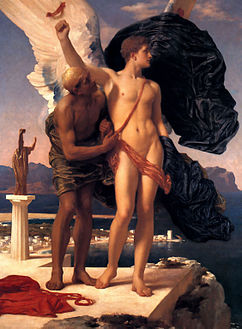
- Daedalus and Icarus, c. 1869 (138.2 cm × 106.5 cm (54.4 in × 41.9 in))
- Hercules Wrestling with Death for the Body of Alcestis (1869–71) (132.4 cm × 265.4 cm (52.1 in × 104.5 in))
- After Vespers, 1871 (111.5 cm × 71.5 cm (43.9 in × 28.1 in)), Princeton University Art Museum
- Greek Girls Picking up Pebbles by the Sea, 1871 (84 cm × 129.5 cm (33.1 in × 51.0 in))
- Teresina (c. 1874) Christchurch Art Gallery Te Puna o Waiwhetu, Christchurch, New Zealand
- Music Lesson, c. 1877 (92.8 cm × 118.1 cm (36.5 in × 46.5 in))
- An Athlete Wrestling with a Python (1877),[21] bronze sculpture
- Nausicaa, c. 1878 (145 cm × 67 cm (57 in × 26 in))
- Winding the Skein, c. 1878 (100.3 cm × 161.3 cm (39.5 in × 63.5 in))
- Light of the Harem, c. 1880 (152.4 cm × 83.8 cm (60.0 in × 33.0 in))
- Idyll, c. 1880–81
- Wedded, (c. 1881–1882) (145.4 cm × 81 cm (57.2 in × 31.9 in))
- Cymon and Iphigenia (1884) Art Gallery of New South Wales
- Captive Andromache, c. 1888 (197 cm × 406.5 cm (77.6 in × 160.0 in))
- The Bath of Psyche (c. 1889–90) (189.2 cm × 62.2 cm (74.5 in × 24.5 in)) Tate Gallery
- The Garden of the Hesperides, c. 1892 (169 cm × 169 cm (67 in × 67 in)), Lady Lever Art Gallery
- Flaming June (1895), oil on canvas, Museo de Arte de Ponce, Puerto Rico (120.6 cm × 120.6 cm (47.5 in × 47.5 in))
- The Parable of the Wise and Foolish Virgins (Fresco)[22]
- The armlet
- Phoebe (55.88 cm × 60.96 cm (22.00 in × 24.00 in))
- A Bather
- The Leighton Frescoes, The Arts of Industry as Applied to War and The Arts of Industry as Applied to Peace
- Phoenicians Trading with the Early Britons on the Coast of Cornwall, 1895. Mural at the Royal Exchange, London
- The Return of Persephone, 1891, oil on canvas, Leeds Art Gallery[23]
Gallery[edit]
-
-
 The Garden of the Hesperides, oil on canvas painting, 1892, Lady Lever Art Gallery
 -
 The Sluggard, 1885
 -
 Athlete wrestling with a Python, white marble sculpture, 1888–1891 (Private collection: on loan to the Art Gallery of New South Wales)
 -
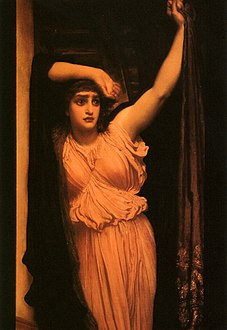 The Last Watch of Hero, 1880
 -
 Perseus and Andromeda, 1891, Walker Art Gallery, Liverpool.
 -
 Moses views the Promised Land
 -
 The Painter's Honeymoon, 1864
 -
 Memories, 1883
 -
 The Bath of Psyche, 1879


-
 Captive Andromache, oil on canvas painting, 1886–1888, Manchester City Art Gallery
 -
 Cymon and Iphigenia, oil on canvas painting, 1884, Art Gallery of New South Wales
 -
 Portrait of May Sartoris
 -
 Biondina, 1879
 -
 The Return of Persephone, 1891
 -
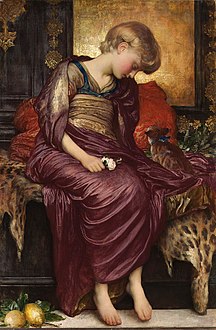 Kittens, 1883
 -
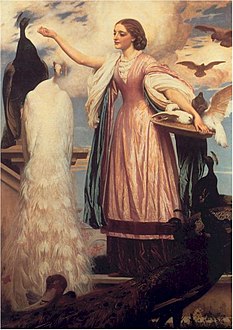 A Girl Feeding Peacocks, c. 1863
 -
 Solitude, c. 1890
 -
 Winding the skein, 1878


.jpg)


See also[edit]
- Romola – the 1863 novel by George Eliot for which Leighton did the illustrations
Citations[edit]
- ^ Leigh Rayment (1 September 2015). "Peerage Records". Leigh Rayment's Peerage Page. Archived from the original on 23 March 2016.
{{cite web}}: CS1 maint: unfit URL (link) - ^ "Biography of Lord Frederick Leighton". ARC. Retrieved 4 October 2022.
- ^ "Frederic Leighton". RBKC. Retrieved 4 October 2022.
- ^ "Orr [née Leighton], Alexandra". Oxford Dictionary of National Biography (online ed.). Oxford University Press. 2004. doi:10.1093/ref:odnb/35332. ISBN 978-0-19-861412-8. Retrieved 30 April 2017. (Subscription or UK public library membership required.)
- ^ Crowther, Paul, and Miruna Cuzman. "A Rediscovered Contemporary Full-Length Sketch-Portrait of Schopenhauer by Frederic, Lord Leighton." Schopenhauer Jahrbuch, 92 Band, Konigshausen und Neumann, 2011: 301–306.
- ^ Shinn, Earl (1880). The World's Art: From the International Exhibition. Lovering.
- ^ "Members of the Survey Committee Pages 4-7 Survey of London Monograph 12". British History Online. Guild & School of Handicraft, London, 1926. Retrieved 30 December 2022.
- ^ "No. 24651". The London Gazette. 29 November 1878. p. 6695.
- ^ "No. 25551". The London Gazette. 22 January 1886. p. 328.
- ^ "No. 26705". The London Gazette. 31 January 1896. p. 587.
- ^ a b Emanuel Cooper, The Sexual Perspective: Homosexuality and Art in the Last 100 Years in the West, 2005
- ^ Oxford Dictionary of National Biography vol 33
- ^ Cornucopia 10, Ingres and Lady Mary Montagu, Leighton House, yurts, the Lycians plus elegant eggplant. Cornucopia.net. Retrieved on 20 February 2011.
- ^ "LEIGHTON, FREDERICK, LORD LEIGHTON (1830–1896)". English Heritage. Retrieved 1 July 2012.
- ^ "Memorials of St Paul's Cathedral" Sinclair, W. p. 469: London; Chapman & Hall, Ltd; 1909.
- ^ Barry Gregory. A History of The Artists Rifles 1859–1947. Pen & Sword. 2006.
- ^ Frederic, Lord Leighton | Cimabue's Celebrated Madonna | L275 | The National Gallery, London. Nationalgallery.org.uk. Retrieved on 20 February 2011.
- ^ Tate Collection | Study for 'The Discovery of Juliet Apparently Lifeless'. Tate.org.uk. Retrieved on 20 February 2011.
- ^ Frederic, Lord Leighton | The Villa Malta, Rome | L851 | The National Gallery, London. Nationalgallery.org.uk. Retrieved on 20 February 2011.
- ^ Artwork Page: Actaea, the Nymph of the Shore Archived 28 August 2004 at the Wayback Machine. Cybermuse.gallery.ca. Retrieved on 20 February 2011.
- ^ Tate Collection | An Athlete Wrestling with a Python by Frederic, Lord Leighton. Tate.org.uk. Retrieved on 20 February 2011.
- ^ Newforestparishes.com Archived 3 July 2007 at the Wayback Machine
- ^ "Leeds Art Gallery, listings". Archived from the original on 30 November 2016. Retrieved 28 September 2016.
General references[edit]
- Monkhouse, William Cosmo (1911). . In Chisholm, Hugh (ed.). Encyclopædia Britannica. Vol. 16 (11th ed.). Cambridge University Press. pp. 396–398.
External links[edit]

| External videos | |
|---|---|
 Leighton's An Athlete Wrestling with a Python, Smarthistory Leighton's An Athlete Wrestling with a Python, Smarthistory |
- Frederic-Leighton.org—114 works by Frederic Leighton
- Advice to Young Artists by Frederick Lord Leighton—high resolution images
- Scarborough, Birthplace of Lord Frederic Leighton
- Leighton House Museum
- Obituary from The Times
- Leighton Gallery Archived 27 September 2007 at the Wayback Machine at MuseumSyndicate
- 171 artworks by or after Frederic Leighton at the Art UK site
- Portrait of Sir Frederick Leighton, PRA by Alphonse Legros at University of Michigan Museum of Art
| International | |
|---|---|
| National | |
| Artists | |
| People | |
| Other | |


- 1830 births
- 1896 deaths
- Barons in the Peerage of the United Kingdom
- English sculptors
- English male sculptors
- English history painters
- People of the Victorian era
- Prix de Rome for painting
- Artists from Scarborough, North Yorkshire
- Royal Academicians
- People educated at University College School
- Knights Bachelor
- Artists' Rifles officers
- Academic art
- Officers of the Legion of Honour
- Recipients of the Royal Gold Medal
- Recipients of the Pour le Mérite (civil class)
- 19th-century British sculptors
- 19th-century English painters
- English Orientalist painters
- English male painters
- Peers of the United Kingdom created by Queen Victoria
- Baronets in the Baronetage of the United Kingdom
- Military personnel from Scarborough, North Yorkshire
- 19th-century British Army personnel
- Volunteer Force officers