


Gaussian process
In probability theory and statistics, a Gaussian process is a stochastic process (a collection of random variables indexed by time or space), such that every finite collection of those random variables has a multivariate normal distribution. The distribution of a Gaussian process is the joint distribution of all those (infinitely many) random variables, and as such, it is a distribution over functions with a continuous domain, e.g. time or space.
The concept of Gaussian processes is named after Carl Friedrich Gauss because it is based on the notion of the Gaussian distribution (normal distribution). Gaussian processes can be seen as an infinite-dimensional generalization of multivariate normal distributions.
Gaussian processes are useful in statistical modelling, benefiting from properties inherited from the normal distribution. For example, if a random process is modelled as a Gaussian process, the distributions of various derived quantities can be obtained explicitly. Such quantities include the average value of the process over a range of times and the error in estimating the average using sample values at a small set of times. While exact models often scale poorly as the amount of data increases, multiple approximation methods have been developed which often retain good accuracy while drastically reducing computation time.
Definition[edit]
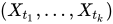
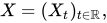
A time continuous stochastic process is Gaussian if and only if for every finite set of indices in the index set



is a multivariate Gaussian random variable.[1] That is the same as saying every linear combination of has a univariate normal (or Gaussian) distribution.
Using characteristic functions of random variables with denoting the imaginary unit such that , the Gaussian property can be formulated as follows: is Gaussian if and only if, for every finite set of indices , there are real-valued , with such that the following equality holds for all ,



![{\displaystyle {\mathbb {E} }\left[\exp \left(i\sum _{\ell =1}^{k}s_{\ell }\,\mathbf {X} _{t_{\ell }}\right)\right]=\exp \left(-{\tfrac {1}{2}}\sum _{\ell ,j}\sigma _{\ell j}s_{\ell }s_{j}+i\sum _{\ell }\mu _{\ell }s_{\ell }\right),}](https://wikimedia.org/api/rest_v1/media/math/render/svg/bdb34f9f73060f65ce8450012831f2f32f0264b6)
or . The numbers and can be shown to be the covariances and means of the variables in the process.[2]
![{\displaystyle {\mathbb {E} }\left[{\mathrm {e} }^{i\,\mathbf {s} \,(\mathbf {X} _{t}-\mathbf {\mu } )}\right]={\mathrm {e} }^{-\mathbf {s} \,\sigma \,\mathbf {s} /2}}](https://wikimedia.org/api/rest_v1/media/math/render/svg/97565415a502310350caf381b920a8bece43914d)
Variance[edit]
The variance of a Gaussian process is finite at any time , formally[3]: p. 515

![{\displaystyle \operatorname {var} [X(t)]={\mathbb {E} }\left[\left|X(t)-\operatorname {E} [X(t)]\right|^{2}\right]<\infty \quad {\text{for all }}t\in T.}](https://wikimedia.org/api/rest_v1/media/math/render/svg/66fc2c7877763c8da8ffd6a8b1276b477bddecec)
Stationarity[edit]
For general stochastic processes strict-sense stationarity implies wide-sense stationarity but not every wide-sense stationary stochastic process is strict-sense stationary. However, for a Gaussian stochastic process the two concepts are equivalent.[3]: p. 518
A Gaussian stochastic process is strict-sense stationary if and only if it is wide-sense stationary.
Example[edit]
There is an explicit representation for stationary Gaussian processes.[4] A simple example of this representation is

where and are independent random variables with the standard normal distribution.


Covariance functions[edit]
A key fact of Gaussian processes is that they can be completely defined by their second-order statistics.[5] Thus, if a Gaussian process is assumed to have mean zero, defining the covariance function completely defines the process' behaviour. Importantly the non-negative definiteness of this function enables its spectral decomposition using the Karhunen–Loève expansion. Basic aspects that can be defined through the covariance function are the process' stationarity, isotropy, smoothness and periodicity.[6][7]
Stationarity refers to the process' behaviour regarding the separation of any two points and . If the process is stationary, the covariance function depends only on . For example, the Ornstein–Uhlenbeck process is stationary.


If the process depends only on , the Euclidean distance (not the direction) between and , then the process is considered isotropic. A process that is concurrently stationary and isotropic is considered to be homogeneous;[8] in practice these properties reflect the differences (or rather the lack of them) in the behaviour of the process given the location of the observer.

Ultimately Gaussian processes translate as taking priors on functions and the smoothness of these priors can be induced by the covariance function.[6] If we expect that for "near-by" input points and their corresponding output points and to be "near-by" also, then the assumption of continuity is present. If we wish to allow for significant displacement then we might choose a rougher covariance function. Extreme examples of the behaviour is the Ornstein–Uhlenbeck covariance function and the squared exponential where the former is never differentiable and the latter infinitely differentiable.


Periodicity refers to inducing periodic patterns within the behaviour of the process. Formally, this is achieved by mapping the input to a two dimensional vector .

Usual covariance functions[edit]

There are a number of common covariance functions:[7]
- Constant :
- Linear:
- white Gaussian noise:
- Squared exponential:
- Ornstein–Uhlenbeck:
- Matérn:
- Periodic:
- Rational quadratic:
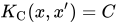


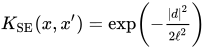




Here . The parameter is the characteristic length-scale of the process (practically, "how close" two points and have to be to influence each other significantly), is the Kronecker delta and the standard deviation of the noise fluctuations. Moreover, is the modified Bessel function of order and is the gamma function evaluated at . Importantly, a complicated covariance function can be defined as a linear combination of other simpler covariance functions in order to incorporate different insights about the data-set at hand.


The inferential results are dependent on the values of the hyperparameters (e.g. and ) defining the model's behaviour. A popular choice for is to provide maximum a posteriori (MAP) estimates of it with some chosen prior. If the prior is very near uniform, this is the same as maximizing the marginal likelihood of the process; the marginalization being done over the observed process values .[7] This approach is also known as maximum likelihood II, evidence maximization, or empirical Bayes.[9]

Continuity[edit]
For a Gaussian process, continuity in probability is equivalent to mean-square continuity,[10]: 145 and continuity with probability one is equivalent to sample continuity.[11]: 91 "Gaussian processes are discontinuous at fixed points." The latter implies, but is not implied by, continuity in probability. Continuity in probability holds if and only if the mean and autocovariance are continuous functions. In contrast, sample continuity was challenging even for stationary Gaussian processes (as probably noted first by Andrey Kolmogorov), and more challenging for more general processes.[12]: Sect. 2.8 [13]: 69, 81 [14]: 80 [15] As usual, by a sample continuous process one means a process that admits a sample continuous modification. [16]: 292 [17]: 424
Stationary case[edit]
For a stationary Gaussian process some conditions on its spectrum are sufficient for sample continuity, but fail to be necessary. A necessary and sufficient condition, sometimes called Dudley–Fernique theorem, involves the function defined by
![{\displaystyle \sigma (h)={\sqrt {{\mathbb {E} }{\big [}X(t+h)-X(t){\big ]}^{2}}}}](https://wikimedia.org/api/rest_v1/media/math/render/svg/64ab58a38a47b0e6e16940be44327bb0ab0b957e)




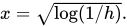


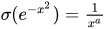




![{\displaystyle [0,\varepsilon ]}](https://wikimedia.org/api/rest_v1/media/math/render/svg/09b79b1e11f2a6c9b36a919ddbbf91204fe7a1df)
does not follow from continuity of and the evident relations (for all ) and


Theorem 1 — Let be continuous and satisfy (*). Then the condition is necessary and sufficient for sample continuity of

Some history.[17]: 424 Sufficiency was announced by Xavier Fernique in 1964, but the first proof was published by Richard M. Dudley in 1967.[16]: Theorem 7.1 Necessity was proved by Michael B. Marcus and Lawrence Shepp in 1970.[18]: 380
There exist sample continuous processes such that they violate condition (*). An example found by Marcus and Shepp [18]: 387 is a random lacunary Fourier series






![{\textstyle {\mathbb {E} }\sum _{n}c_{n}(|\xi _{n}|+|\eta _{n}|)=\sum _{n}c_{n}{\mathbb {E} }[|\xi _{n}|+|\eta _{n}|]={\text{const}}\cdot \sum _{n}c_{n}<\infty ,}](https://wikimedia.org/api/rest_v1/media/math/render/svg/f2397aa6b5b6fe4708619c38b3098a7fb9b096d3)
whence almost surely, which ensures uniform convergence of the Fourier series almost surely, and sample continuity of


Its autocovariation function
![{\displaystyle {\mathbb {E} }[X_{t}X_{t+h}]=\sum _{n=1}^{\infty }c_{n}^{2}\cos \lambda _{n}h}](https://wikimedia.org/api/rest_v1/media/math/render/svg/c74c4fe6d709650c8080cc792a2e3081ecc6456f)

![{\displaystyle \sigma (h)={\sqrt {2{\mathbb {E} }[X_{t}X_{t}]-2{\mathbb {E} }[X_{t}X_{t+h}]}}=2{\sqrt {\sum _{n=1}^{\infty }c_{n}^{2}\sin ^{2}{\frac {\lambda _{n}h}{2}}}}.}](https://wikimedia.org/api/rest_v1/media/math/render/svg/b2744f474eb0c2acec5b901987219b0955a7e121)
Brownian motion as the integral of Gaussian processes[edit]
A Wiener process (also known as Brownian motion) is the integral of a white noise generalized Gaussian process. It is not stationary, but it has stationary increments.
The Ornstein–Uhlenbeck process is a stationary Gaussian process.
The Brownian bridge is (like the Ornstein–Uhlenbeck process) an example of a Gaussian process whose increments are not independent.
The fractional Brownian motion is a Gaussian process whose covariance function is a generalisation of that of the Wiener process.
Driscoll's zero-one law[edit]
Driscoll's zero-one law is a result characterizing the sample functions generated by a Gaussian process.
Let be a mean-zero Gaussian process with non-negative definite covariance function . Let be a Reproducing kernel Hilbert space with positive definite kernel .


Then
![{\displaystyle \lim _{n\to \infty }\operatorname {tr} [K_{n}R_{n}^{-1}]<\infty ,}](https://wikimedia.org/api/rest_v1/media/math/render/svg/fc1d1379312a0e78525fce2f2e4404c8069abd48)


![{\displaystyle \Pr[f\in {\mathcal {H}}(R)]=1.}](https://wikimedia.org/api/rest_v1/media/math/render/svg/8c967b1fdbe5cdad6c678a7022bbfdd6a17901bb)
Moreover,
![{\displaystyle \lim _{n\to \infty }\operatorname {tr} [K_{n}R_{n}^{-1}]=\infty }](https://wikimedia.org/api/rest_v1/media/math/render/svg/e133d11ae8a4dc2825314c86ec4c86df1aabb0fe)
![{\displaystyle \Pr[f\in {\mathcal {H}}(R)]=0.}](https://wikimedia.org/api/rest_v1/media/math/render/svg/c3b6ef001cb269a0cbb38ff83d802da1ad908639)
This has significant implications when , as

![{\displaystyle \lim _{n\to \infty }\operatorname {tr} [R_{n}R_{n}^{-1}]=\lim _{n\to \infty }\operatorname {tr} [I]=\lim _{n\to \infty }n=\infty .}](https://wikimedia.org/api/rest_v1/media/math/render/svg/1ecb16aa9321bb328f2529628314558edb19b482)
As such, almost all sample paths of a mean-zero Gaussian process with positive definite kernel will lie outside of the Hilbert space .

Linearly constrained Gaussian processes[edit]
For many applications of interest some pre-existing knowledge about the system at hand is already given. Consider e.g. the case where the output of the Gaussian process corresponds to a magnetic field; here, the real magnetic field is bound by Maxwell's equations and a way to incorporate this constraint into the Gaussian process formalism would be desirable as this would likely improve the accuracy of the algorithm.
A method on how to incorporate linear constraints into Gaussian processes already exists:[20]
Consider the (vector valued) output function which is known to obey the linear constraint (i.e. is a linear operator)








Applications[edit]

A Gaussian process can be used as a prior probability distribution over functions in Bayesian inference.[7][22] Given any set of N points in the desired domain of your functions, take a multivariate Gaussian whose covariance matrix parameter is the Gram matrix of your N points with some desired kernel, and sample from that Gaussian. For solution of the multi-output prediction problem, Gaussian process regression for vector-valued function was developed. In this method, a 'big' covariance is constructed, which describes the correlations between all the input and output variables taken in N points in the desired domain.[23] This approach was elaborated in detail for the matrix-valued Gaussian processes and generalised to processes with 'heavier tails' like Student-t processes.[24]
Inference of continuous values with a Gaussian process prior is known as Gaussian process regression, or kriging; extending Gaussian process regression to multiple target variables is known as cokriging.[25] Gaussian processes are thus useful as a powerful non-linear multivariate interpolation tool.
Gaussian processes are also commonly used to tackle numerical analysis problems such as numerical integration, solving differential equations, or optimisation in the field of probabilistic numerics.
Gaussian processes can also be used in the context of mixture of experts models, for example.[26][27] The underlying rationale of such a learning framework consists in the assumption that a given mapping cannot be well captured by a single Gaussian process model. Instead, the observation space is divided into subsets, each of which is characterized by a different mapping function; each of these is learned via a different Gaussian process component in the postulated mixture.
In the natural sciences, Gaussian processes have found use as probabilistic models of astronomical time series and as predictors of molecular properties.[28]
Gaussian process prediction, or Kriging[edit]

When concerned with a general Gaussian process regression problem (Kriging), it is assumed that for a Gaussian process observed at coordinates , the vector of values is just one sample from a multivariate Gaussian distribution of dimension equal to number of observed coordinates . Therefore, under the assumption of a zero-mean distribution, , where is the covariance matrix between all possible pairs for a given set of hyperparameters θ.[7] As such the log marginal likelihood is:




and maximizing this marginal likelihood towards θ provides the complete specification of the Gaussian process f. One can briefly note at this point that the first term corresponds to a penalty term for a model's failure to fit observed values and the second term to a penalty term that increases proportionally to a model's complexity. Having specified θ, making predictions about unobserved values at coordinates x* is then only a matter of drawing samples from the predictive distribution where the posterior mean estimate A is defined as






Often, the covariance has the form , where is a scaling parameter. Examples are the Matérn class covariance functions. If this scaling parameter is either known or unknown (i.e. must be marginalized), then the posterior probability, , i.e. the probability for the hyperparameters given a set of data pairs of observations of and , admits an analytical expression.[32]



Bayesian neural networks as Gaussian processes[edit]
Bayesian neural networks are a particular type of Bayesian network that results from treating deep learning and artificial neural network models probabilistically, and assigning a prior distribution to their parameters. Computation in artificial neural networks is usually organized into sequential layers of artificial neurons. The number of neurons in a layer is called the layer width. As layer width grows large, many Bayesian neural networks reduce to a Gaussian process with a closed form compositional kernel. This Gaussian process is called the Neural Network Gaussian Process (NNGP).[7][33][34] It allows predictions from Bayesian neural networks to be more efficiently evaluated, and provides an analytic tool to understand deep learning models.
Computational issues[edit]
In practical applications, Gaussian process models are often evaluated on a grid leading to multivariate normal distributions. Using these models for prediction or parameter estimation using maximum likelihood requires evaluating a multivariate Gaussian density, which involves calculating the determinant and the inverse of the covariance matrix. Both of these operations have cubic computational complexity which means that even for grids of modest sizes, both operations can have a prohibitive computational cost. This drawback led to the development of multiple approximation methods.
See also[edit]
- Bayes linear statistics
- Bayesian interpretation of regularization
- Kriging
- Gaussian free field
- Gauss–Markov process
- Gradient-enhanced kriging (GEK)
- Student's t-process
References[edit]
- ^ MacKay, David, J.C. (2003). Information Theory, Inference, and Learning Algorithms (PDF). Cambridge University Press. p. 540. ISBN 9780521642989.
The probability distribution of a function is a Gaussian processes if for any finite selection of points , the density is a Gaussian
{{cite book}}: CS1 maint: multiple names: authors list (link) - ^ Dudley, R.M. (1989). Real Analysis and Probability. Wadsworth and Brooks/Cole. ISBN 0-534-10050-3.
- ^ a b Amos Lapidoth (8 February 2017). A Foundation in Digital Communication. Cambridge University Press. ISBN 978-1-107-17732-1.
- ^ Kac, M.; Siegert, A.J.F (1947). "An Explicit Representation of a Stationary Gaussian Process". The Annals of Mathematical Statistics. 18 (3): 438–442. doi:10.1214/aoms/1177730391.
- ^ Bishop, C.M. (2006). Pattern Recognition and Machine Learning. Springer. ISBN 978-0-387-31073-2.
- ^ a b c Barber, David (2012). Bayesian Reasoning and Machine Learning. Cambridge University Press. ISBN 978-0-521-51814-7.
- ^ a b c d e f Rasmussen, C.E.; Williams, C.K.I (2006). Gaussian Processes for Machine Learning. MIT Press. ISBN 978-0-262-18253-9.
- ^ Grimmett, Geoffrey; David Stirzaker (2001). Probability and Random Processes. Oxford University Press. ISBN 978-0198572220.
- ^ Seeger, Matthias (2004). "Gaussian Processes for Machine Learning". International Journal of Neural Systems. 14 (2): 69–104. CiteSeerX 10.1.1.71.1079. doi:10.1142/s0129065704001899. PMID 15112367. S2CID 52807317.
- ^ Dudley, R. M. (1975). "The Gaussian process and how to approach it" (PDF). Proceedings of the International Congress of Mathematicians. Vol. 2. pp. 143–146.
- ^ Dudley, R. M. (2010). "Sample Functions of the Gaussian Process". Selected Works of R.M. Dudley. Vol. 1. pp. 66–103. doi:10.1007/978-1-4419-5821-1_13. ISBN 978-1-4419-5820-4.
{{cite book}}:|journal=ignored (help) - ^ Talagrand, Michel (2014). Upper and lower bounds for stochastic processes: modern methods and classical problems. Ergebnisse der Mathematik und ihrer Grenzgebiete. 3. Folge / A Series of Modern Surveys in Mathematics. Springer, Heidelberg. ISBN 978-3-642-54074-5.
- ^ Ledoux, Michel (1996), "Isoperimetry and Gaussian analysis", in Dobrushin, Roland; Groeneboom, Piet; Ledoux, Michel (eds.), Lectures on Probability Theory and Statistics: Ecole d'Eté de Probabilités de Saint-Flour XXIV–1994, Lecture Notes in Mathematics, vol. 1648, Berlin: Springer, pp. 165–294, doi:10.1007/BFb0095676, ISBN 978-3-540-62055-6, MR 1600888
- ^ Adler, Robert J. (1990). An Introduction to Continuity, Extrema, and Related Topics for General Gaussian Processes. Vol. 12. Hayward, California: Institute of Mathematical Statistics. ISBN 0-940600-17-X. JSTOR 4355563. MR 1088478.
{{cite book}}:|journal=ignored (help) - ^ Berman, Simeon M. (1992). "Review of: Adler 1990 'An introduction to continuity...'". Mathematical Reviews. MR 1088478.
- ^ a b Dudley, R. M. (1967). "The sizes of compact subsets of Hilbert space and continuity of Gaussian processes". Journal of Functional Analysis. 1 (3): 290–330. doi:10.1016/0022-1236(67)90017-1.
- ^ a b Marcus, M.B.; Shepp, Lawrence A. (1972). "Sample behavior of Gaussian processes". Proceedings of the sixth Berkeley symposium on mathematical statistics and probability, vol. II: probability theory. Vol. 6. Univ. California, Berkeley. pp. 423–441.
- ^ a b Marcus, Michael B.; Shepp, Lawrence A. (1970). "Continuity of Gaussian processes". Transactions of the American Mathematical Society. 151 (2): 377–391. doi:10.1090/s0002-9947-1970-0264749-1. JSTOR 1995502.
- ^ Driscoll, Michael F. (1973). "The reproducing kernel Hilbert space structure of the sample paths of a Gaussian process". Zeitschrift für Wahrscheinlichkeitstheorie und Verwandte Gebiete. 26 (4): 309–316. doi:10.1007/BF00534894. ISSN 0044-3719. S2CID 123348980.
- ^ Jidling, Carl; Wahlström, Niklas; Wills, Adrian; Schön, Thomas B. (2017-09-19). "Linearly constrained Gaussian processes". arXiv:1703.00787 [stat.ML].
- ^ The documentation for scikit-learn also has similar examples.
- ^ Liu, W.; Principe, J.C.; Haykin, S. (2010). Kernel Adaptive Filtering: A Comprehensive Introduction. John Wiley. ISBN 978-0-470-44753-6. Archived from the original on 2016-03-04. Retrieved 2010-03-26.
- ^ Álvarez, Mauricio A.; Rosasco, Lorenzo; Lawrence, Neil D. (2012). "Kernels for vector-valued functions: A review" (PDF). Foundations and Trends in Machine Learning. 4 (3): 195–266. doi:10.1561/2200000036. S2CID 456491.
- ^ Chen, Zexun; Wang, Bo; Gorban, Alexander N. (2019). "Multivariate Gaussian and Student-t process regression for multi-output prediction". Neural Computing and Applications. 32 (8): 3005–3028. arXiv:1703.04455. doi:10.1007/s00521-019-04687-8.
- ^ Stein, M.L. (1999). Interpolation of Spatial Data: Some Theory for Kriging. Springer.
- ^ Platanios, Emmanouil A.; Chatzis, Sotirios P. (2014). "Gaussian Process-Mixture Conditional Heteroscedasticity". IEEE Transactions on Pattern Analysis and Machine Intelligence. 36 (5): 888–900. doi:10.1109/TPAMI.2013.183. PMID 26353224. S2CID 10424638.
- ^ Chatzis, Sotirios P. (2013). "A latent variable Gaussian process model with Pitman–Yor process priors for multiclass classification". Neurocomputing. 120: 482–489. doi:10.1016/j.neucom.2013.04.029.
- ^ Griffiths, Ryan-Rhys (2022). Applications of Gaussian Processes at Extreme Lengthscales: From Molecules to Black Holes (PhD thesis). University of Cambridge. arXiv:2303.14291. doi:10.17863/CAM.93643.
- ^ Smola, A.J.; Schoellkopf, B. (2000). "Sparse greedy matrix approximation for machine learning". Proceedings of the Seventeenth International Conference on Machine Learning: 911–918. CiteSeerX 10.1.1.43.3153.
- ^ Csato, L.; Opper, M. (2002). "Sparse on-line Gaussian processes". Neural Computation. 14 (3): 641–668. CiteSeerX 10.1.1.335.9713. doi:10.1162/089976602317250933. PMID 11860686. S2CID 11375333.
- ^ Lee, Se Yoon; Mallick, Bani (2021). "Bayesian Hierarchical Modeling: Application Towards Production Results in the Eagle Ford Shale of South Texas". Sankhya B. 84: 1–43. doi:10.1007/s13571-020-00245-8.
- ^ Ranftl, Sascha; Melito, Gian Marco; Badeli, Vahid; Reinbacher-Köstinger, Alice; Ellermann, Katrin; von der Linden, Wolfgang (2019-12-31). "Bayesian Uncertainty Quantification with Multi-Fidelity Data and Gaussian Processes for Impedance Cardiography of Aortic Dissection". Entropy. 22 (1): 58. Bibcode:2019Entrp..22...58R. doi:10.3390/e22010058. ISSN 1099-4300. PMC 7516489. PMID 33285833.
- ^ Novak, Roman; Xiao, Lechao; Hron, Jiri; Lee, Jaehoon; Alemi, Alexander A.; Sohl-Dickstein, Jascha; Schoenholz, Samuel S. (2020). "Neural Tangents: Fast and Easy Infinite Neural Networks in Python". International Conference on Learning Representations. arXiv:1912.02803.
- ^ Neal, Radford M. (2012). Bayesian Learning for Neural Networks. Springer Science and Business Media.



External links[edit]

Literature[edit]
- The Gaussian Processes Web Site, including the text of Rasmussen and Williams' Gaussian Processes for Machine Learning
- Ebden, Mark (2015). "Gaussian Processes: A Quick Introduction". arXiv:1505.02965 [math.ST].
- A Review of Gaussian Random Fields and Correlation Functions
- Efficient Reinforcement Learning using Gaussian Processes
Software[edit]
- GPML: A comprehensive Matlab toolbox for GP regression and classification
- STK: a Small (Matlab/Octave) Toolbox for Kriging and GP modeling
- Kriging module in UQLab framework (Matlab)
- CODES Toolbox: implementations of Kriging, variational kriging and multi-fidelity models (Matlab)
- Matlab/Octave function for stationary Gaussian fields
- Yelp MOE – A black box optimization engine using Gaussian process learning
- ooDACE – A flexible object-oriented Kriging Matlab toolbox.
- GPstuff – Gaussian process toolbox for Matlab and Octave
- GPy – A Gaussian processes framework in Python
- GSTools - A geostatistical toolbox, including Gaussian process regression, written in Python
- Interactive Gaussian process regression demo
- Basic Gaussian process library written in C++11
- scikit-learn – A machine learning library for Python which includes Gaussian process regression and classification
- [1] - The Kriging toolKit (KriKit) is developed at the Institute of Bio- and Geosciences 1 (IBG-1) of Forschungszentrum Jülich (FZJ)
